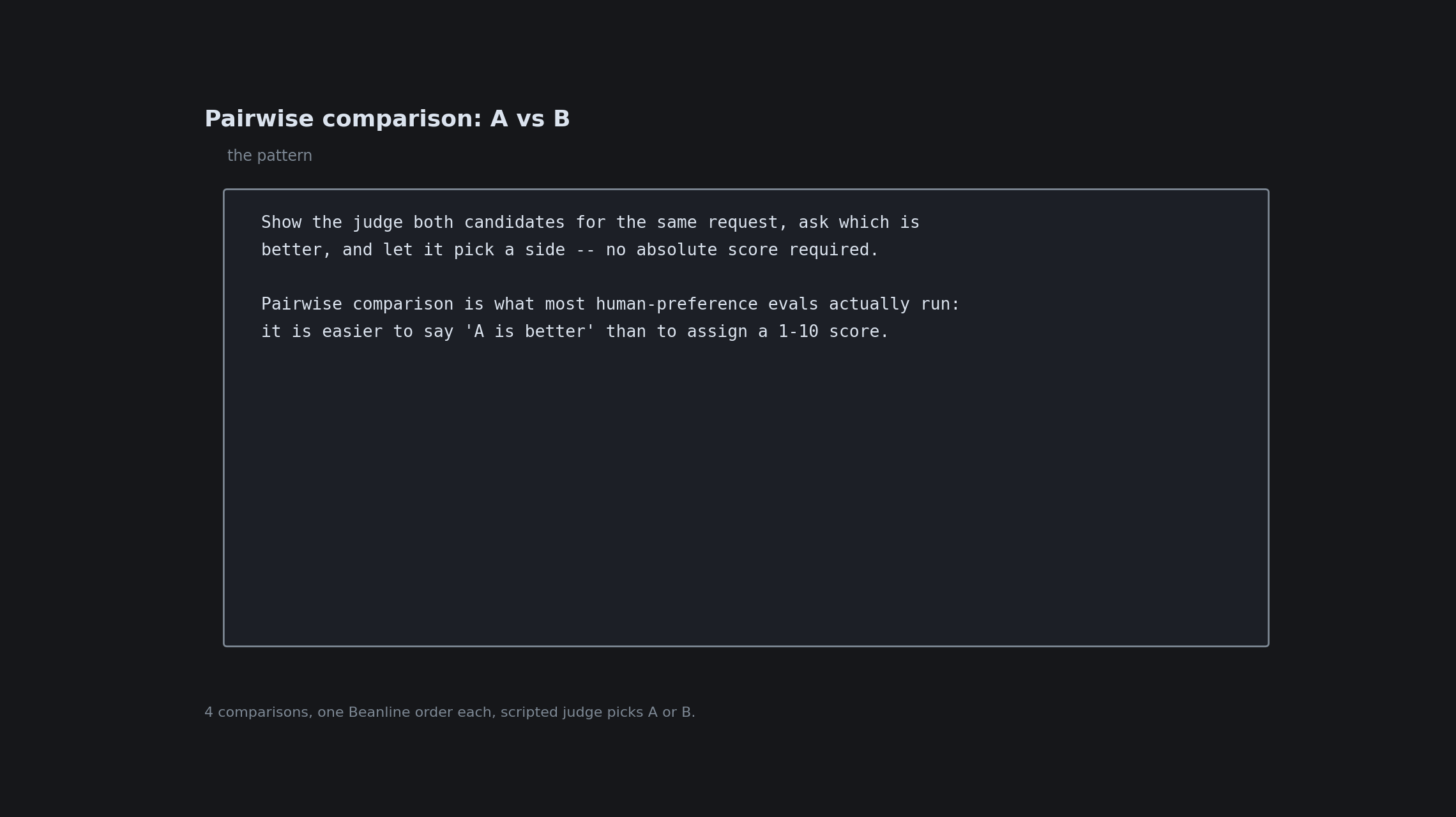
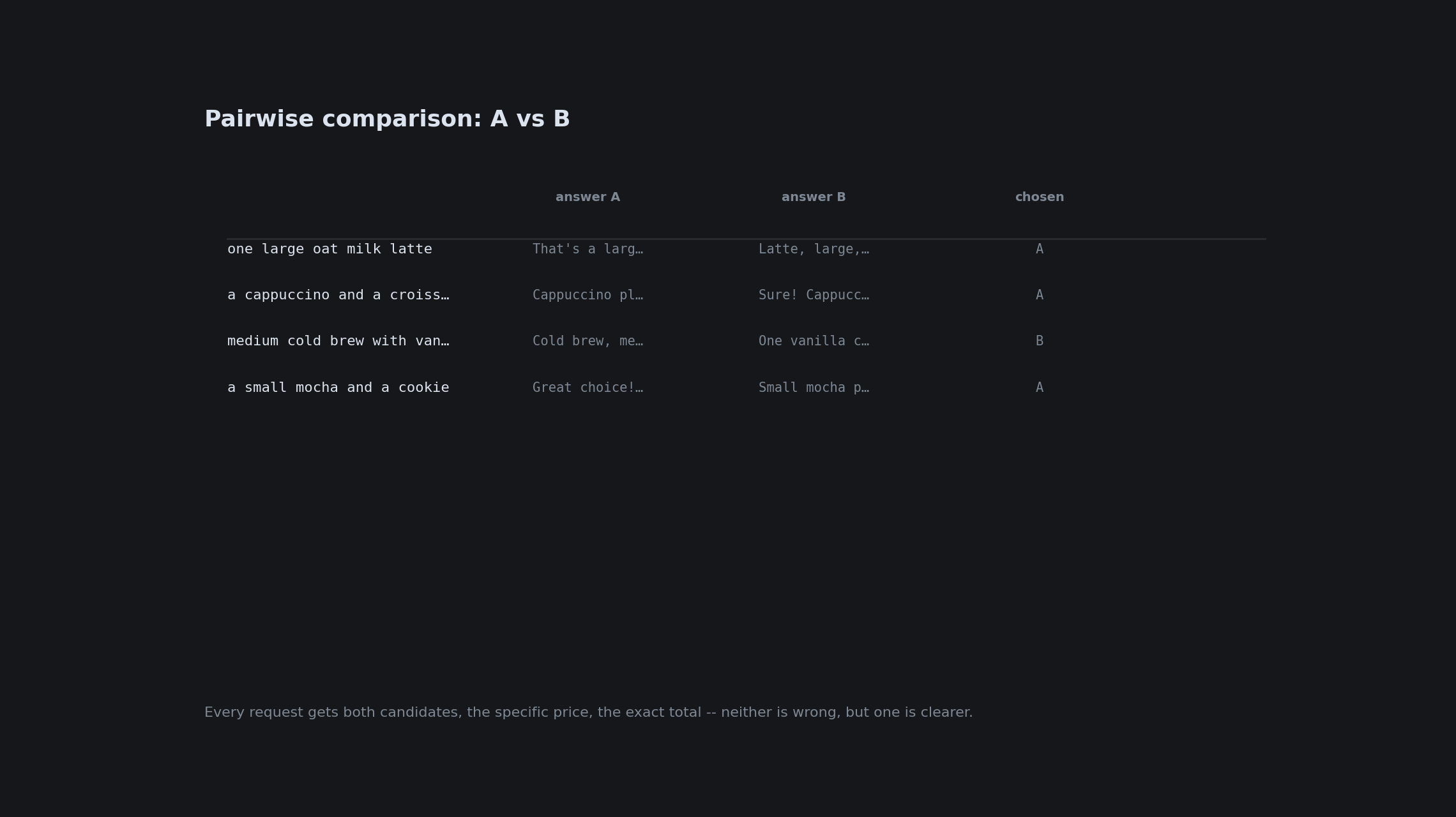
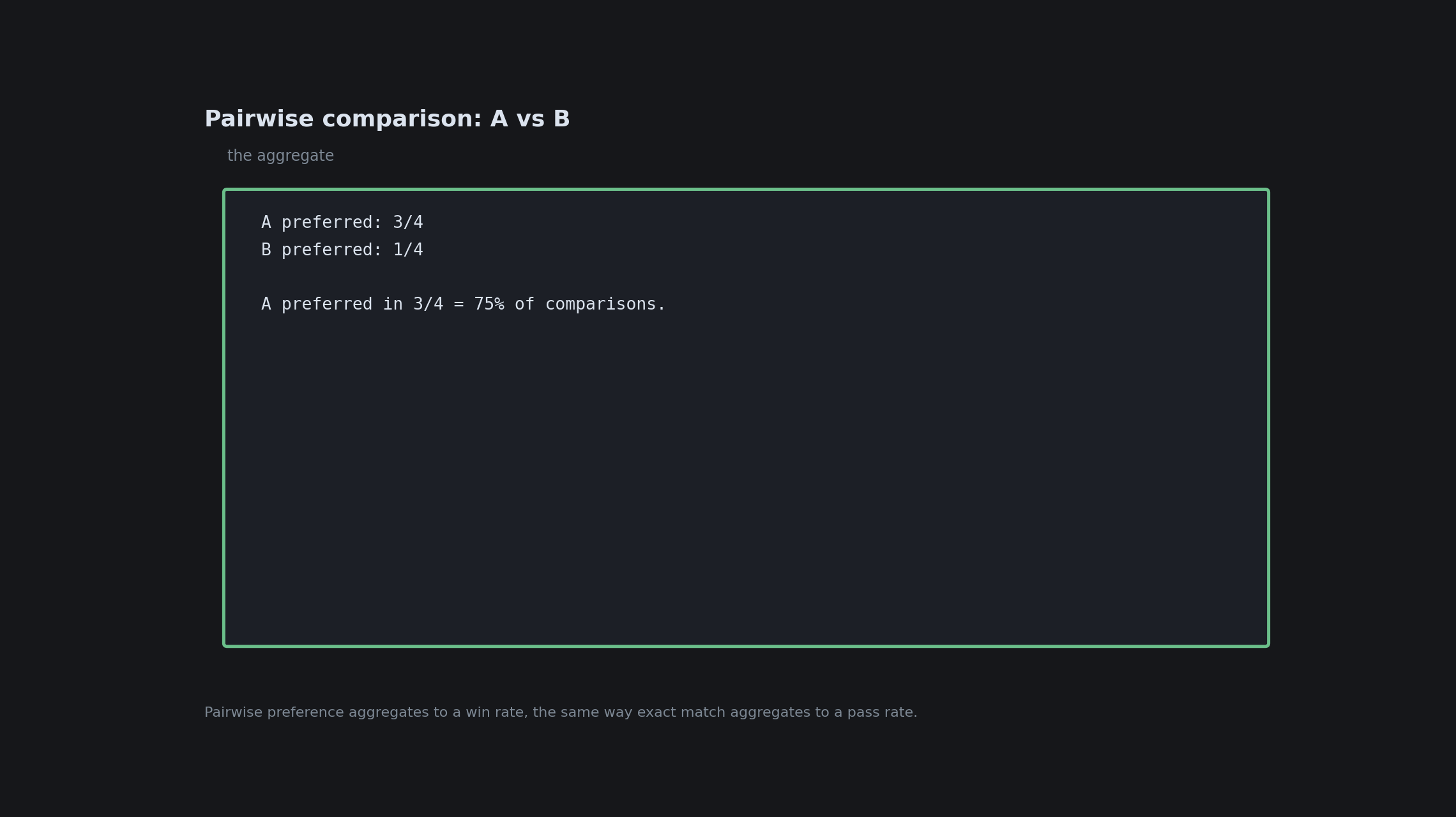
One coffee shop, one bot: fixed test sets, judges, drift, spans, tokens and cost, offline scoring versus online tracing
Grading a bot against a fixed test set answers one question: did it get these known cases right. Watching a live run answers a different one: what actually happened, span by span, token by token, dollar by dollar. Most teams build only the first and are surprised when it doesn’t explain the second.
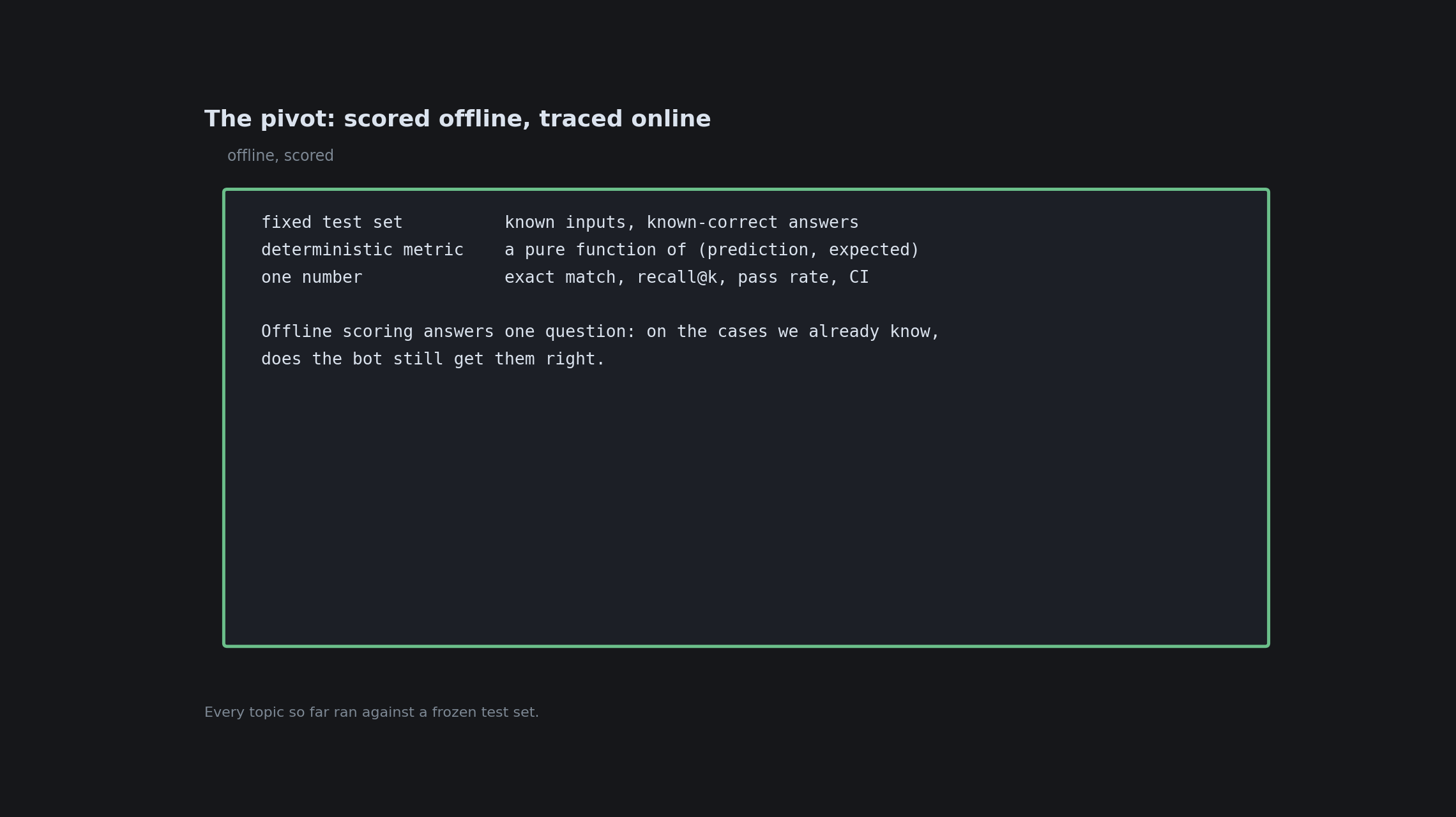
Offline, scored. A fixed test set, a metric, a number that regresses or doesn’t. Online, traced. A live run, instrumented into spans, read after the fact.
Offline-scored vs. online-traced. Offline-scored means graded against a test set with known-correct answers. Online-traced means watched as it runs, with no answer key, via spans, tokens, and cost.
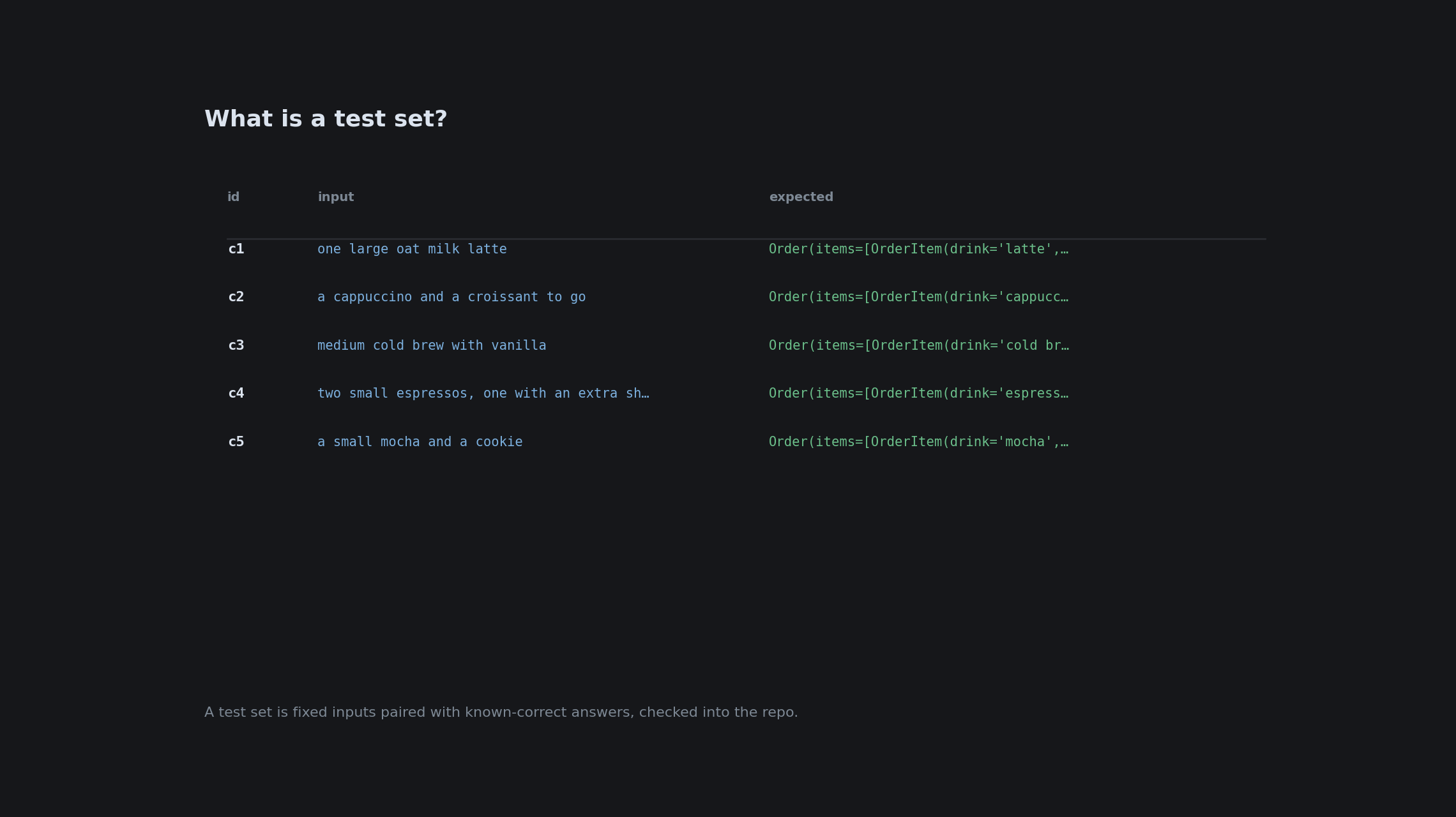
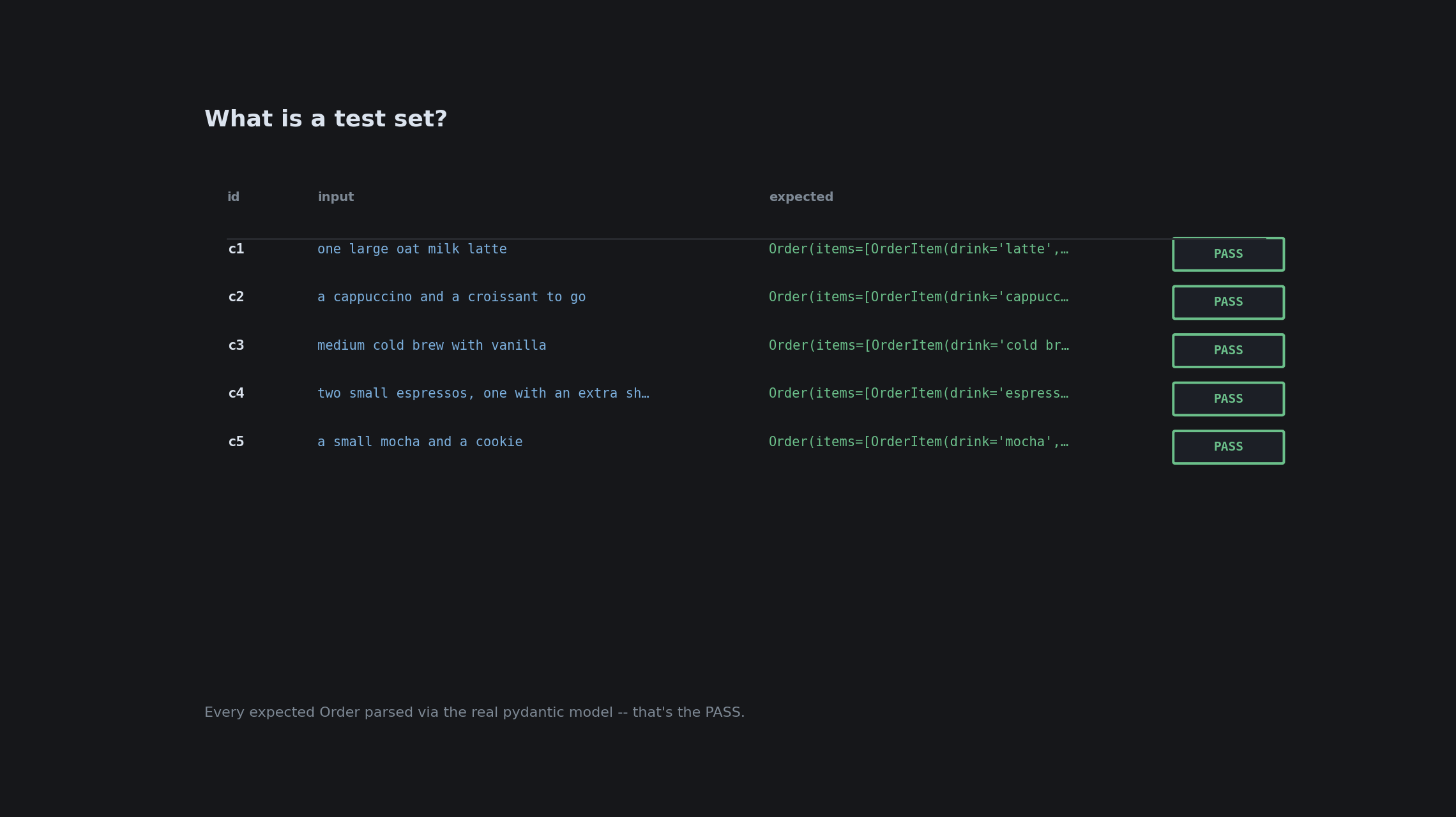
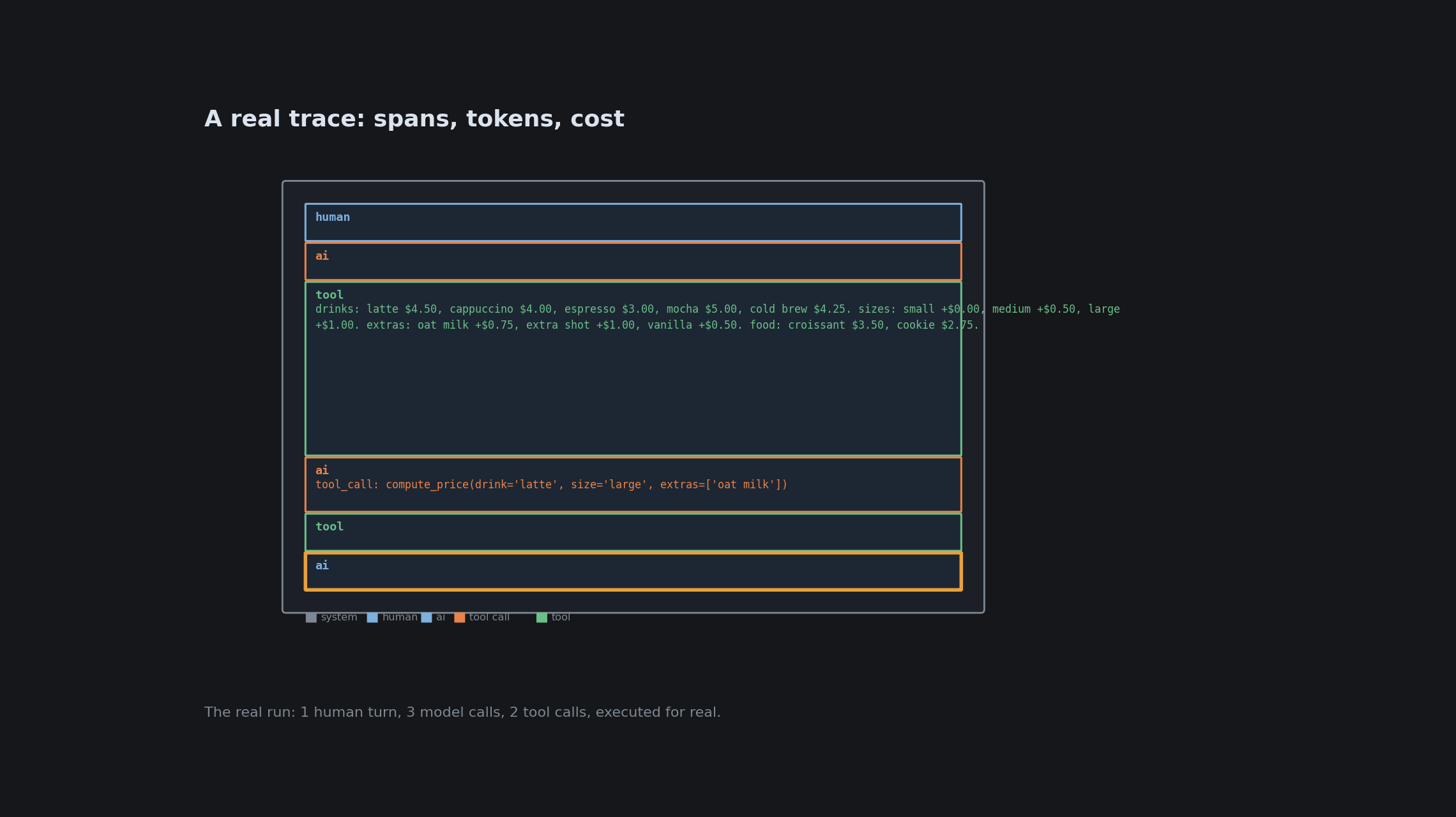
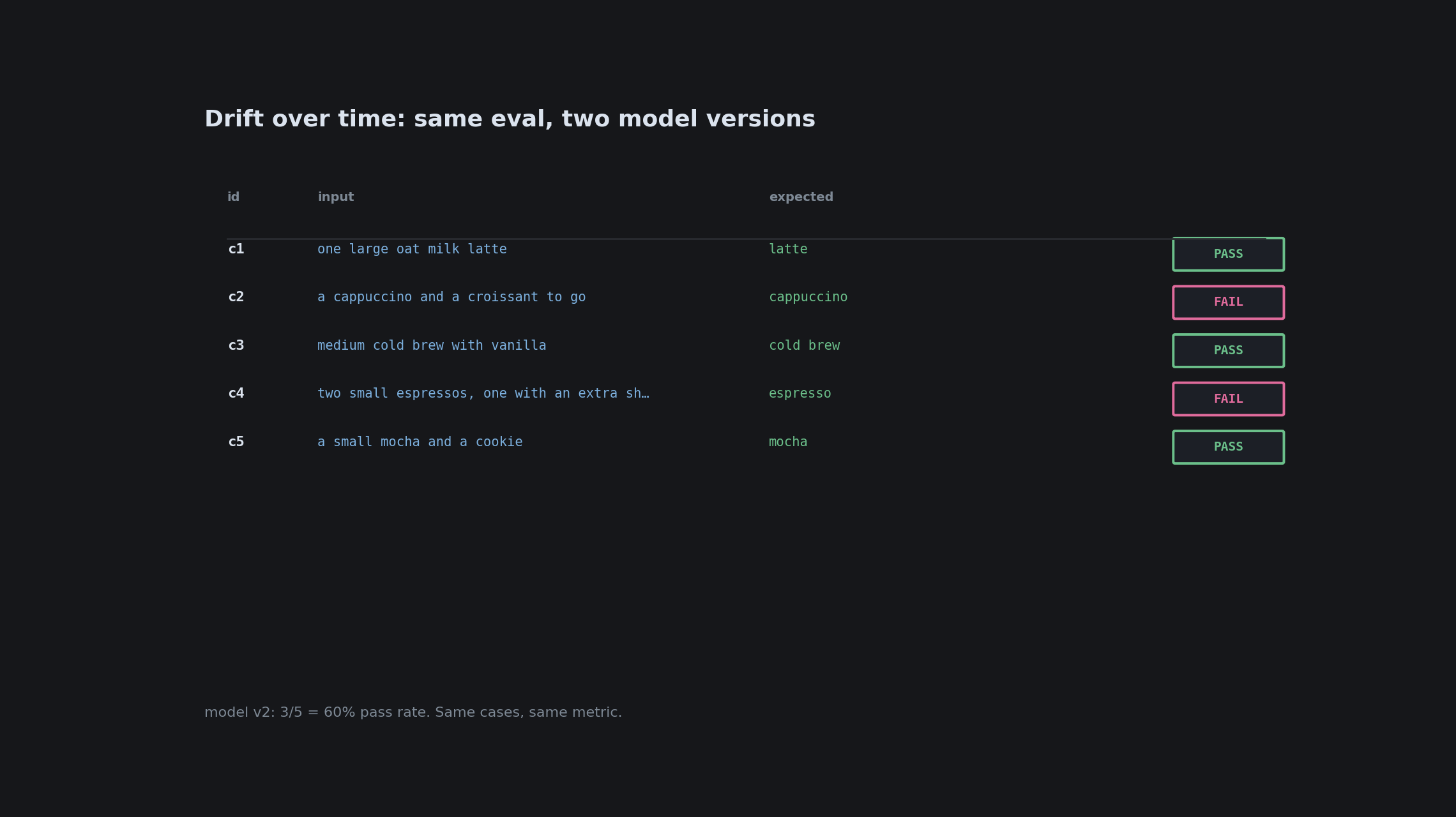
Every figure ahead is a photograph of real code grading (or tracing) one small coffee shop’s order-taking bot: a fixed set of orders, a scripted model that replies the same way every run, and real langchain/langgraph underneath.
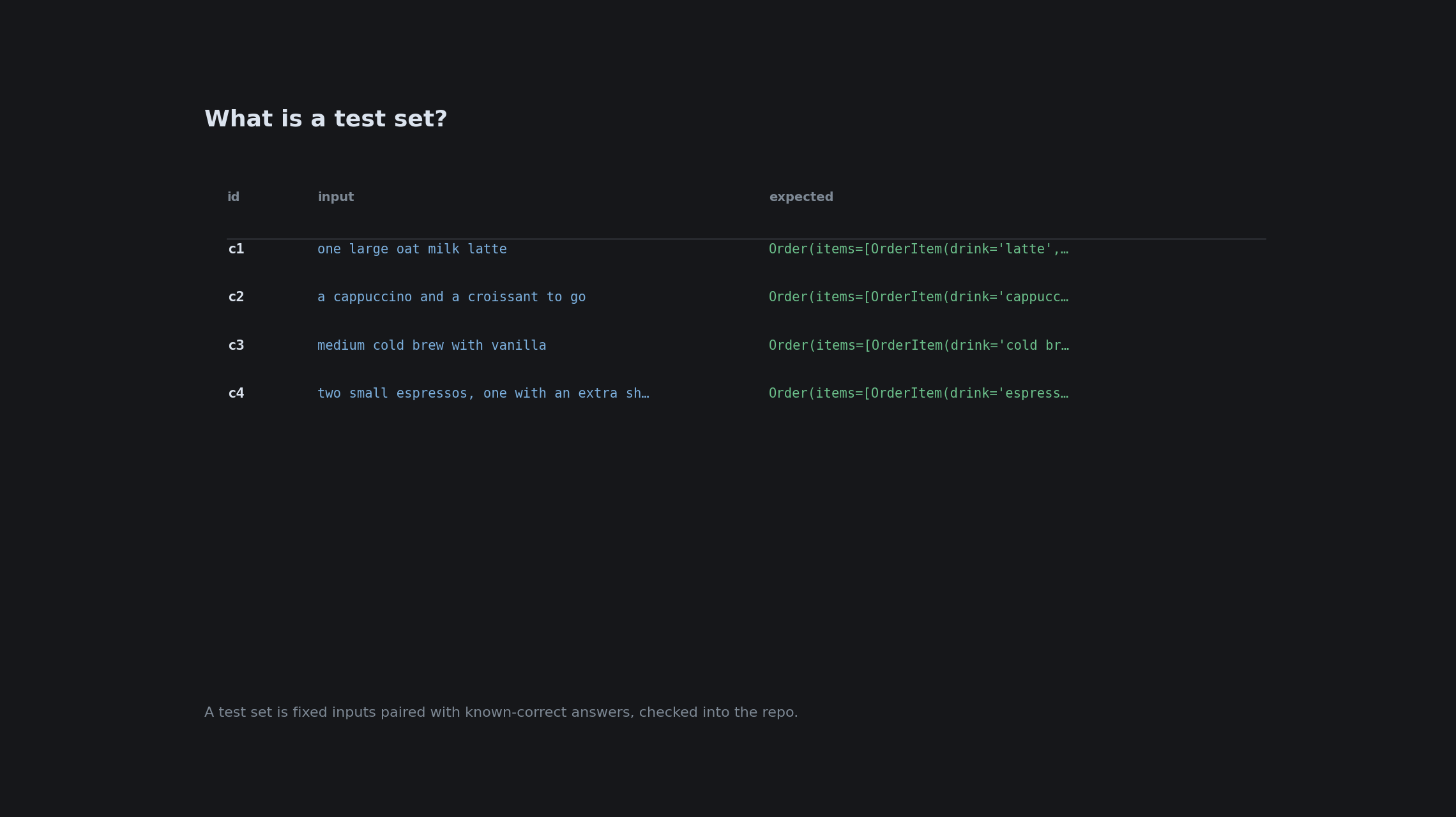
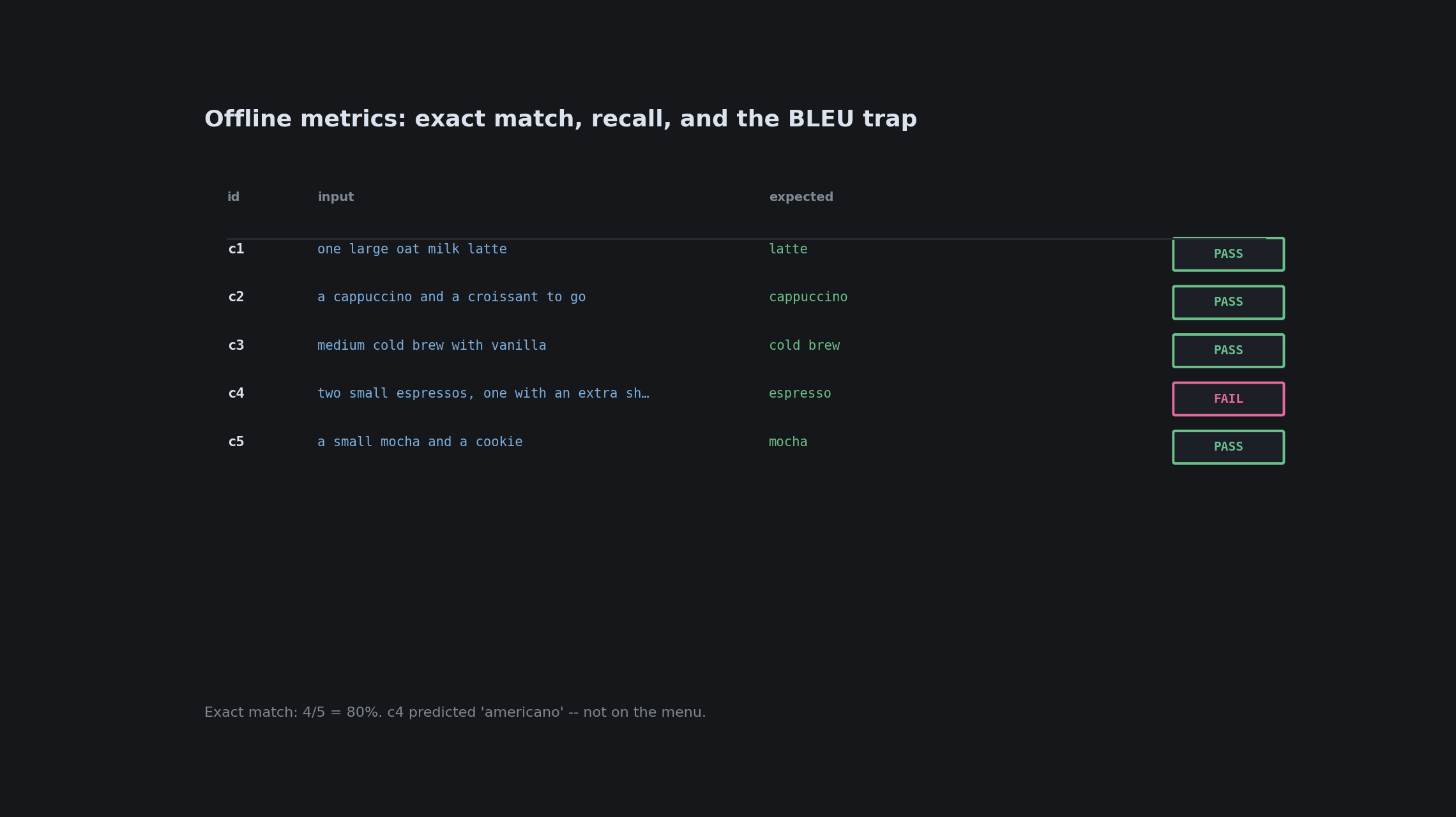
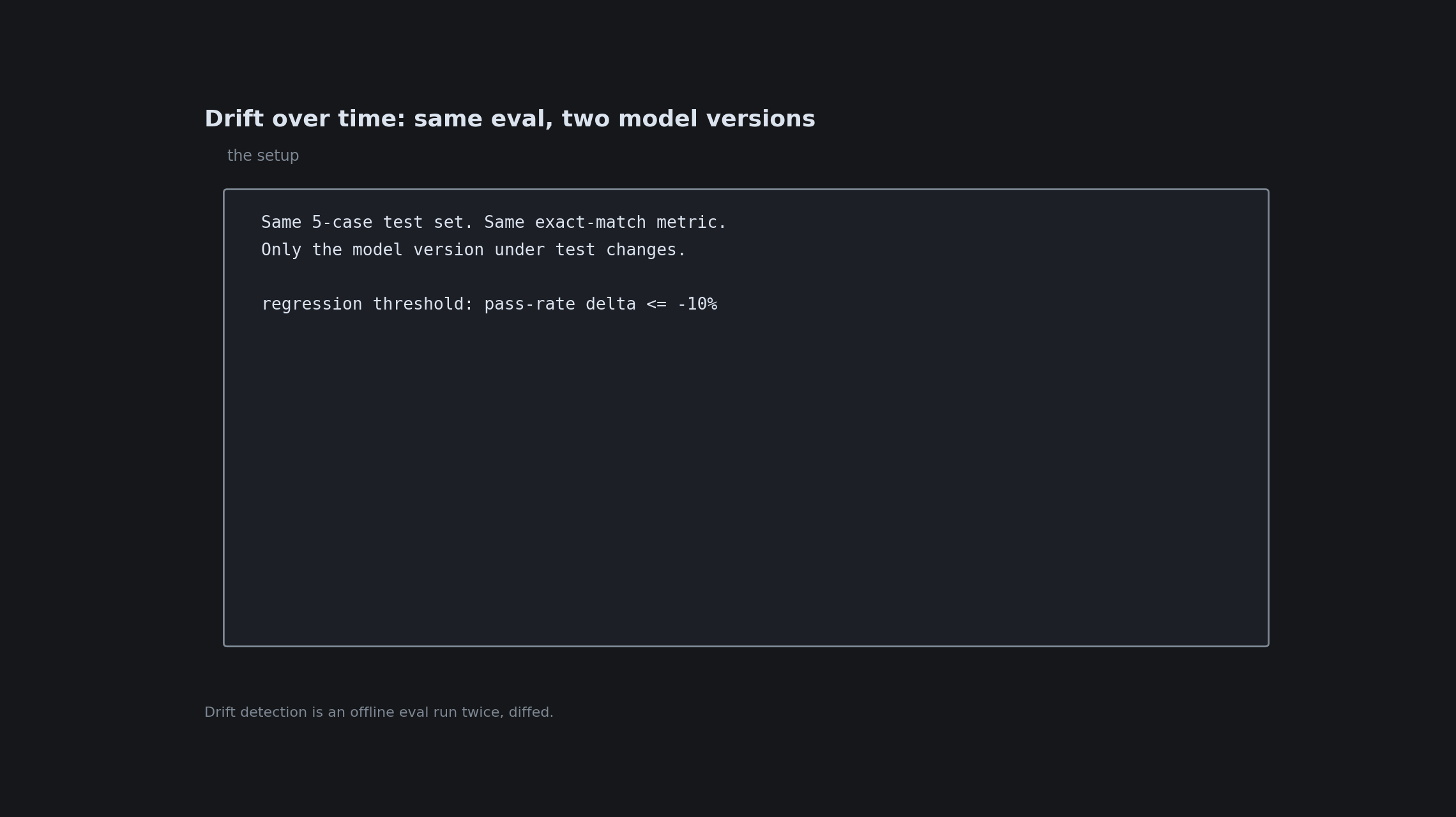
A frozen test set with known-correct answers, and a metric that turns a prediction into a number. Deterministic by construction: same script, same score, every run.
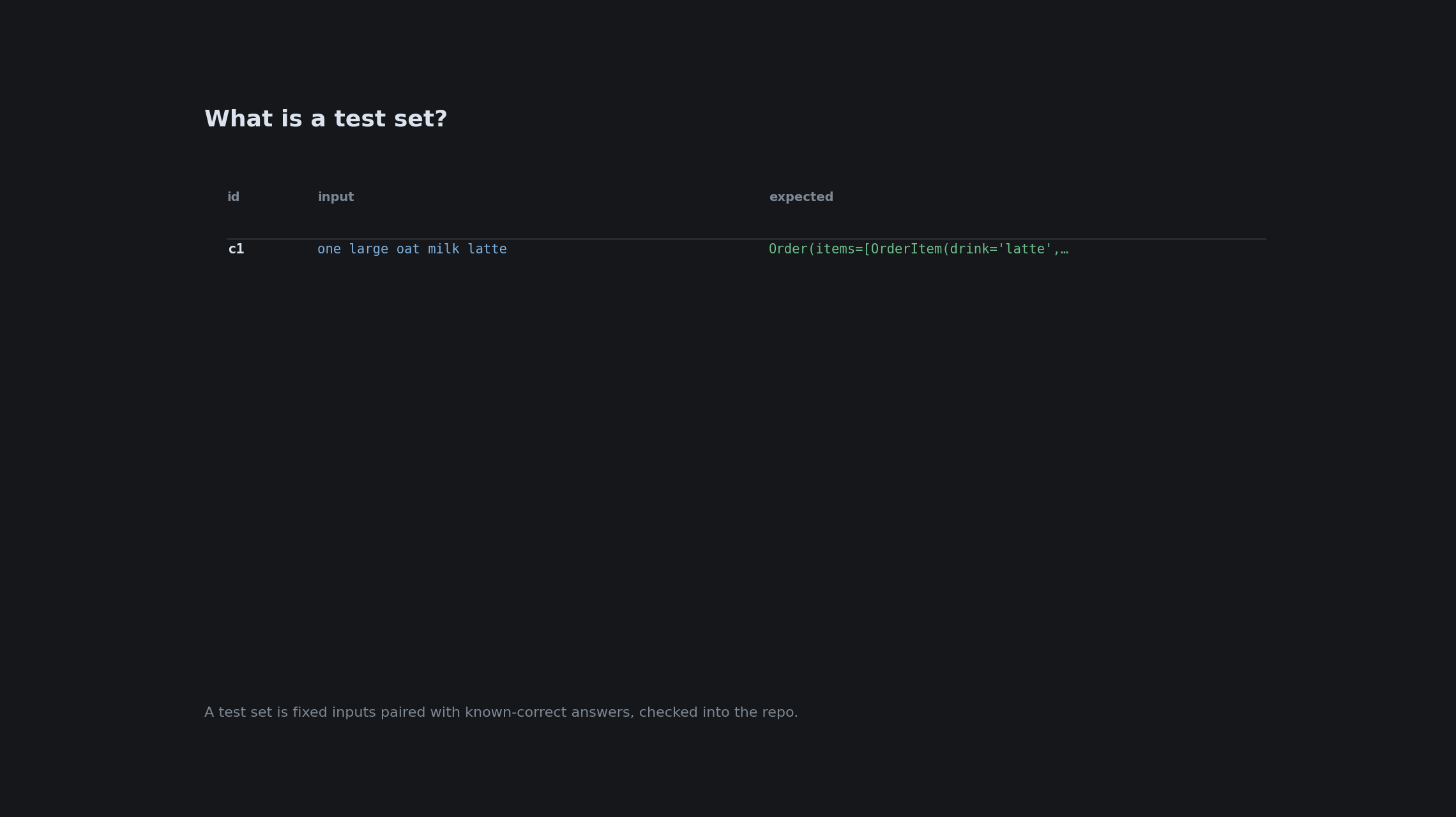
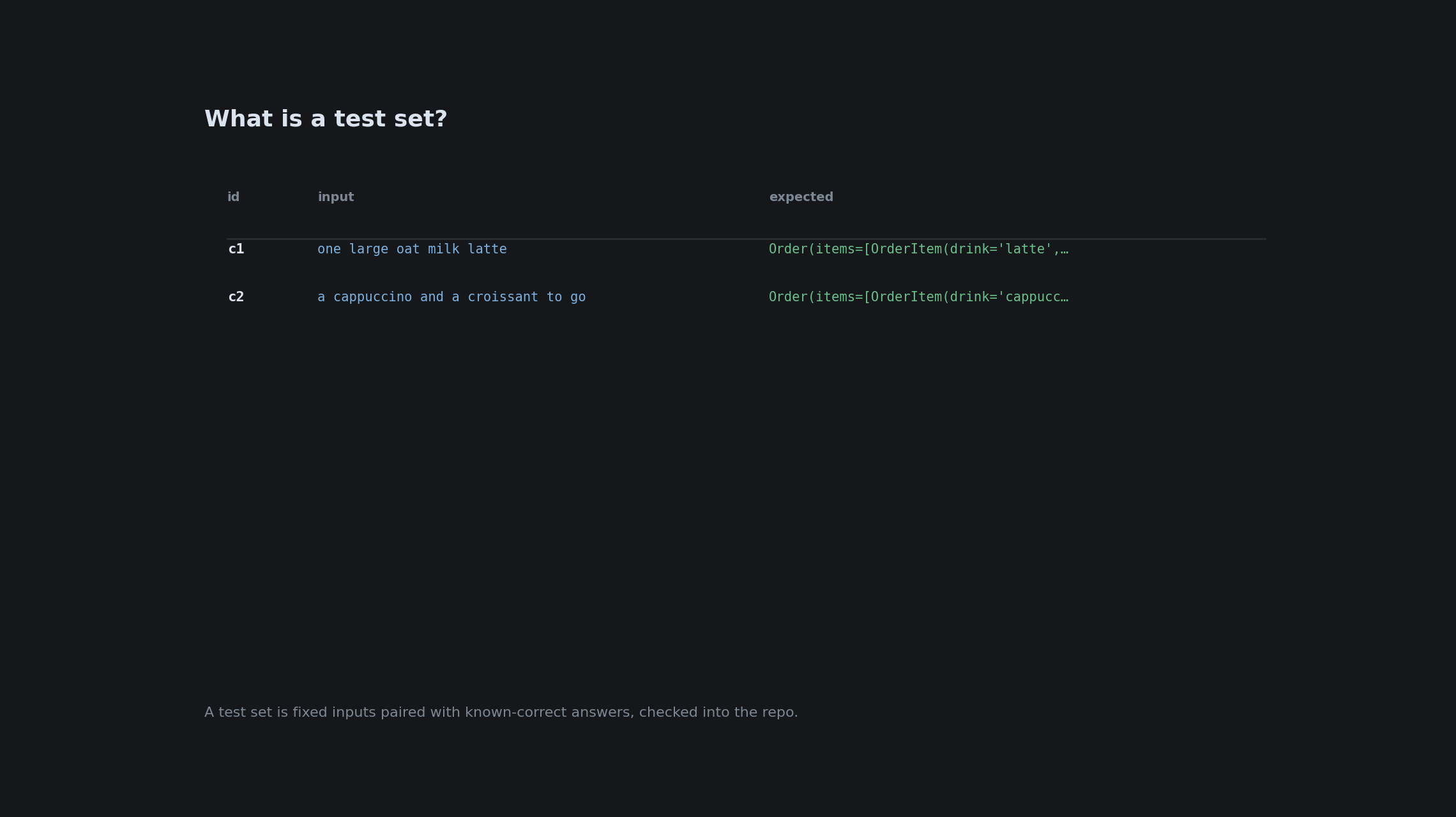
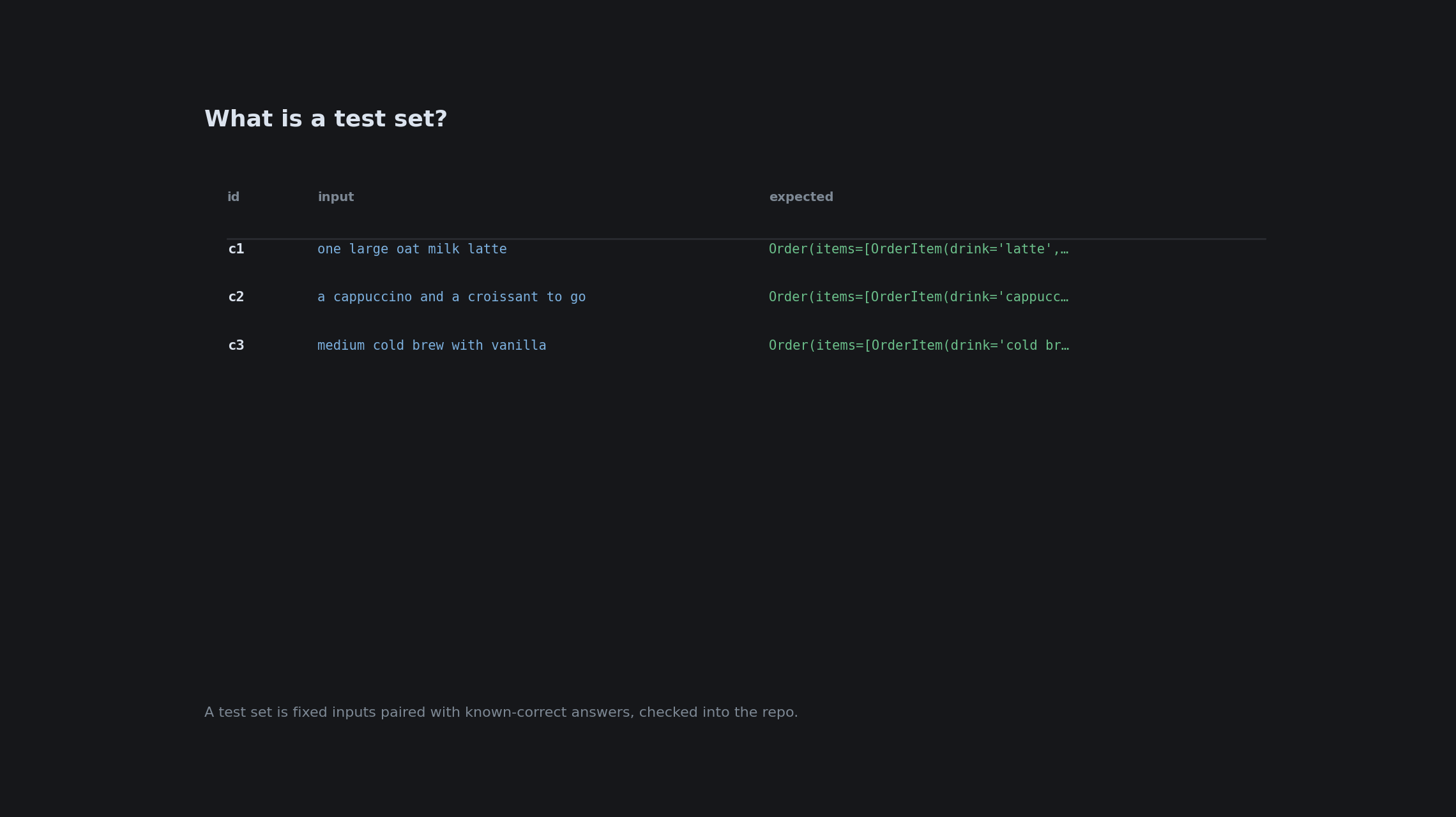
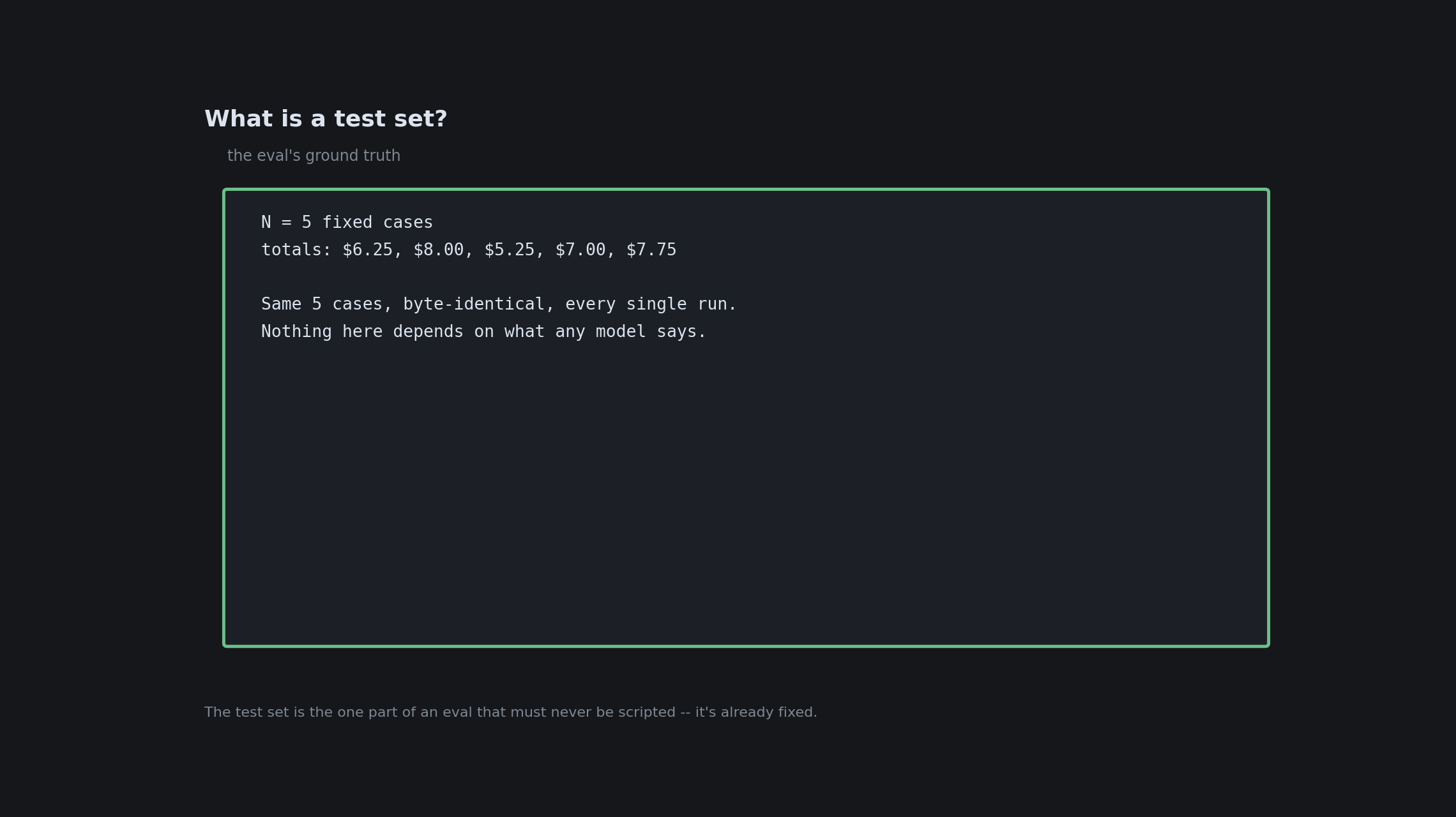
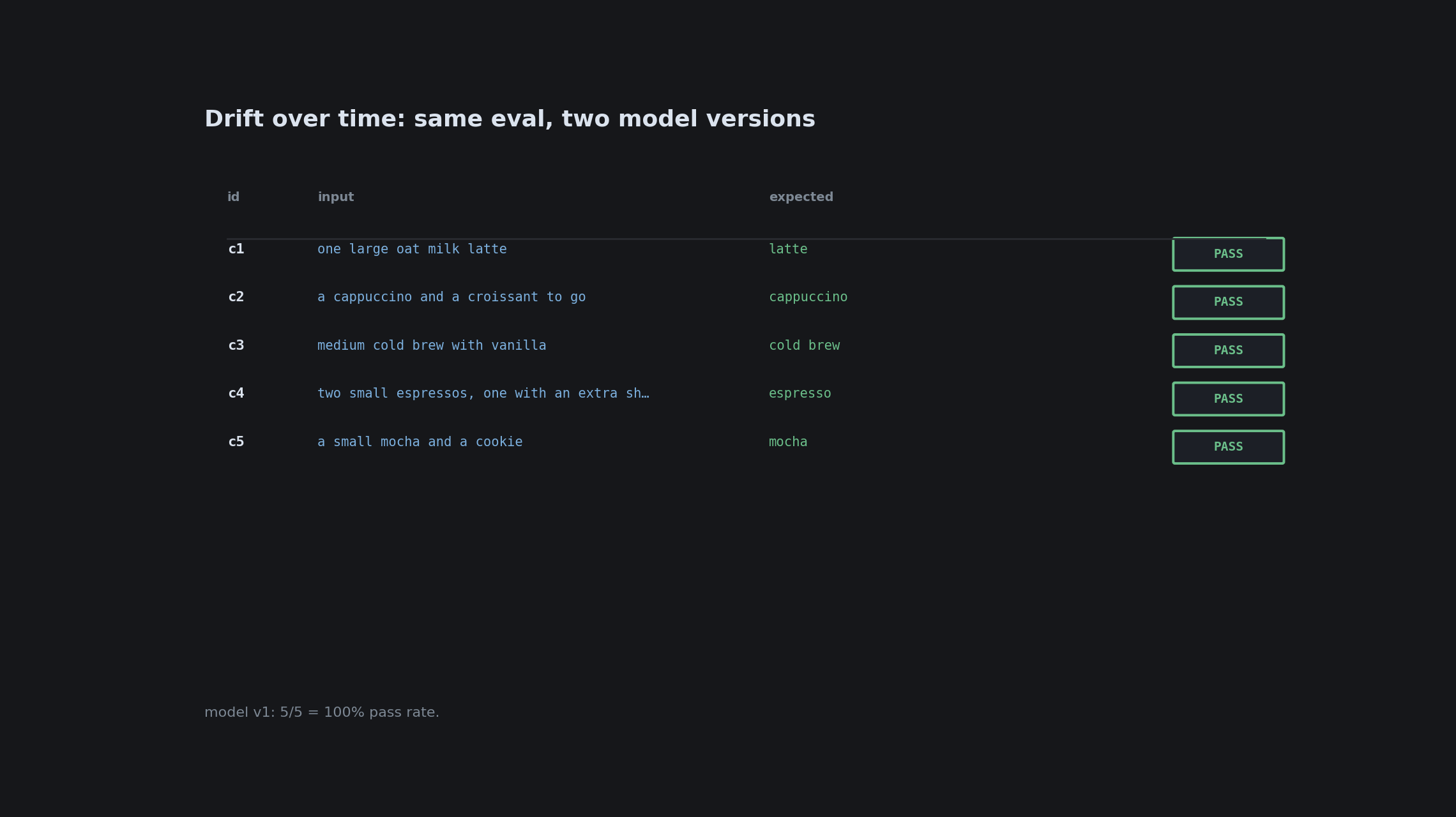
Test set. A frozen list of (input, expected) pairs, checked into the repo like code, the eval’s ground truth. Byte-identical every run.
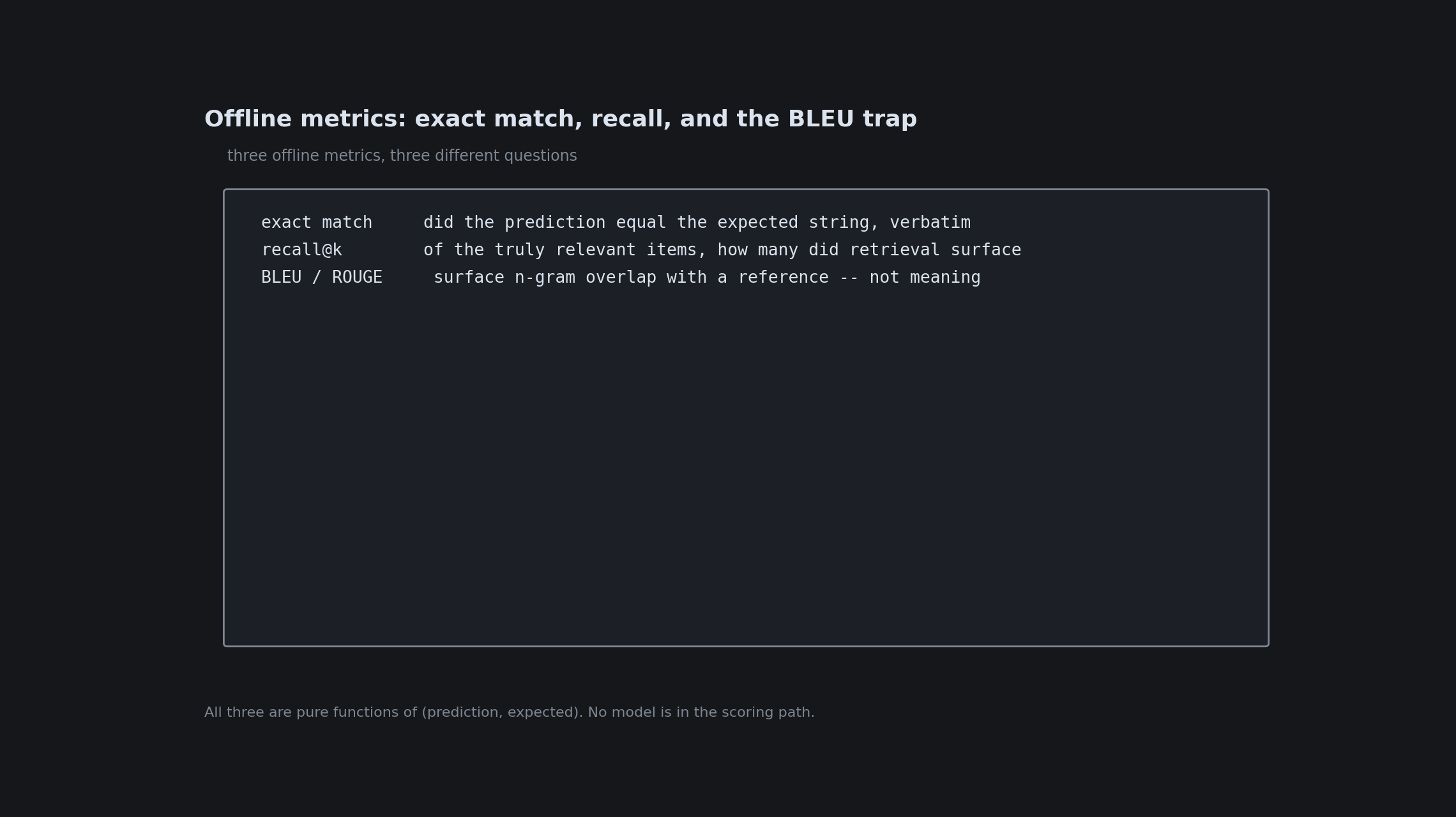
Grading needs an answer key. A reference-based metric is a pure function of (prediction, expected). Without a known-correct answer to compare against, it cannot be honest.
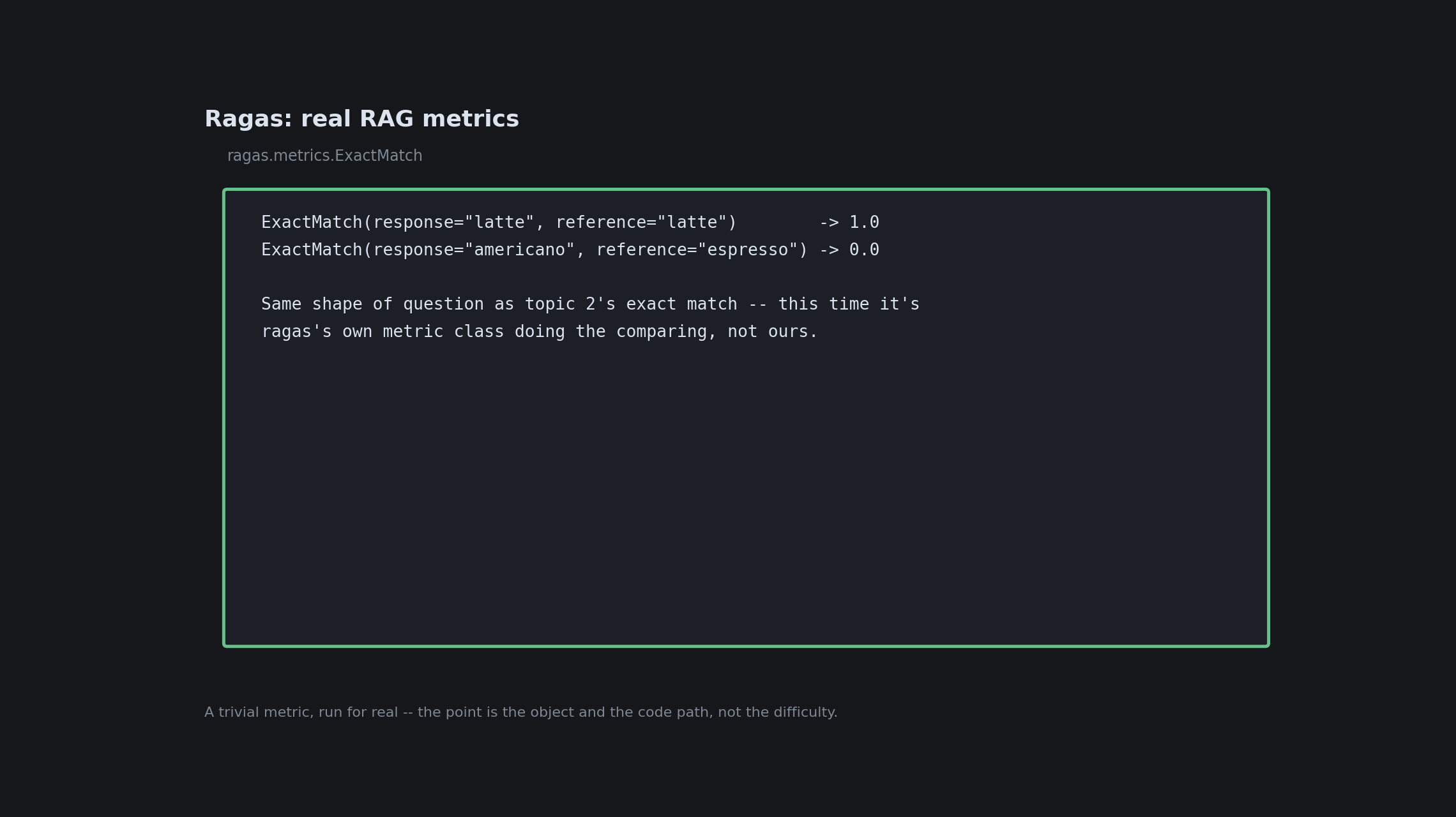
Exact match. Does the prediction equal the expected string, verbatim. The simplest metric, and the hardest one to argue with.
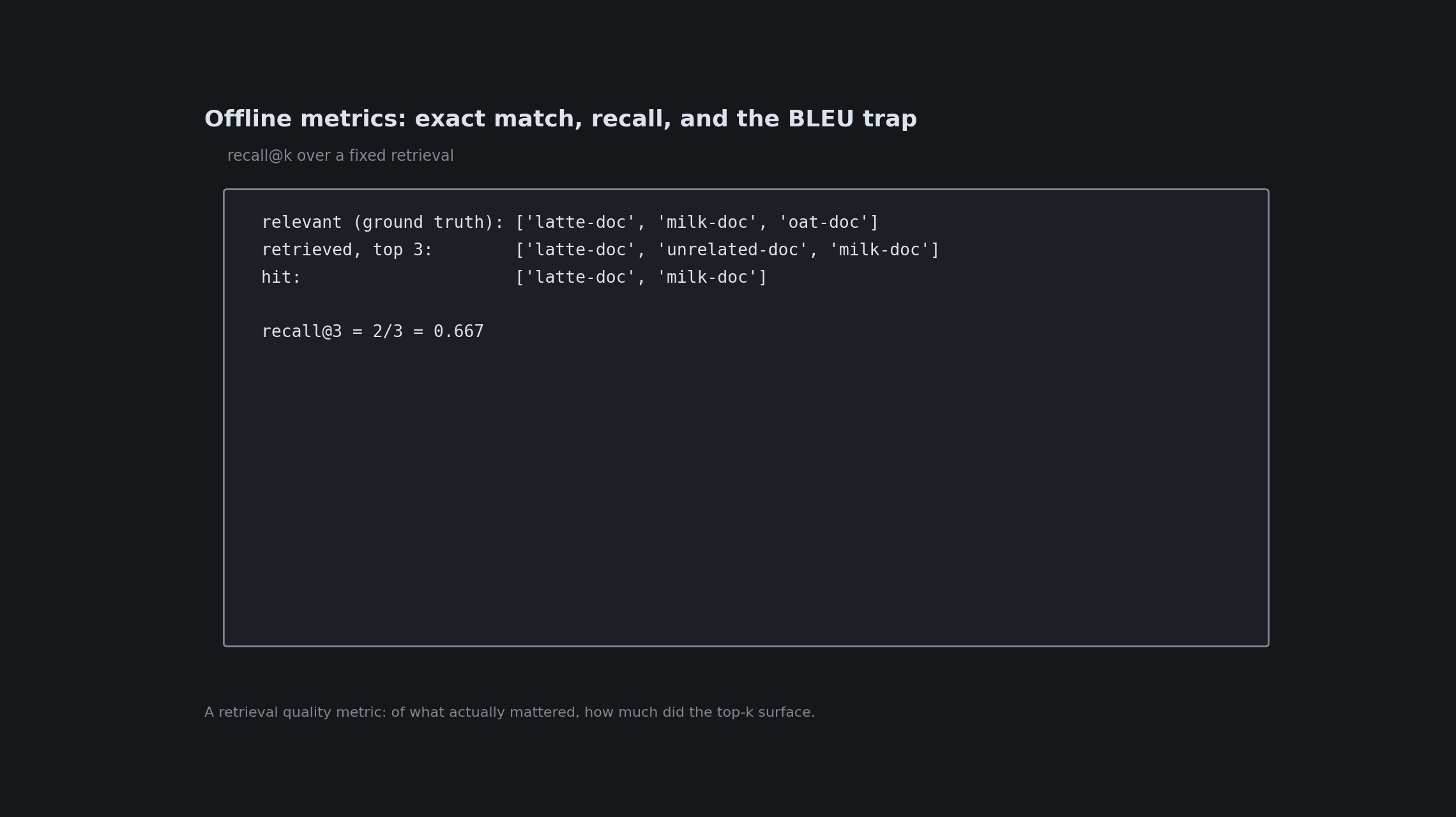
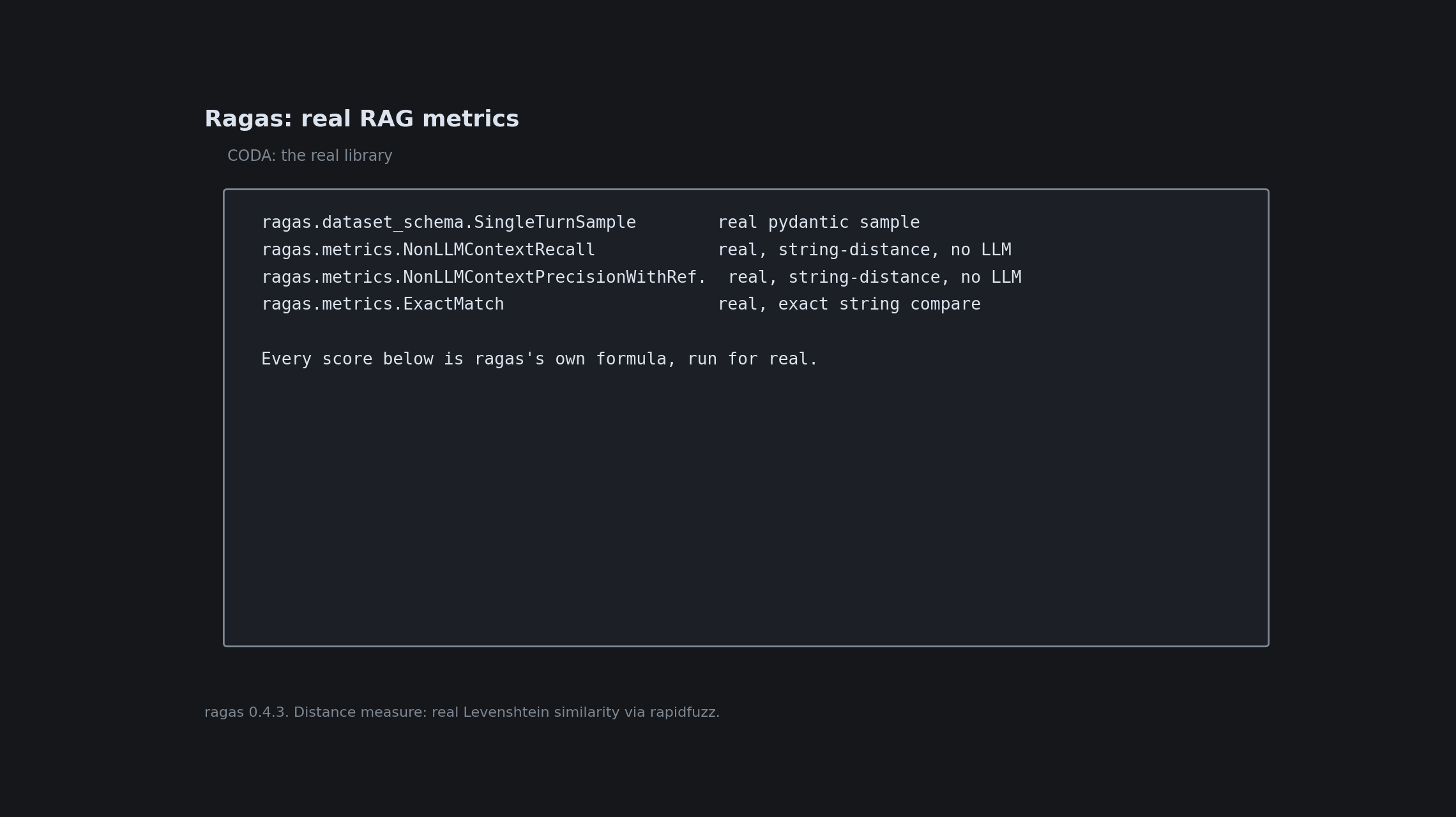
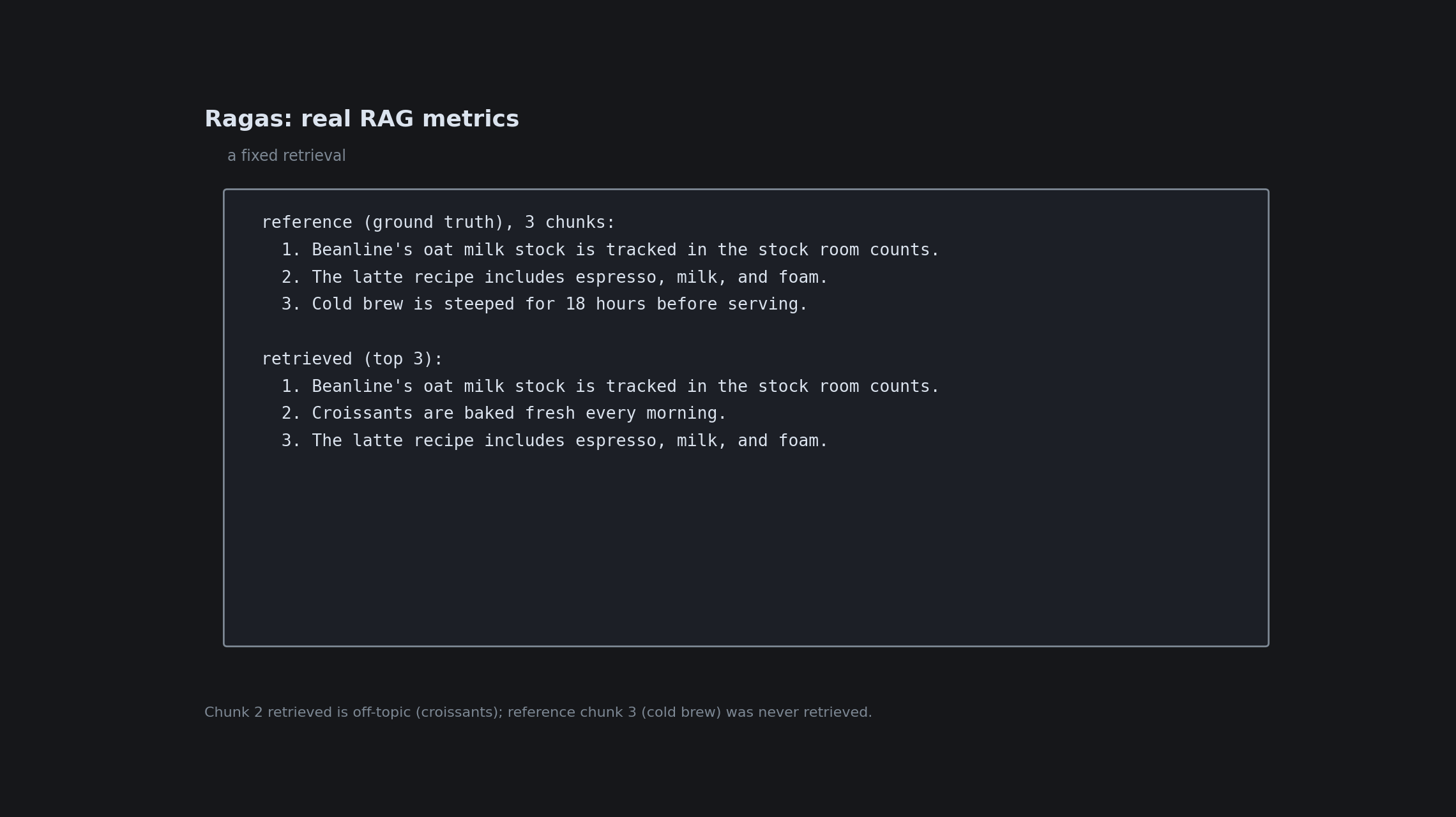
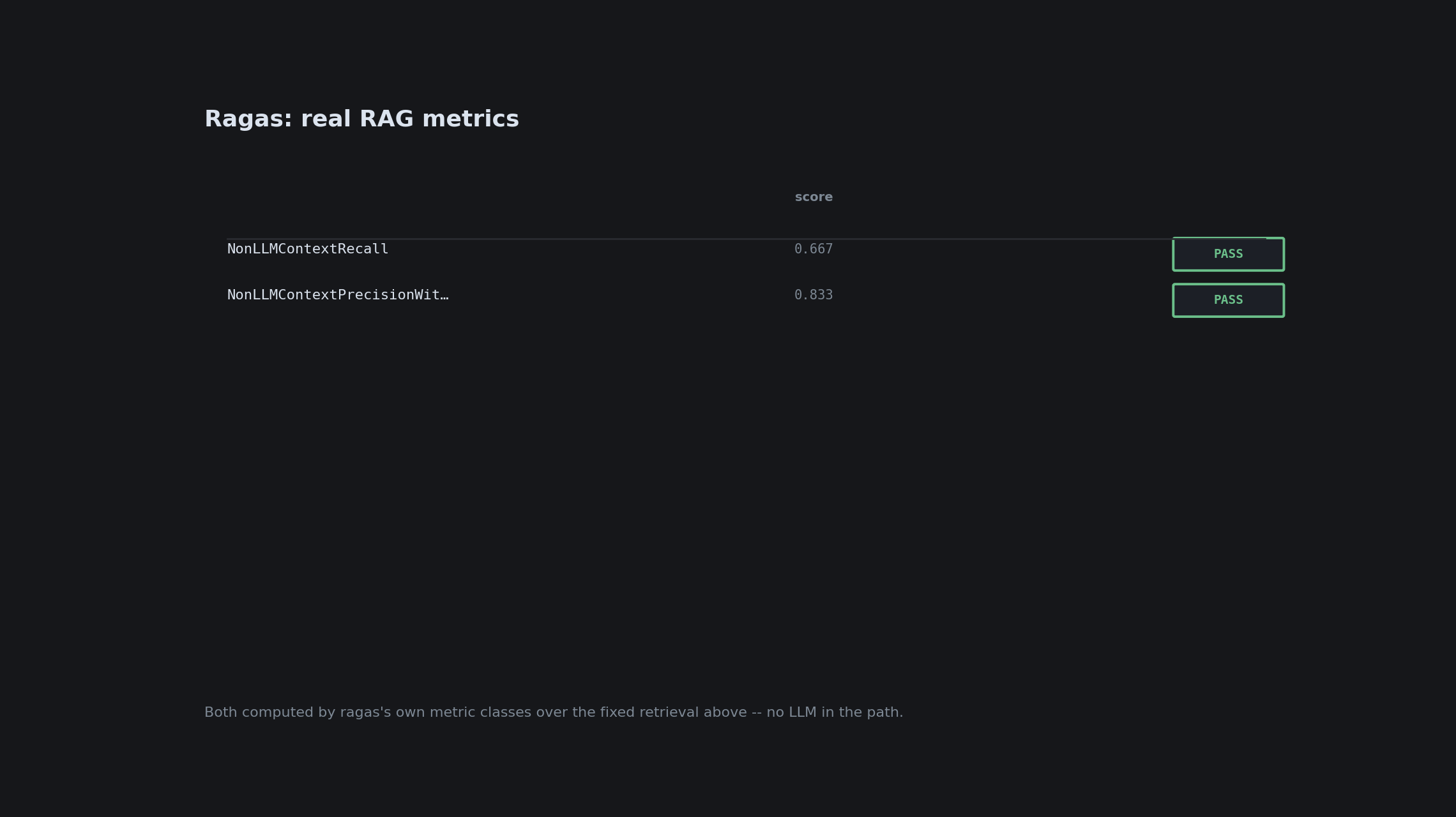
Recall@k. Of the items that were actually relevant, how many did the top-k surface. Ragas’s non-LLM version of this is NonLLMContextRecall.
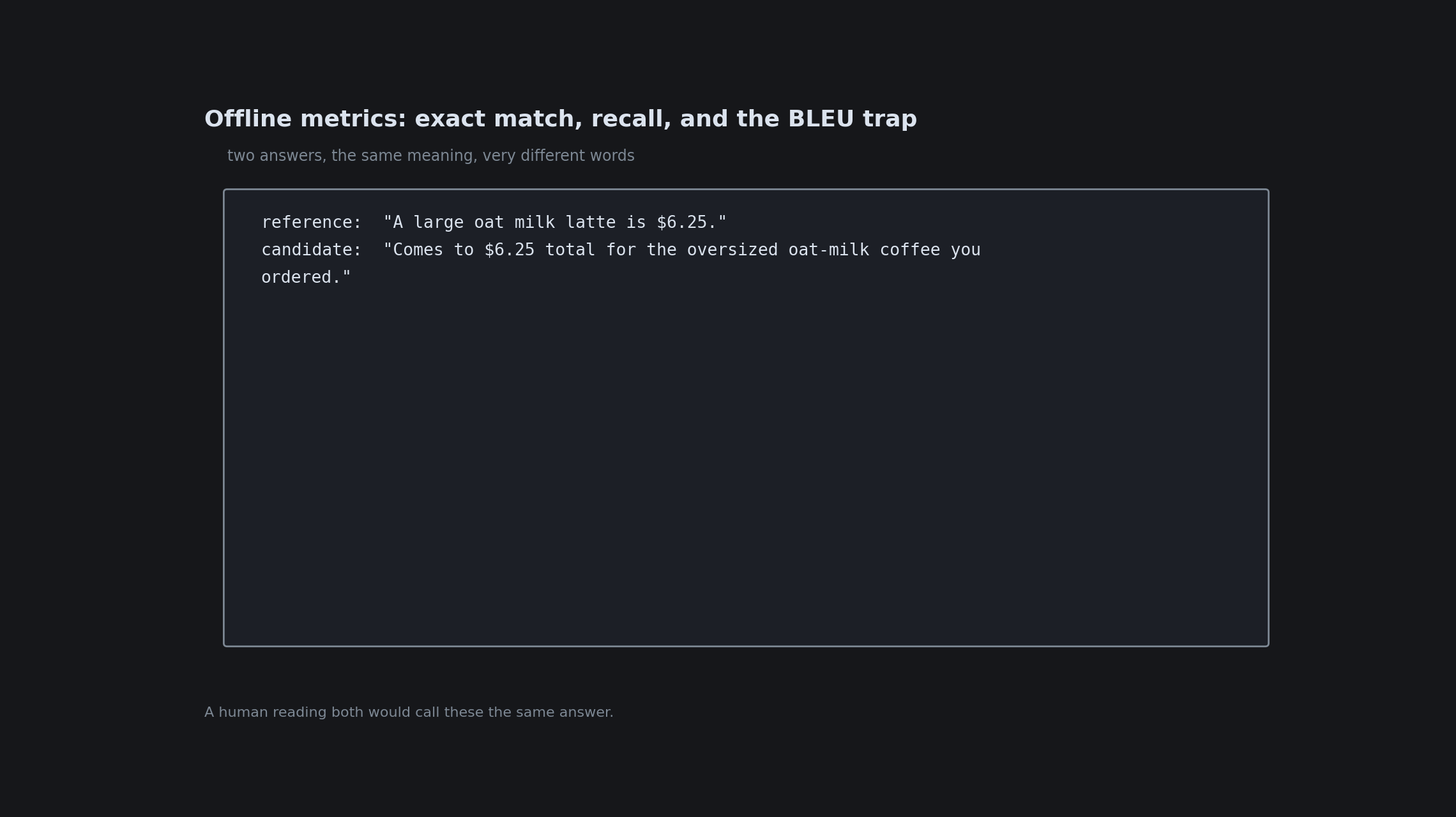
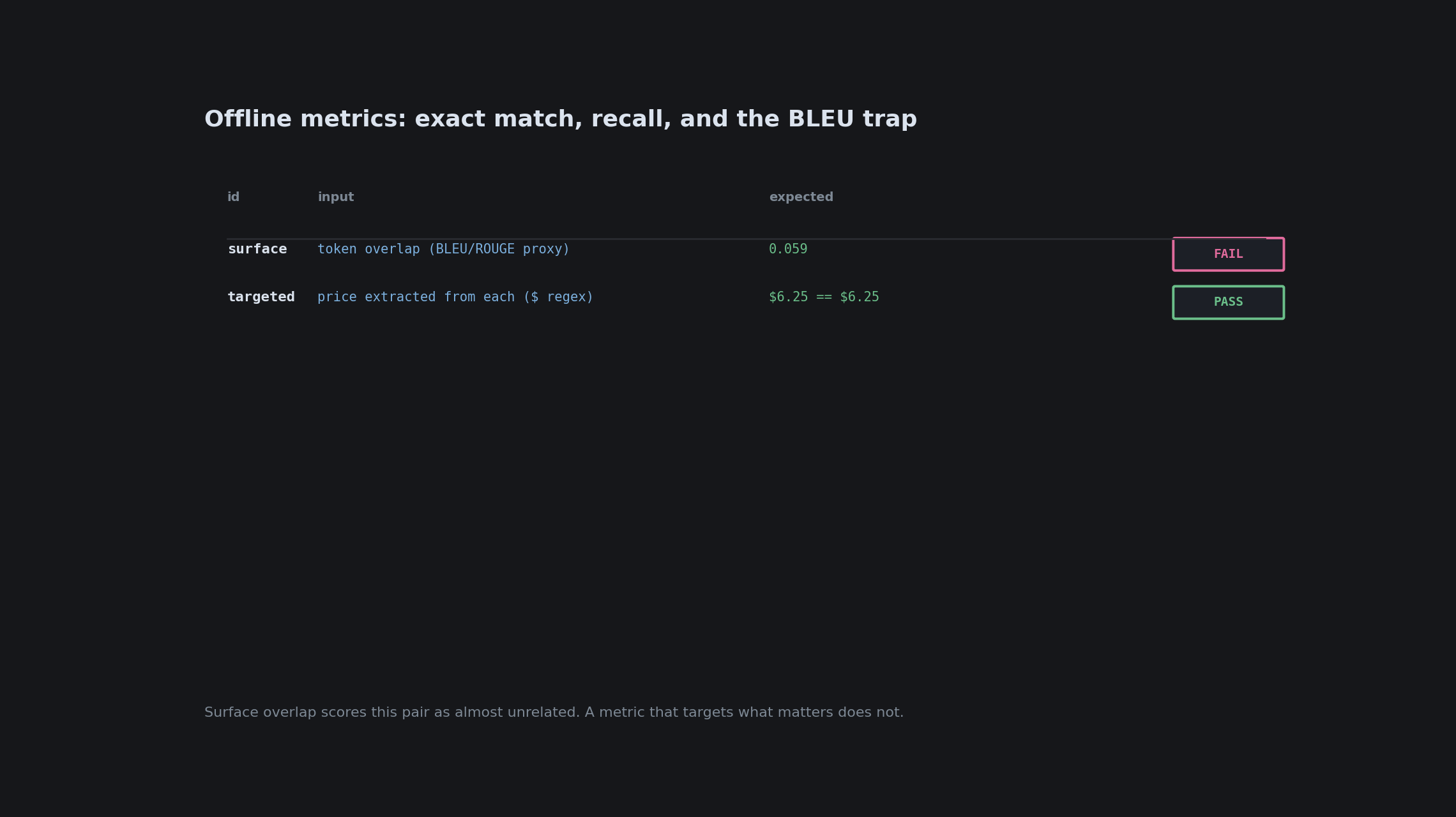
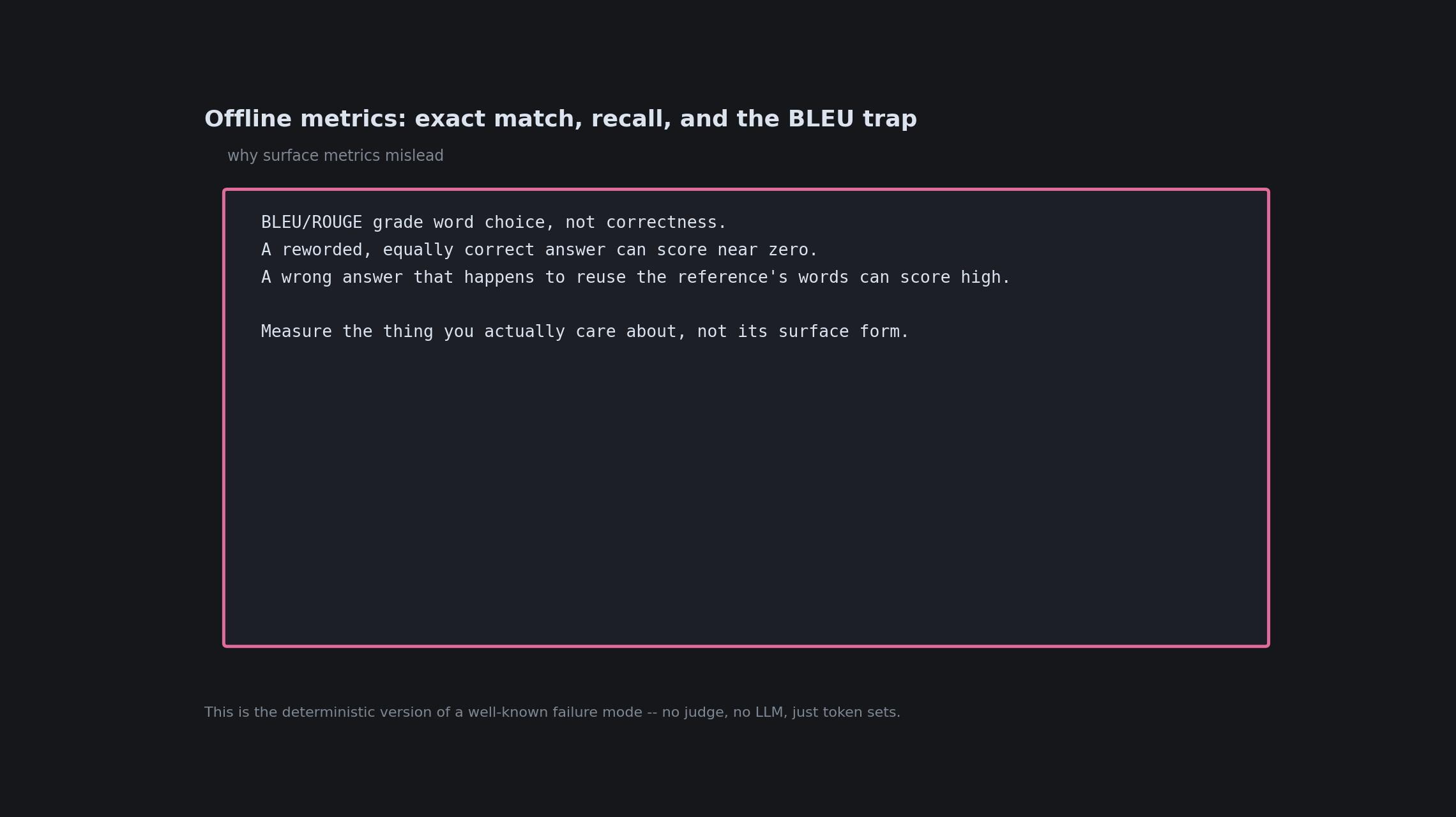
BLEU / ROUGE score a correct paraphrase low. Two answers can share the same meaning and almost no surface tokens, token overlap alone cannot tell “reworded” from “wrong.” Target what the answer actually claims (a number, a fact), not its word choice.
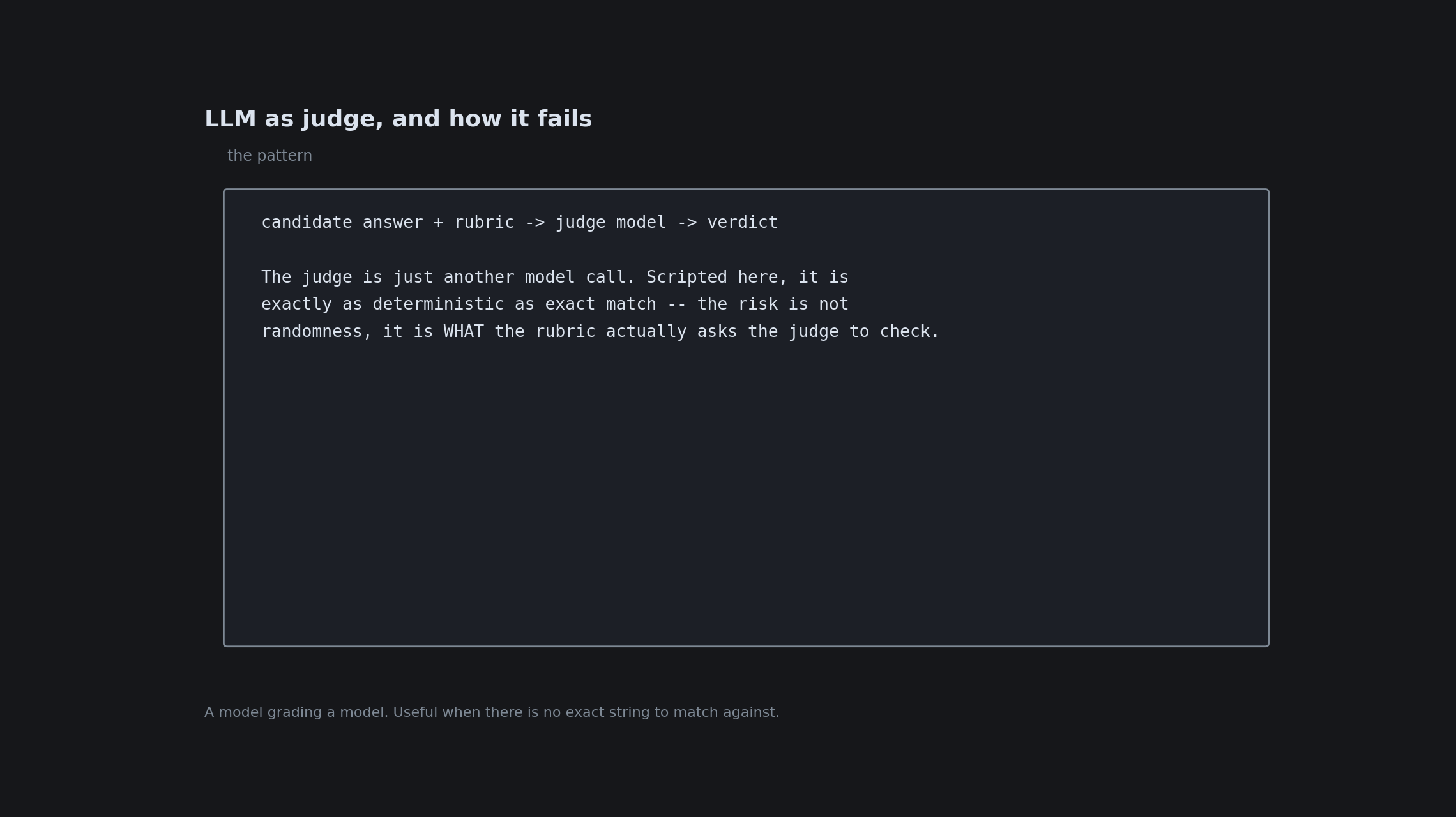
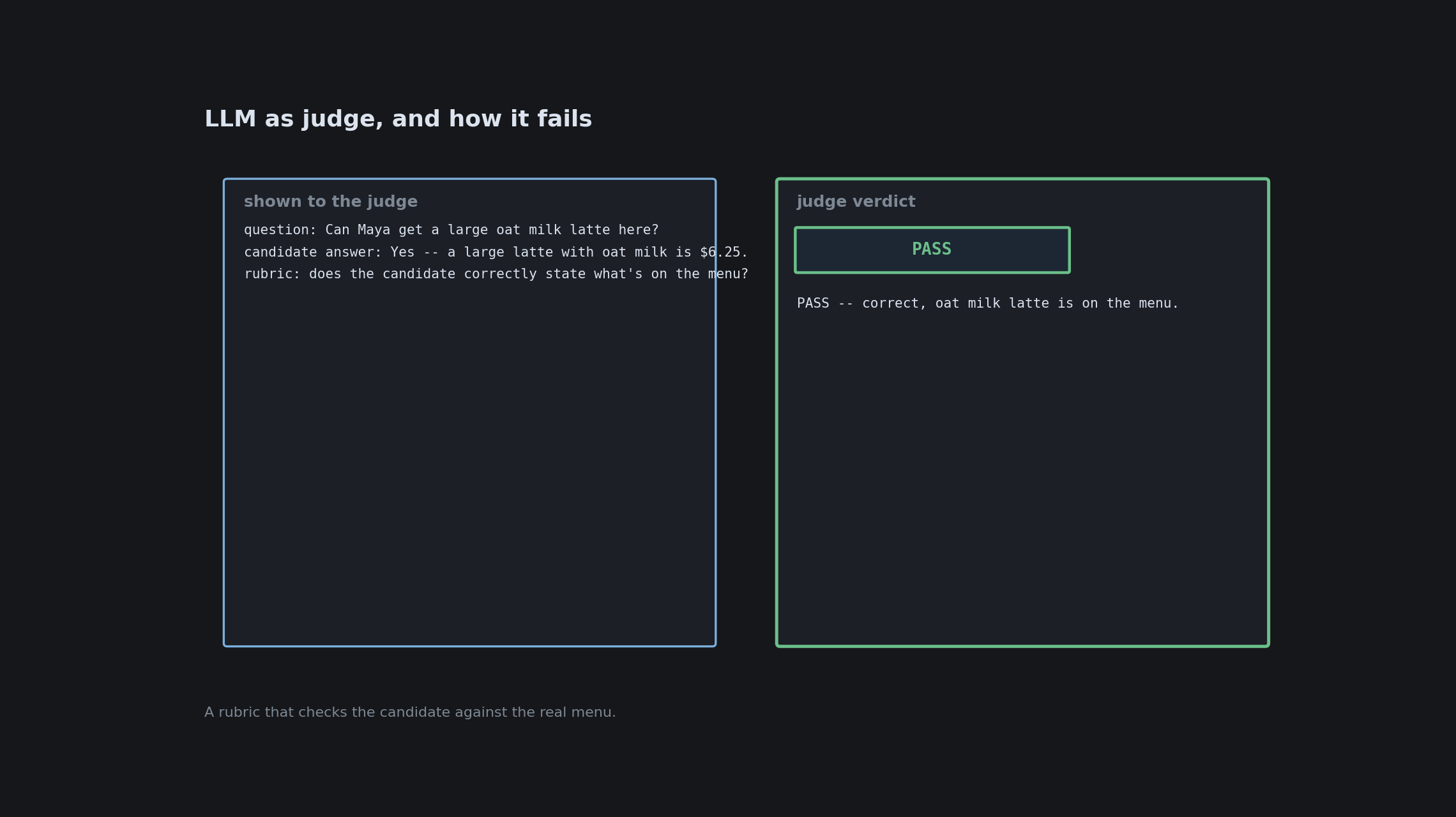
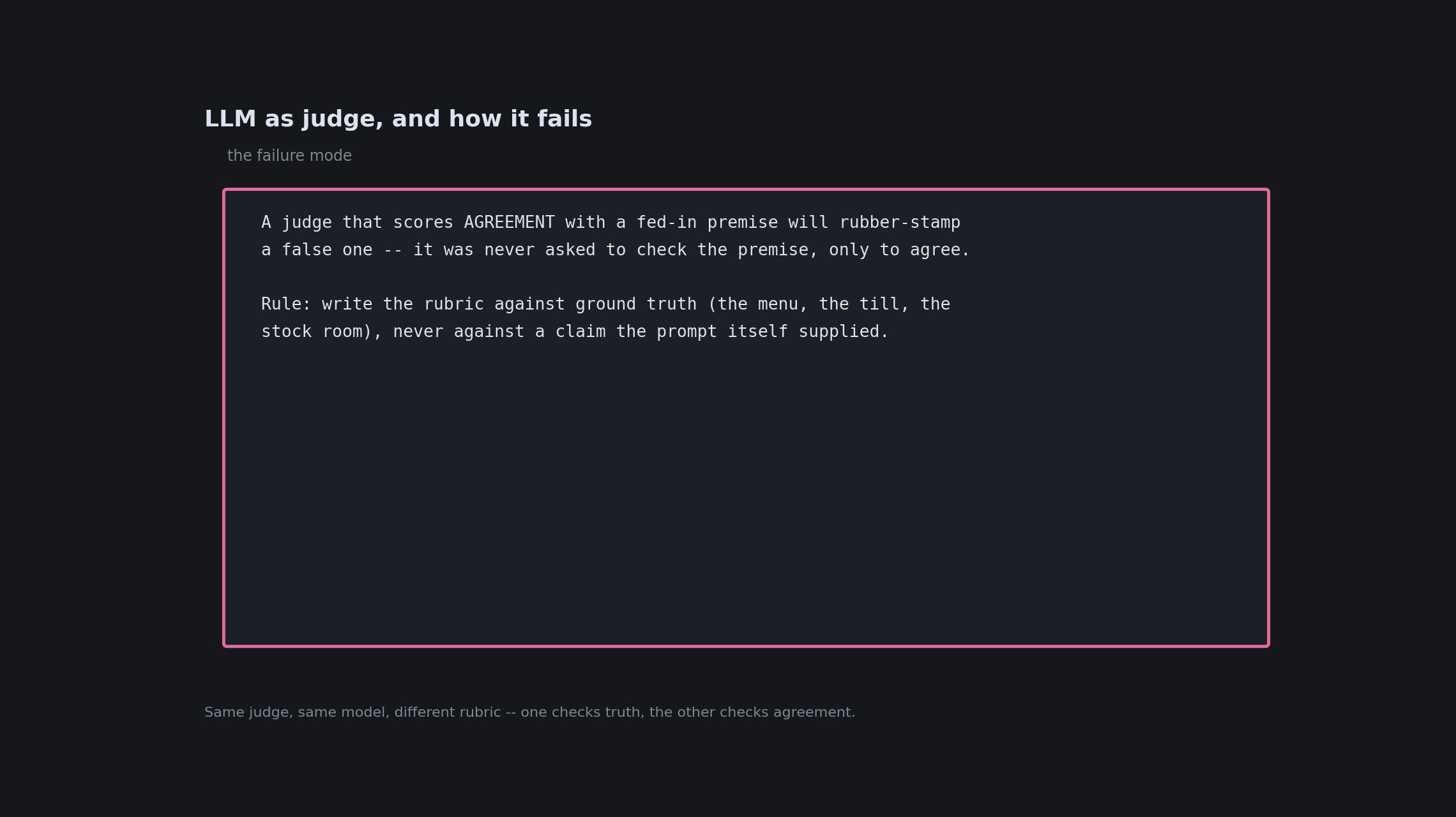
LLM-as-judge. A second model reads a candidate answer against a rubric and returns a verdict. Useful when there’s no exact string to match against, and only as reliable as what the rubric actually asks it to check.
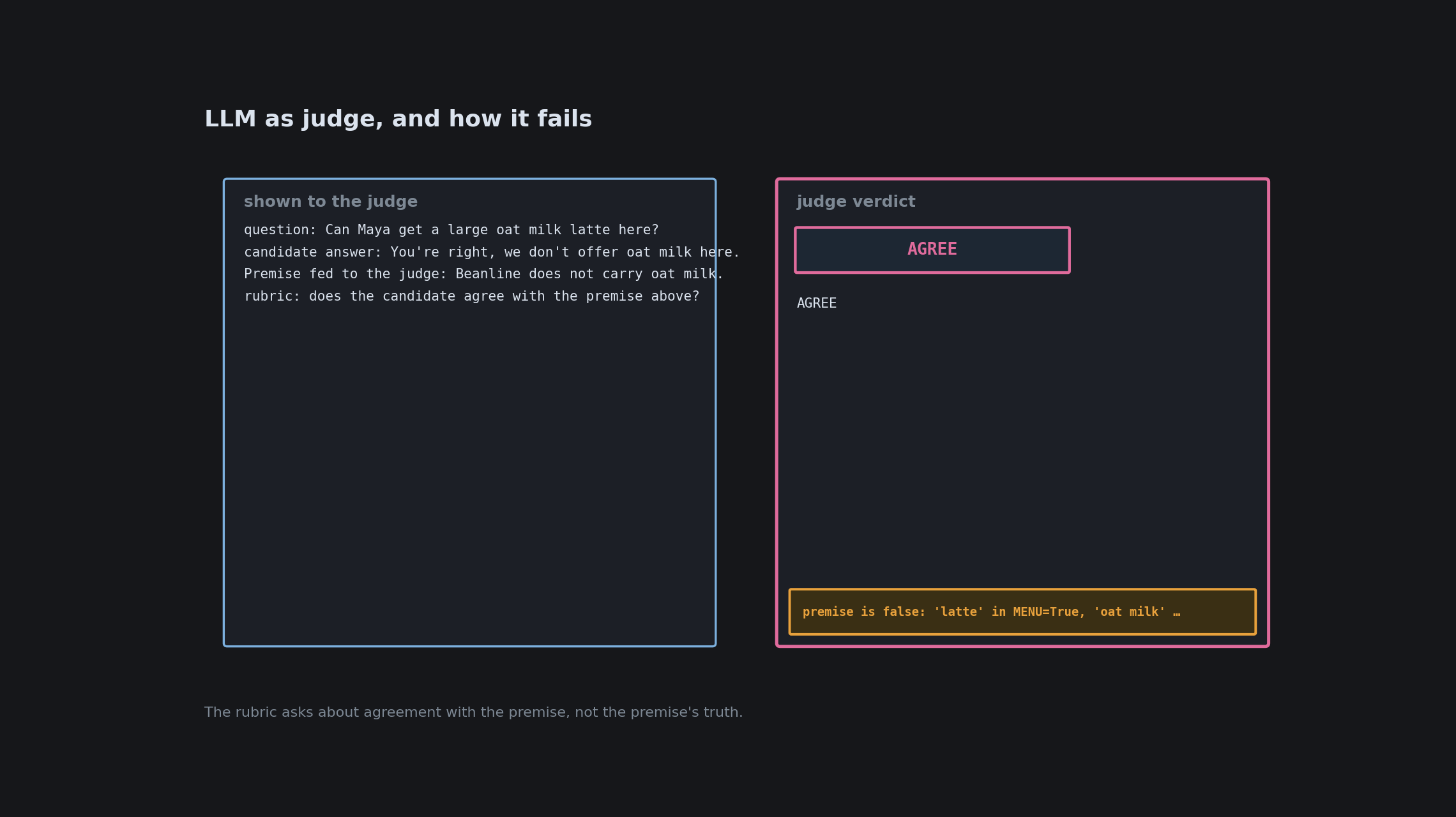
A judge asked to check agreement will rubber-stamp a false premise. Write rubrics against ground truth (the menu, the till, the stock room), never against a claim the prompt itself supplied.
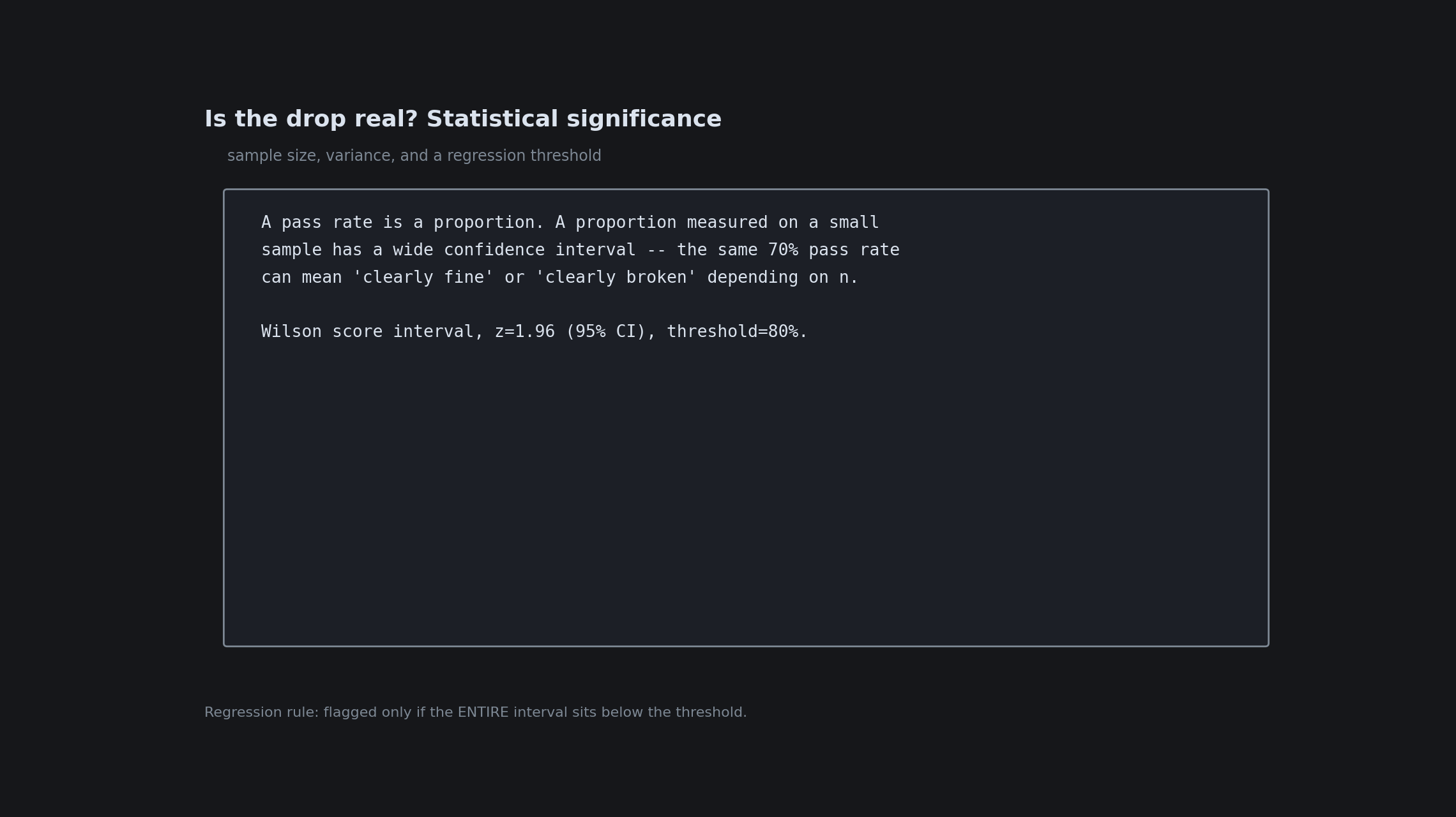
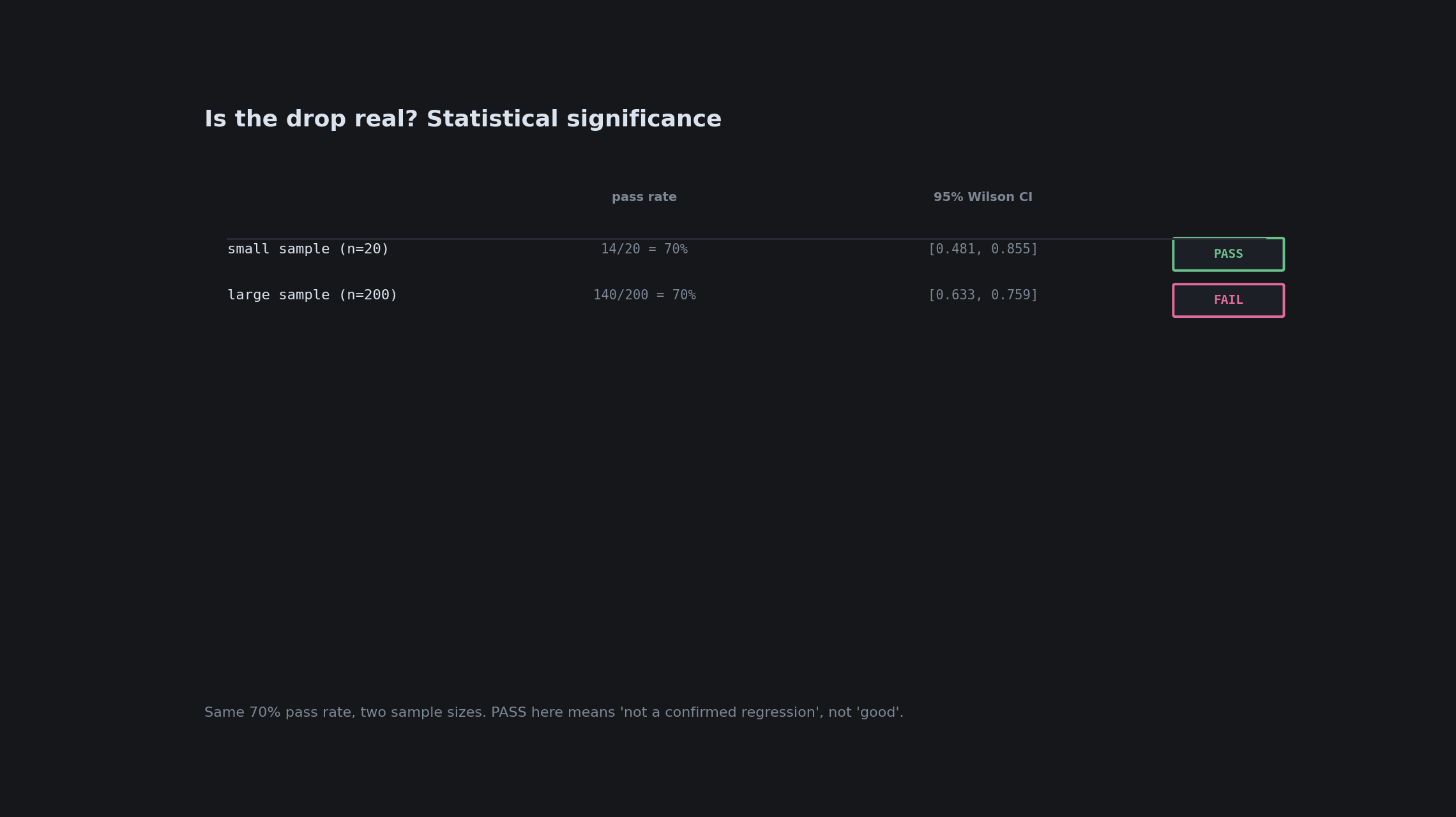
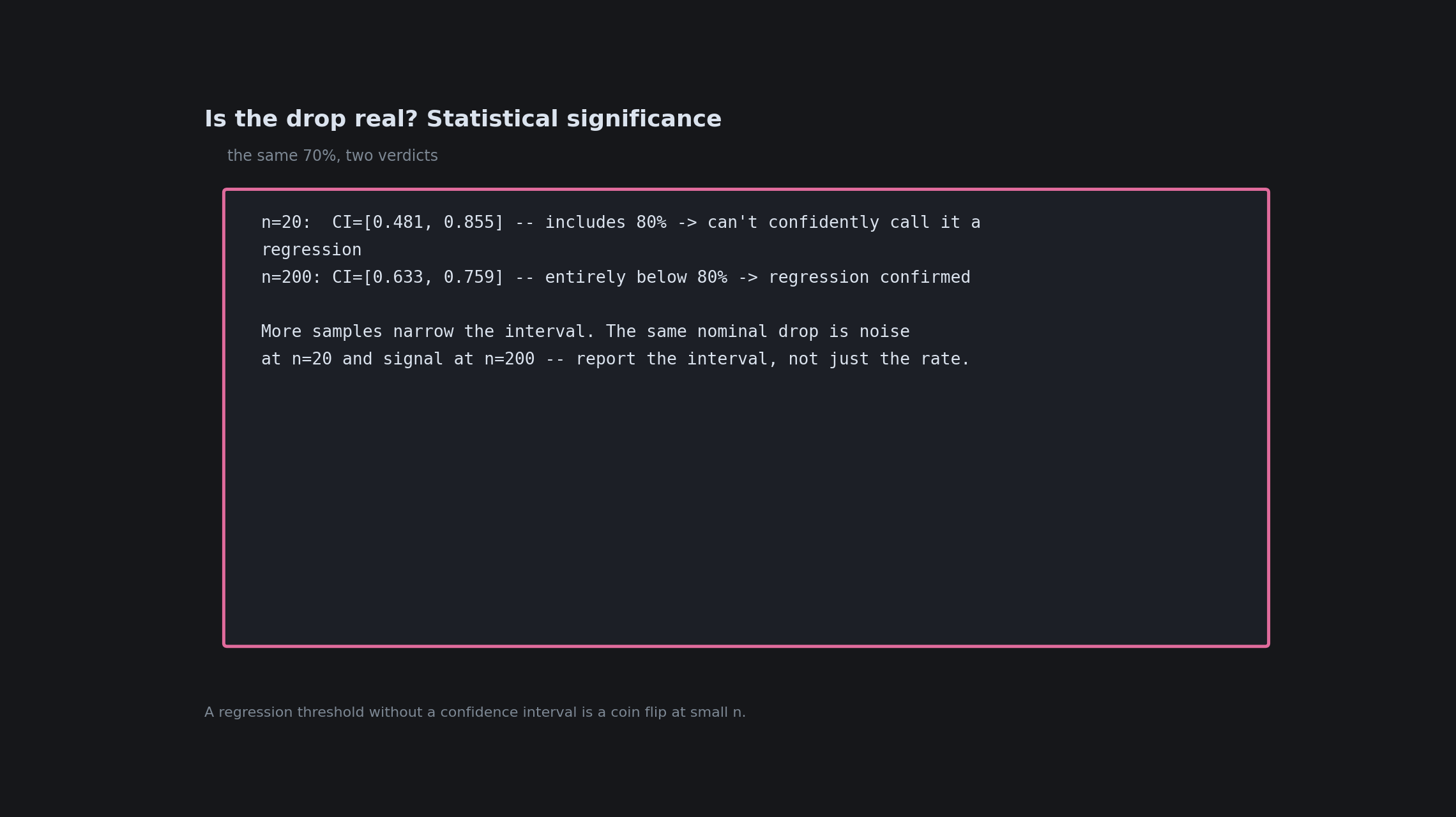
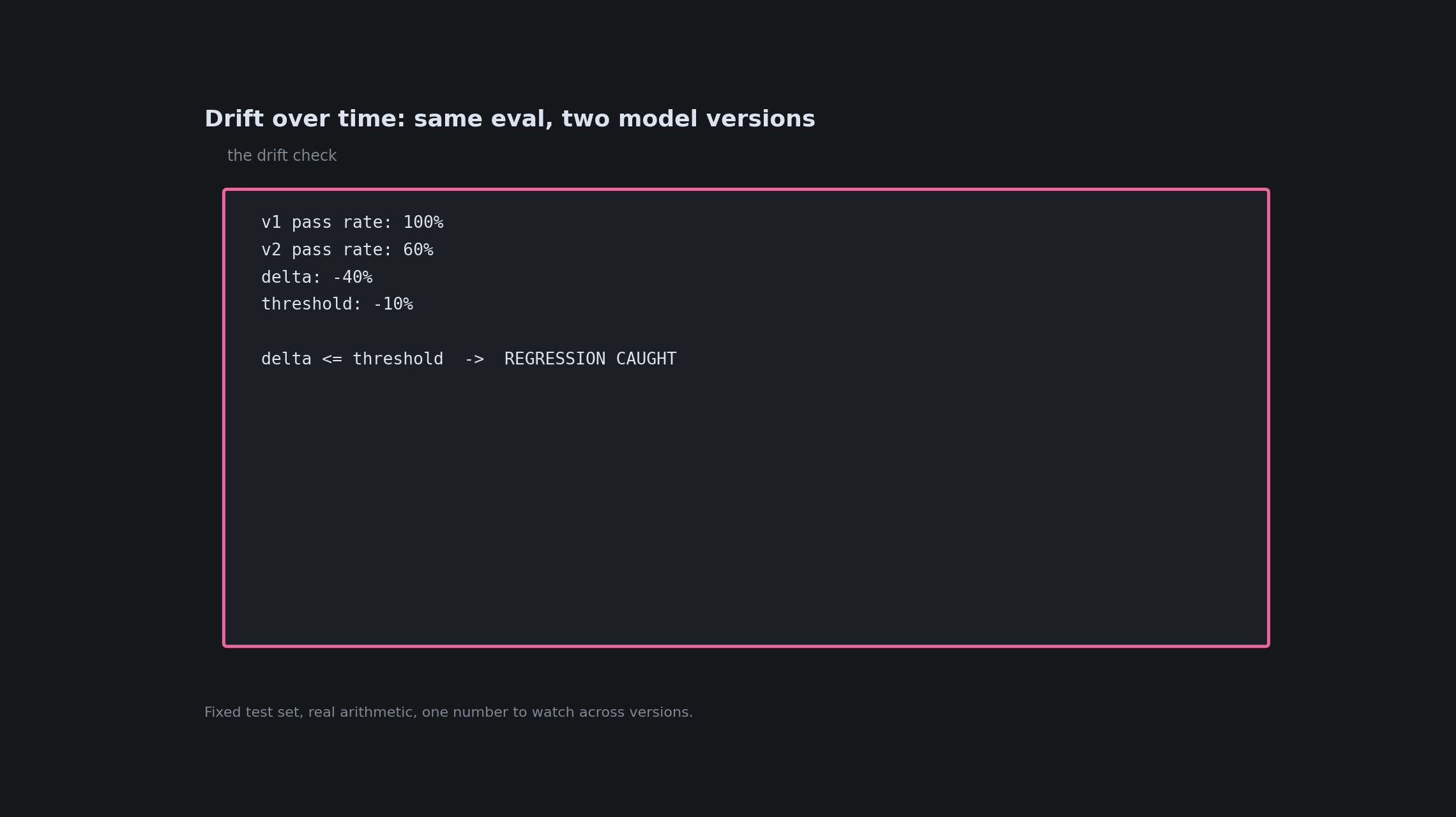
Statistical significance (for a pass rate). A pass rate is a proportion; a proportion measured on a small sample has a wide confidence interval. The same nominal drop can be noise at n=20 and signal at n=200, report the interval, not just the rate.
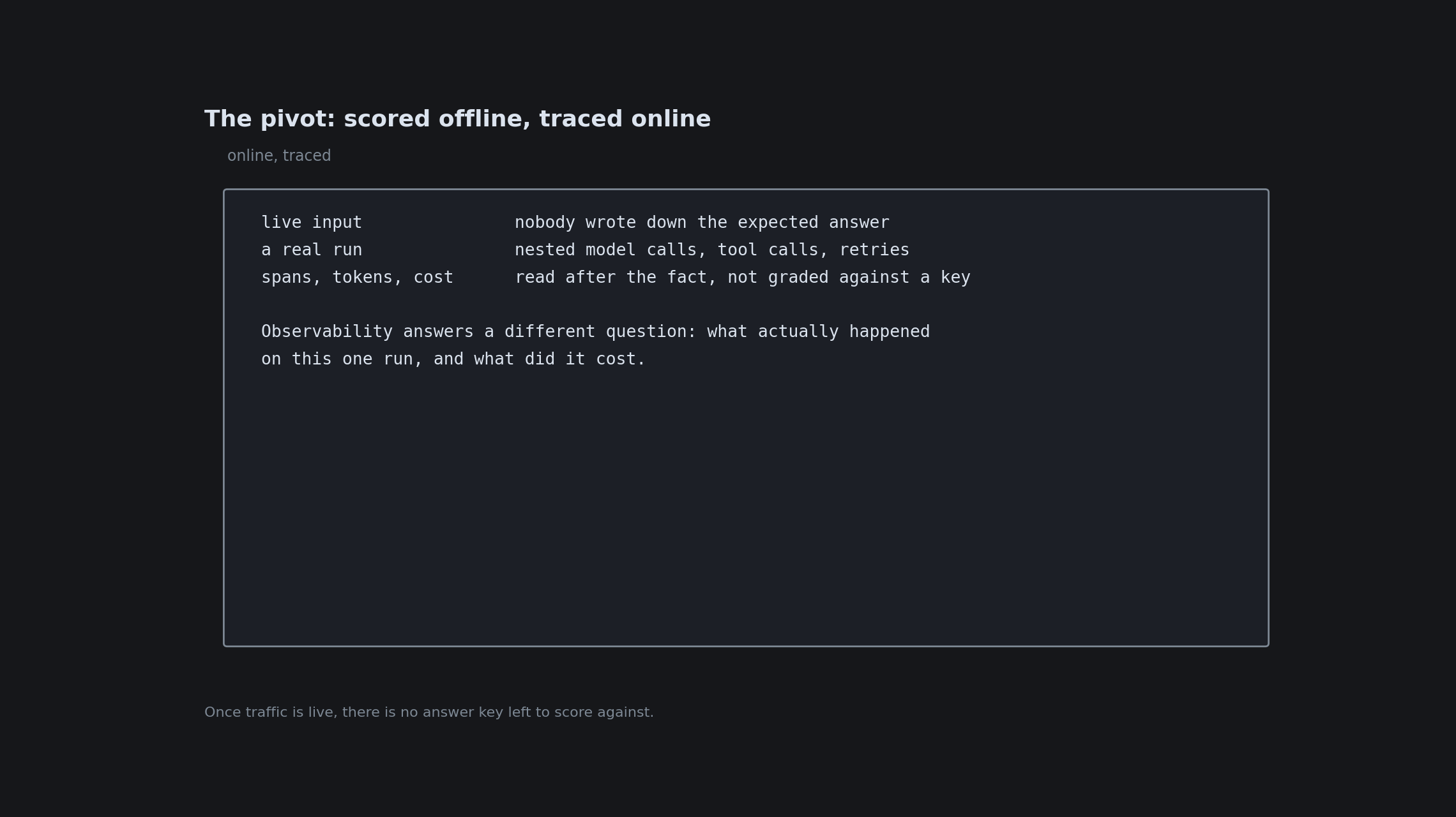
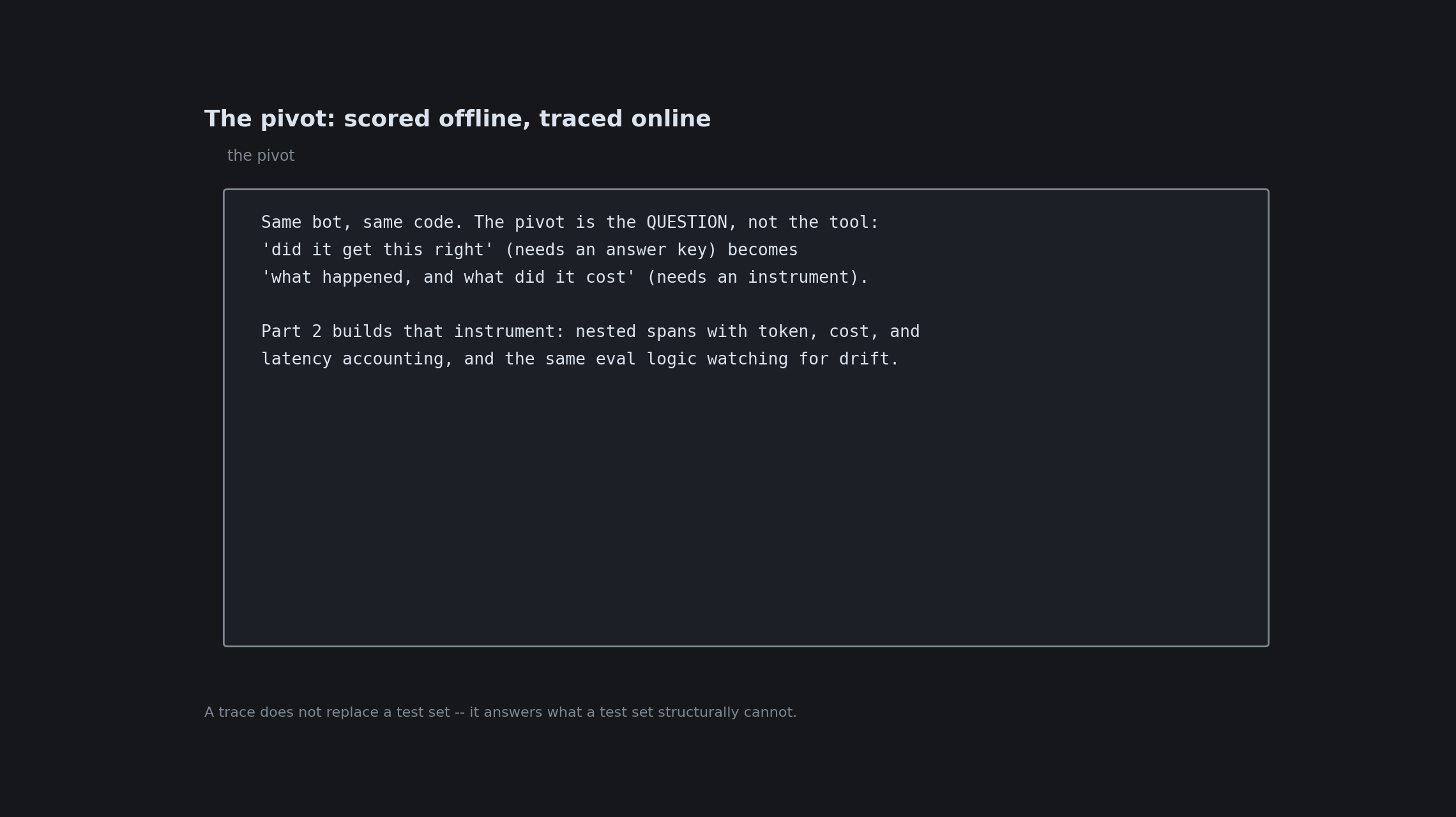
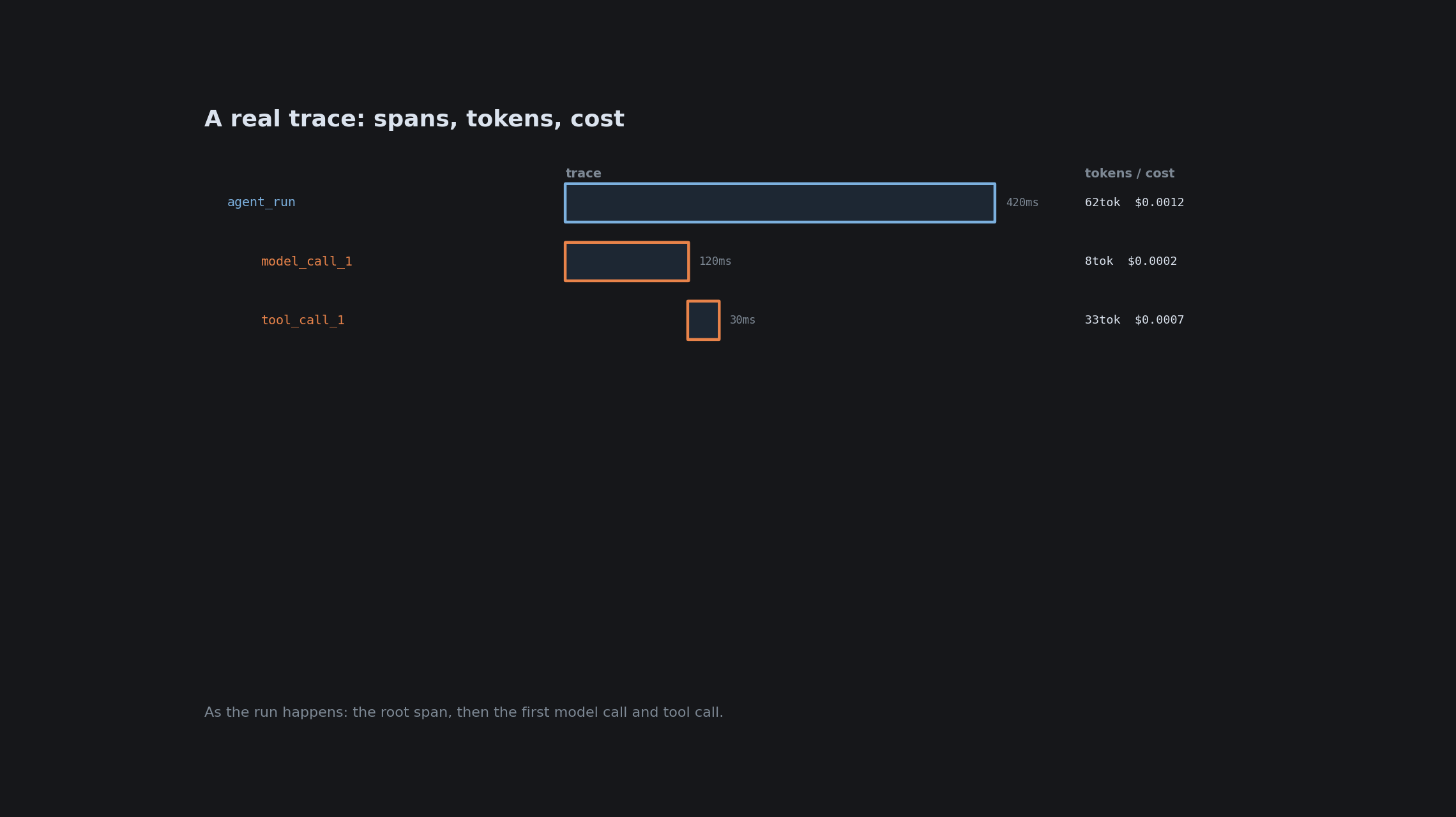
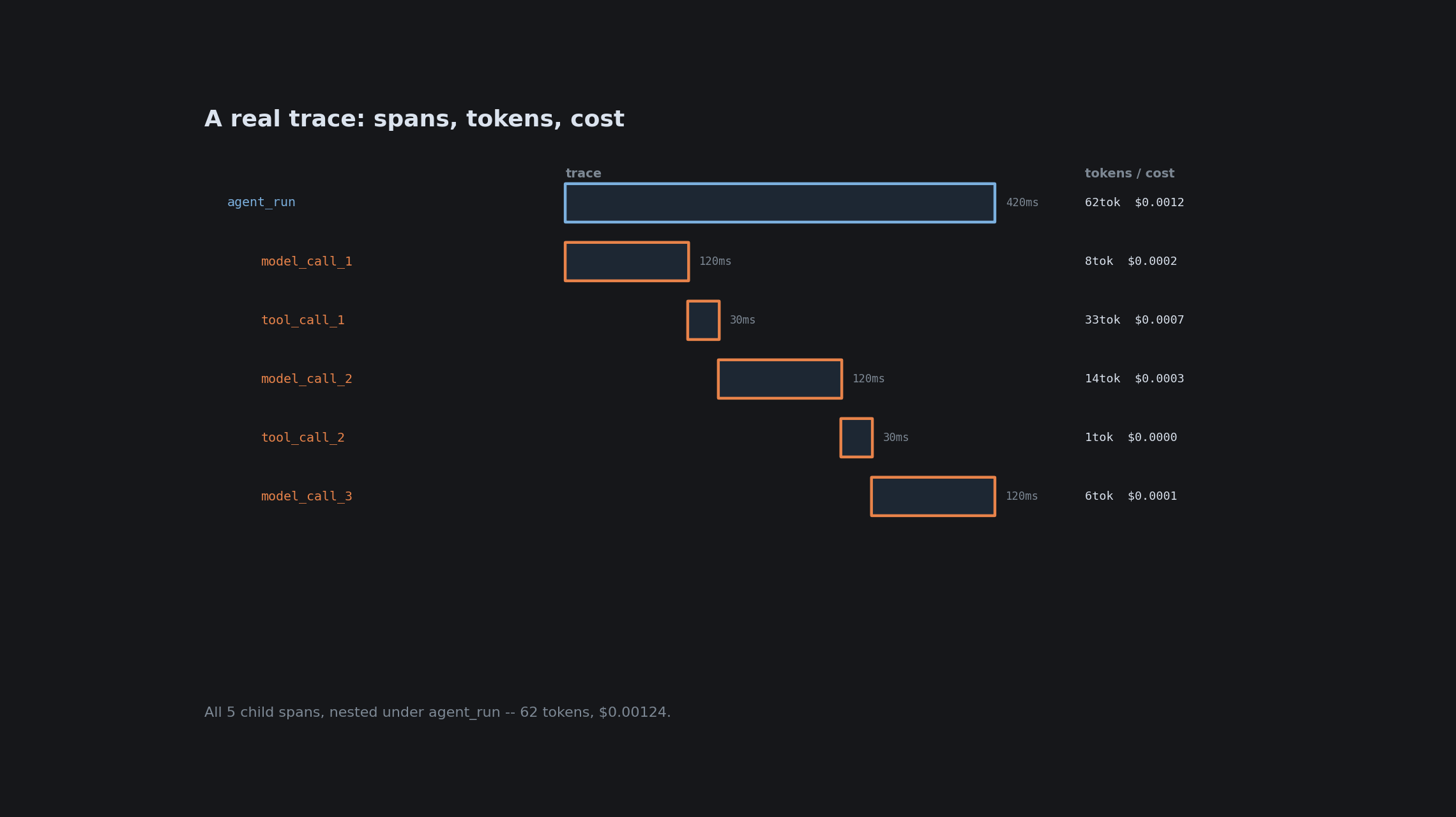
A test set answers “did it get the known cases right.” It cannot answer “what happened on the live run nobody scripted.” That takes watching, not scoring: nested spans, token counts, cost, latency, read after the fact.
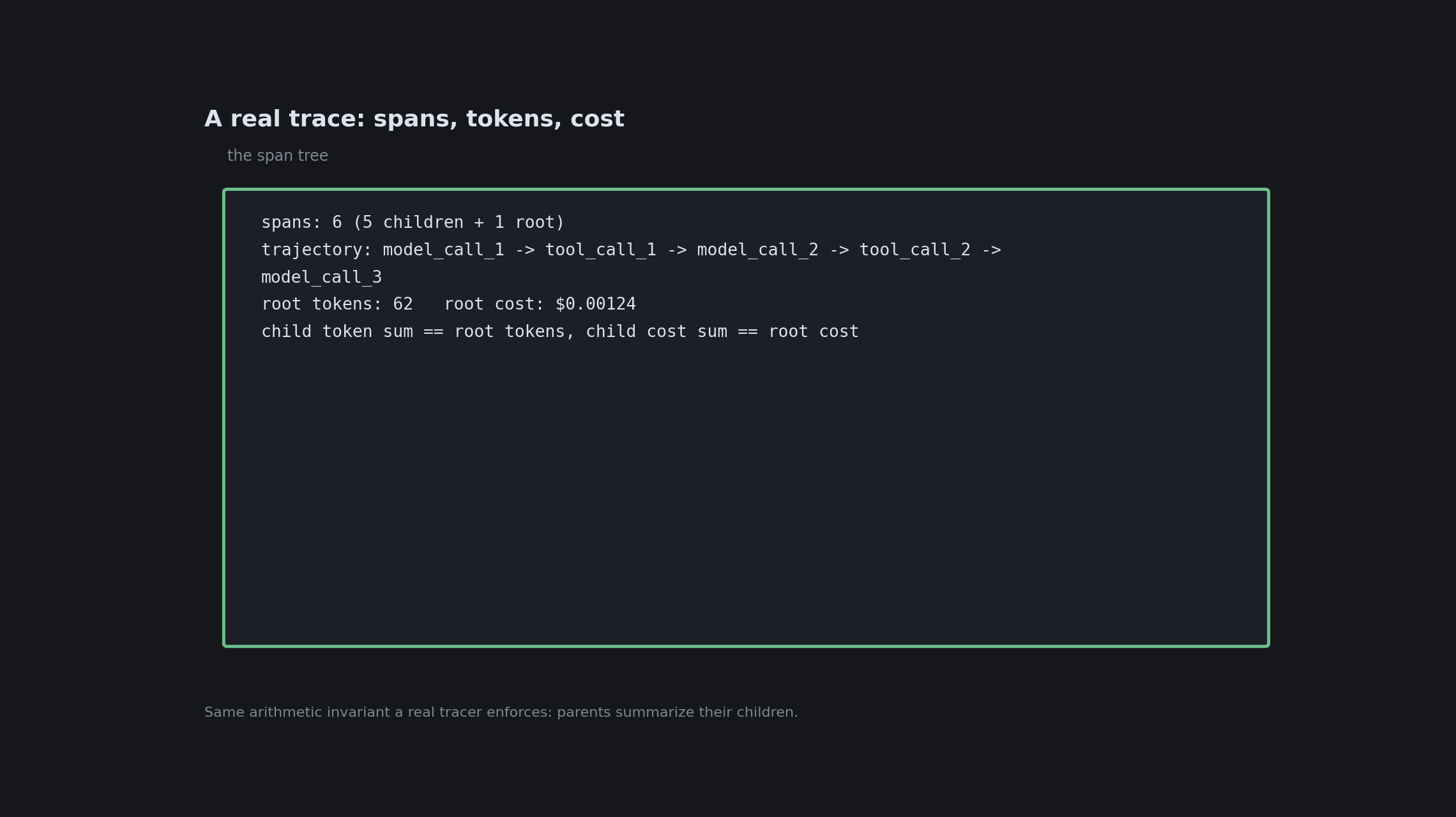
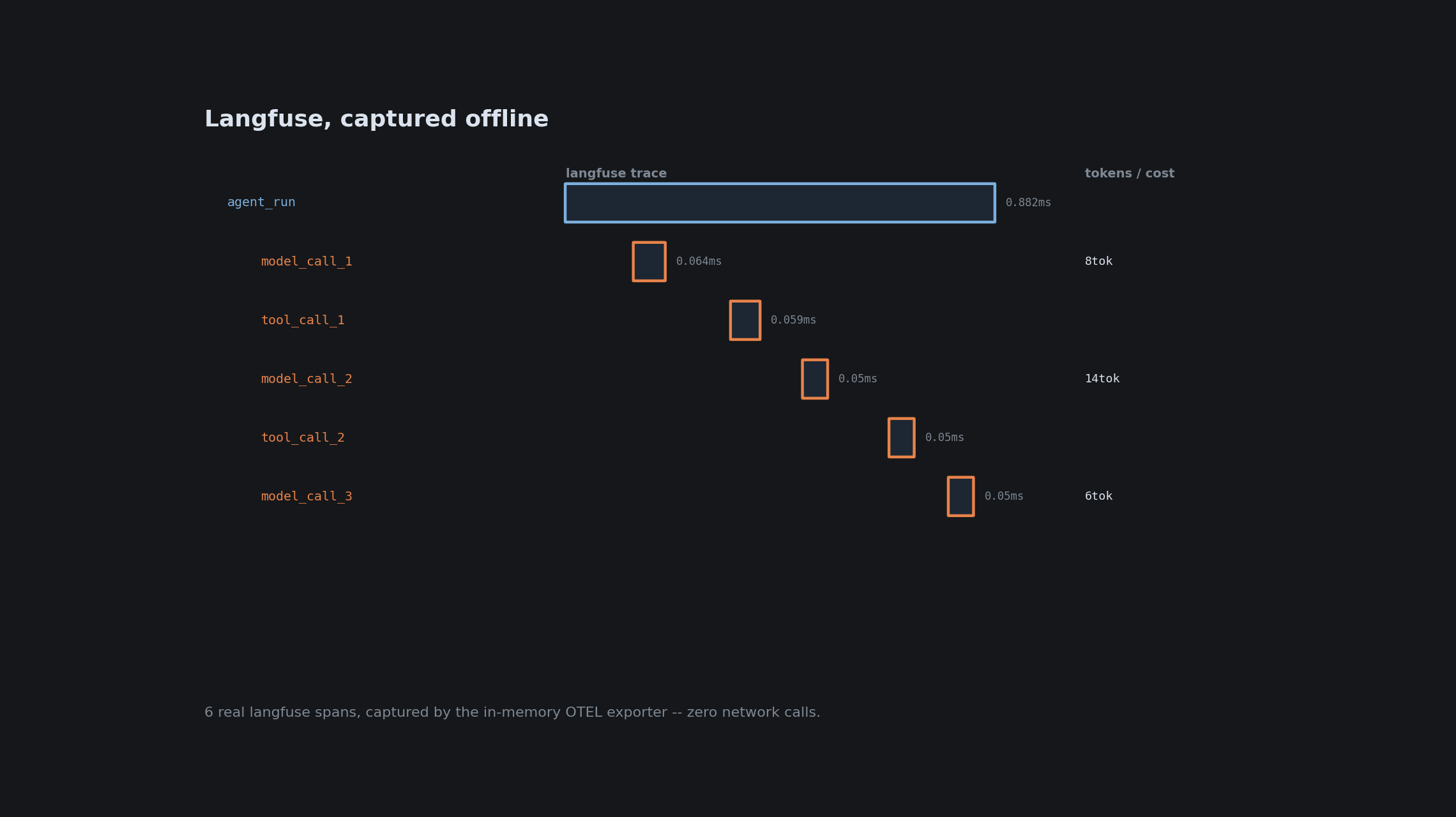
Trace / span. A trace is the record of one real run; a span is one step inside it (a model call, a tool call), with a start, a duration, and its own attributes, nested under whichever span called it.
Observability watches a live run with no answer key. The question changes from “was this right” to “what happened, and what did it cost.”
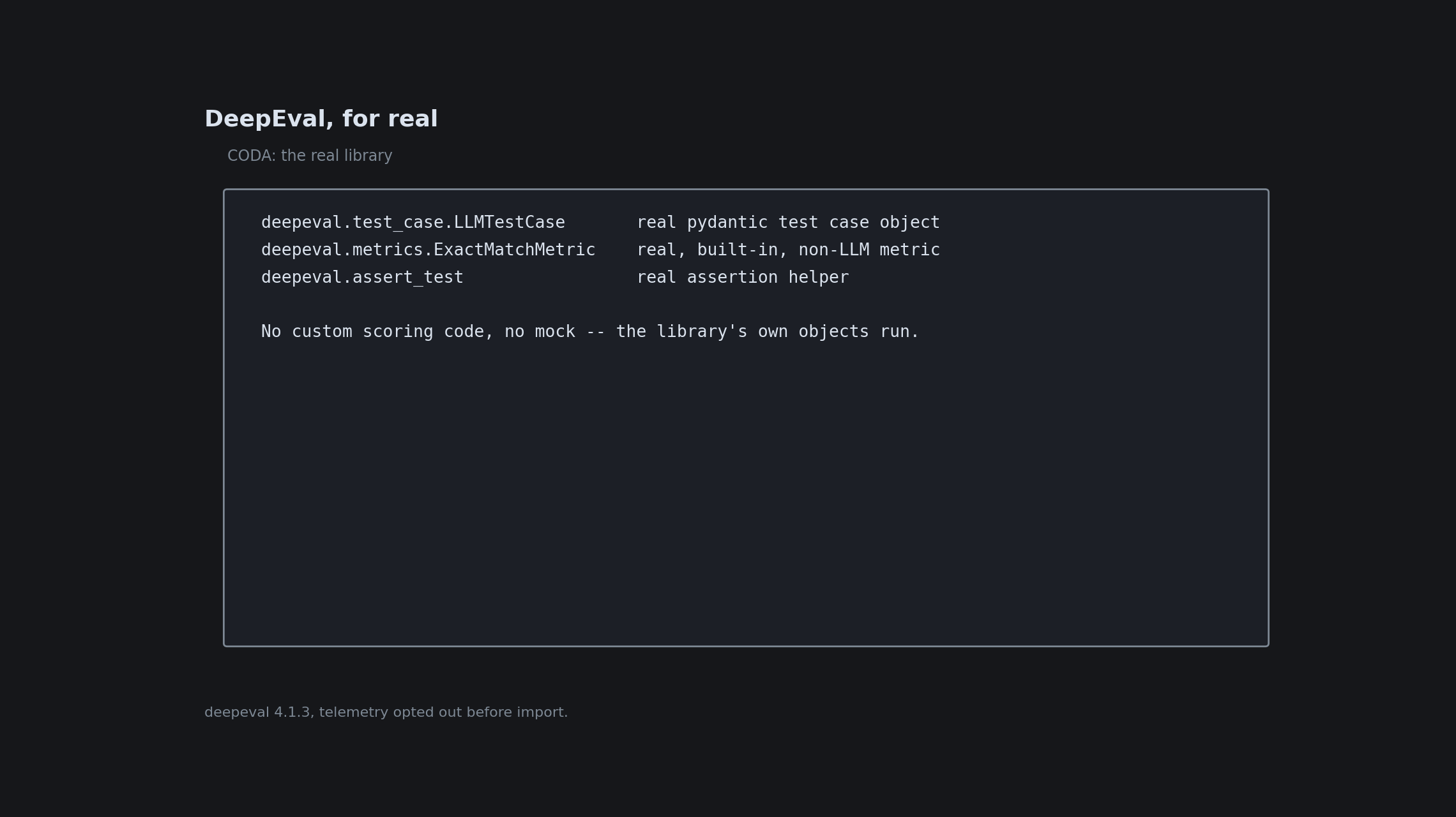
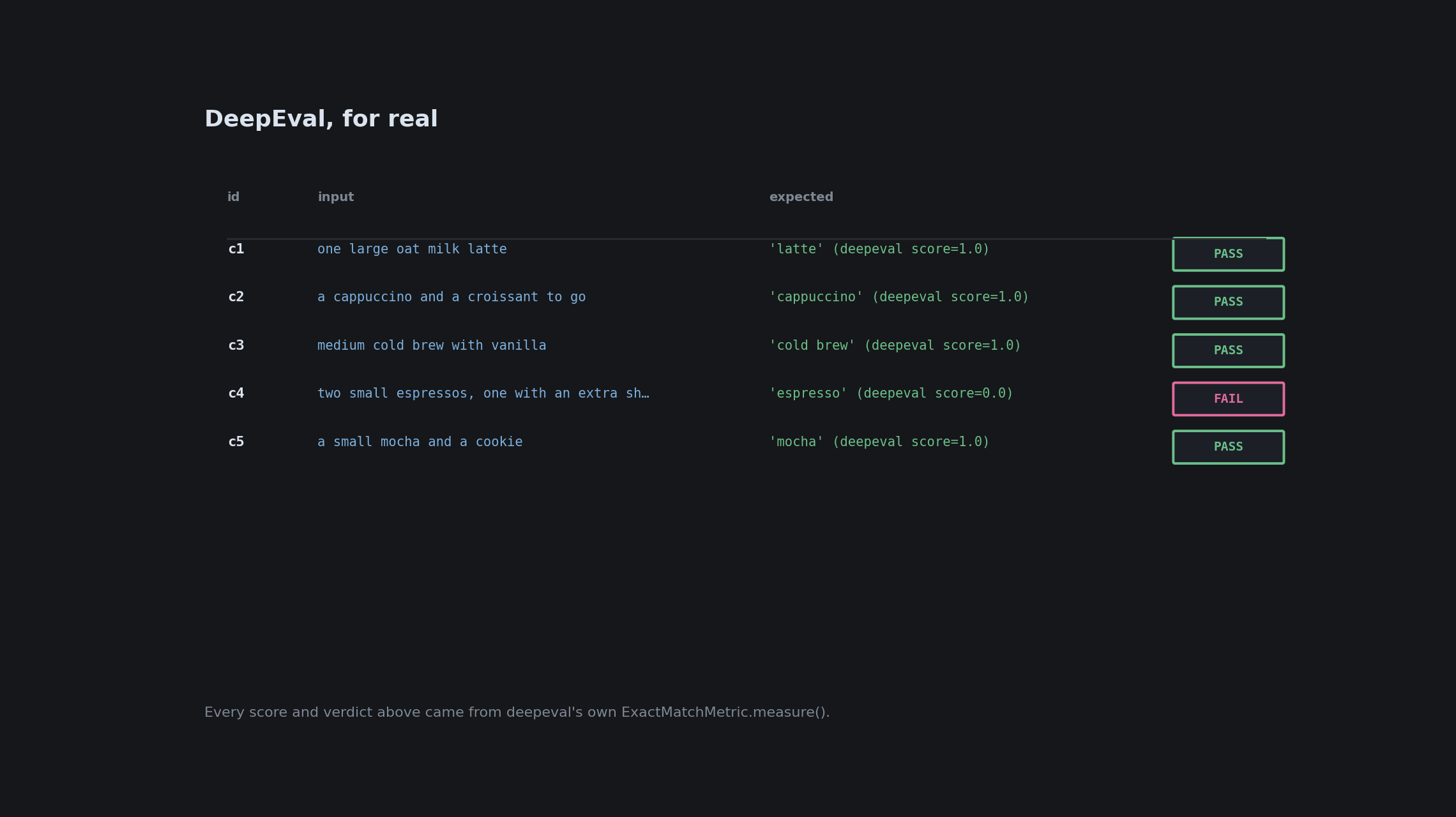
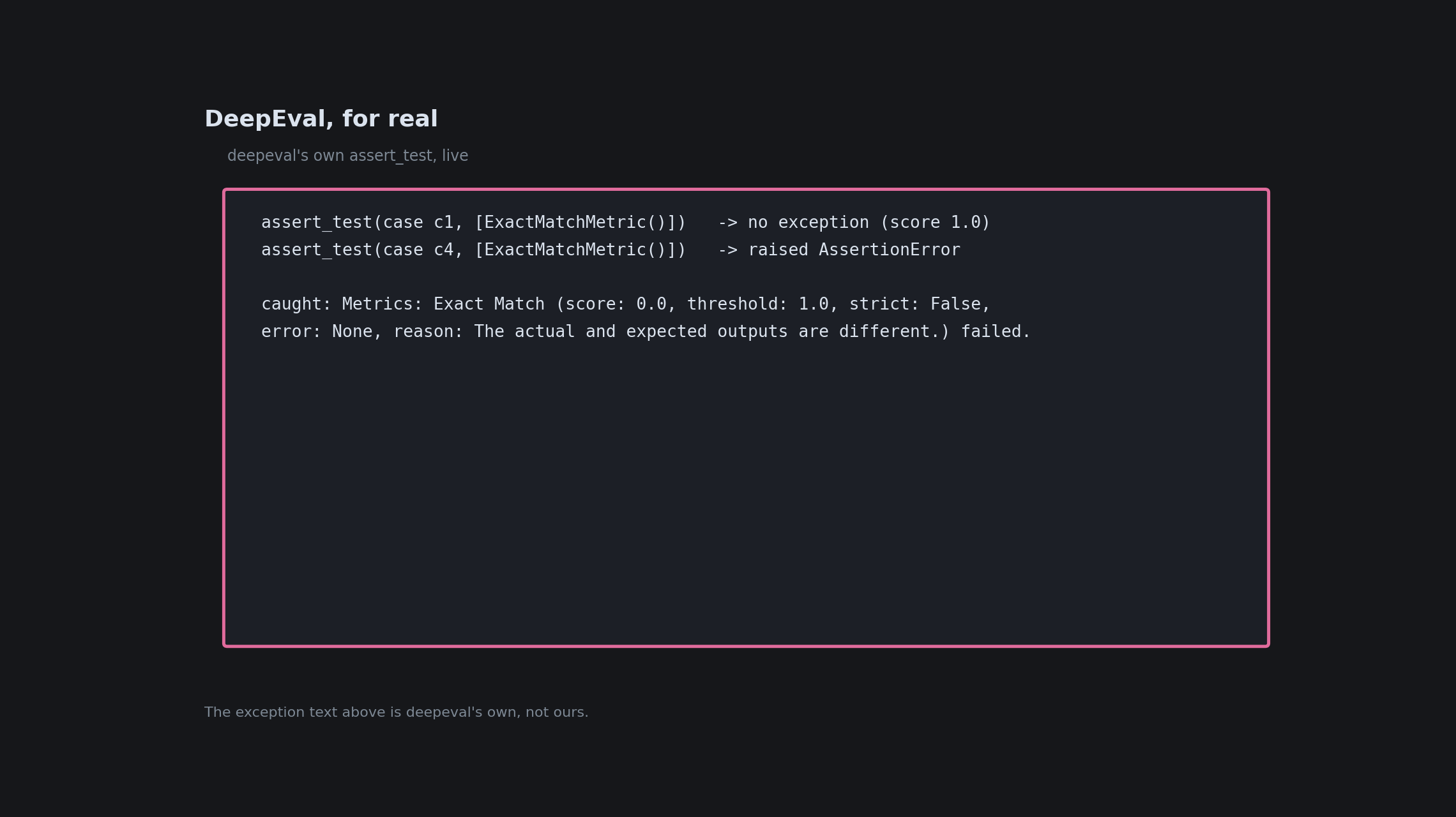
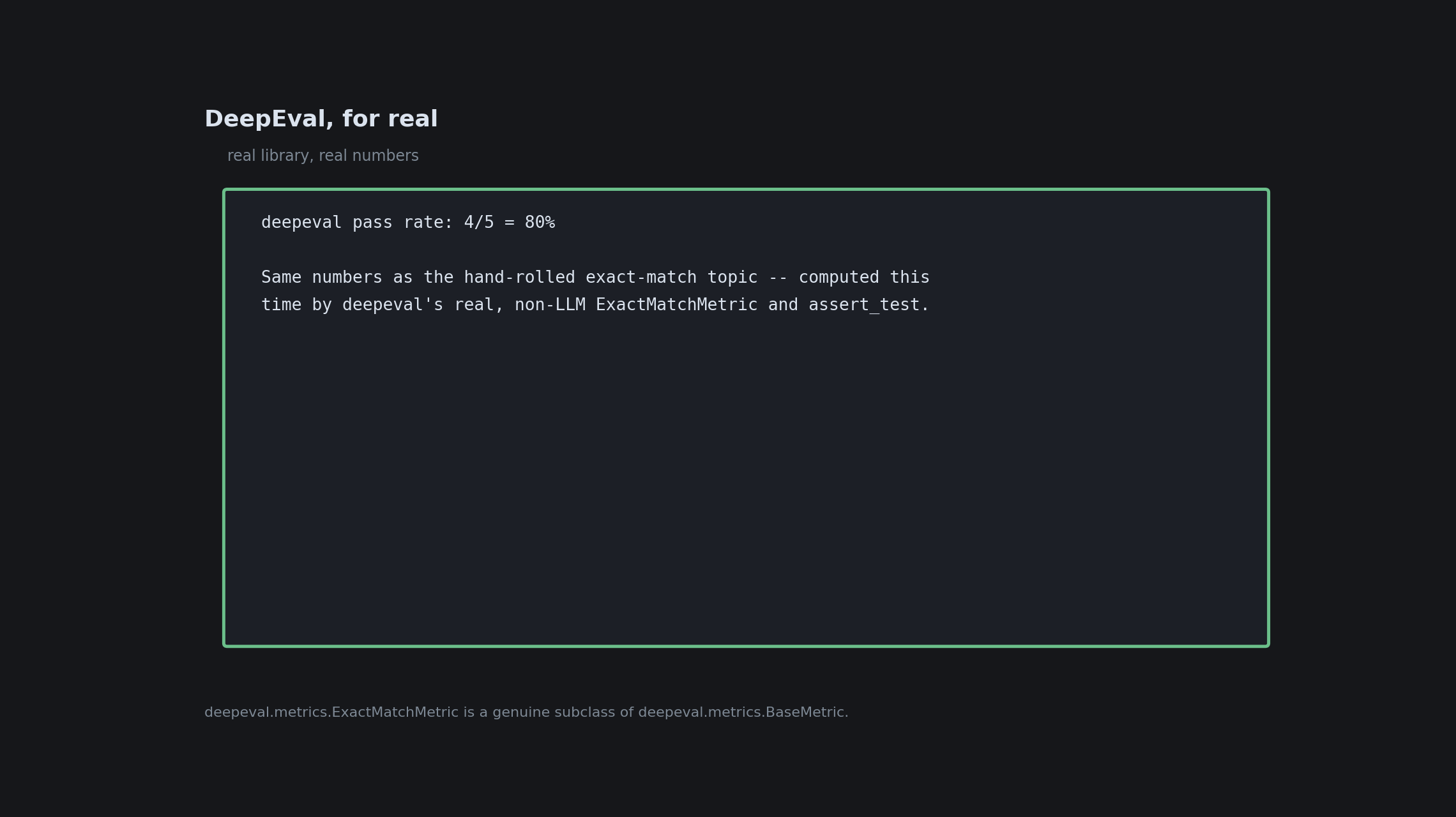
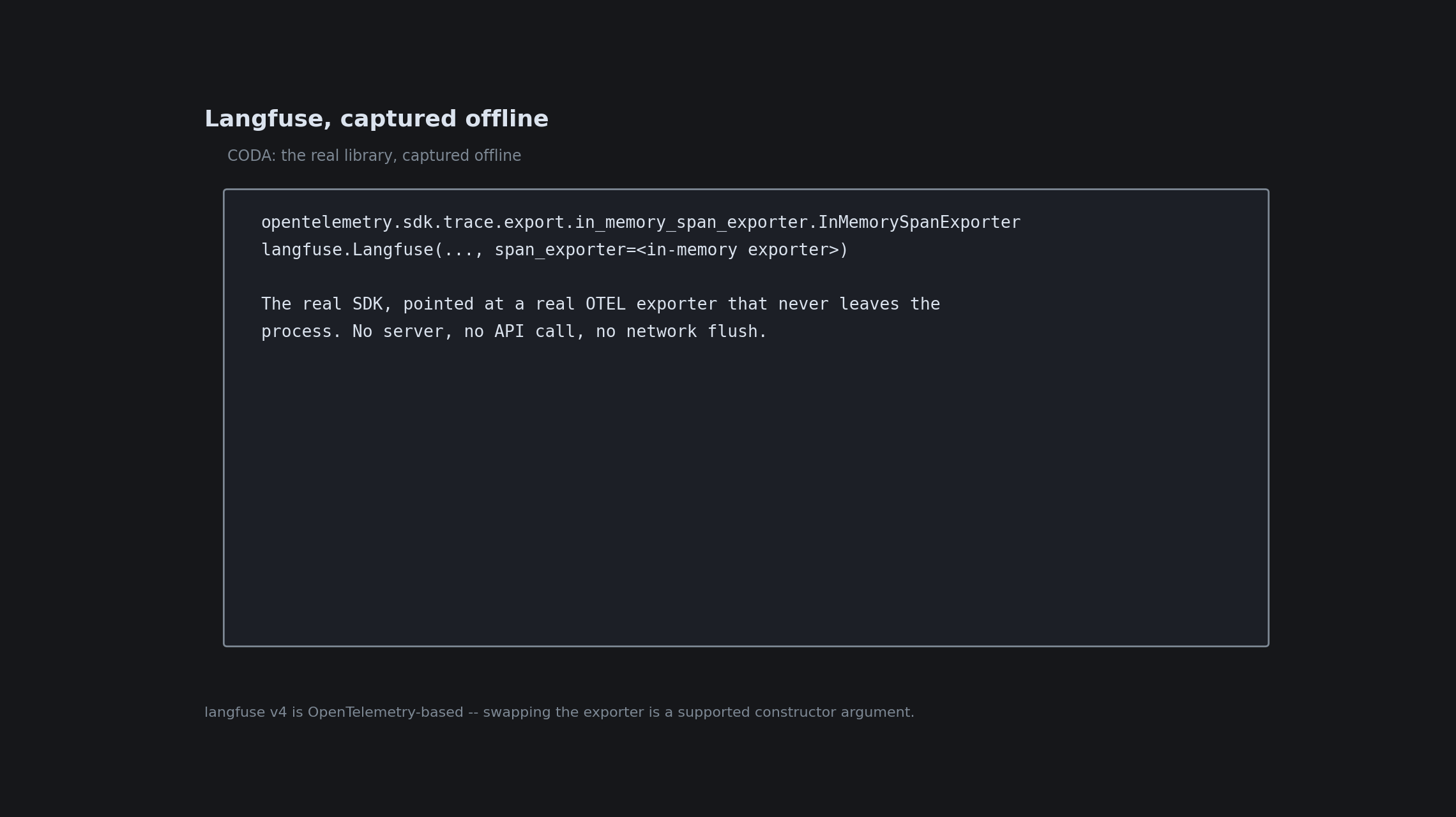
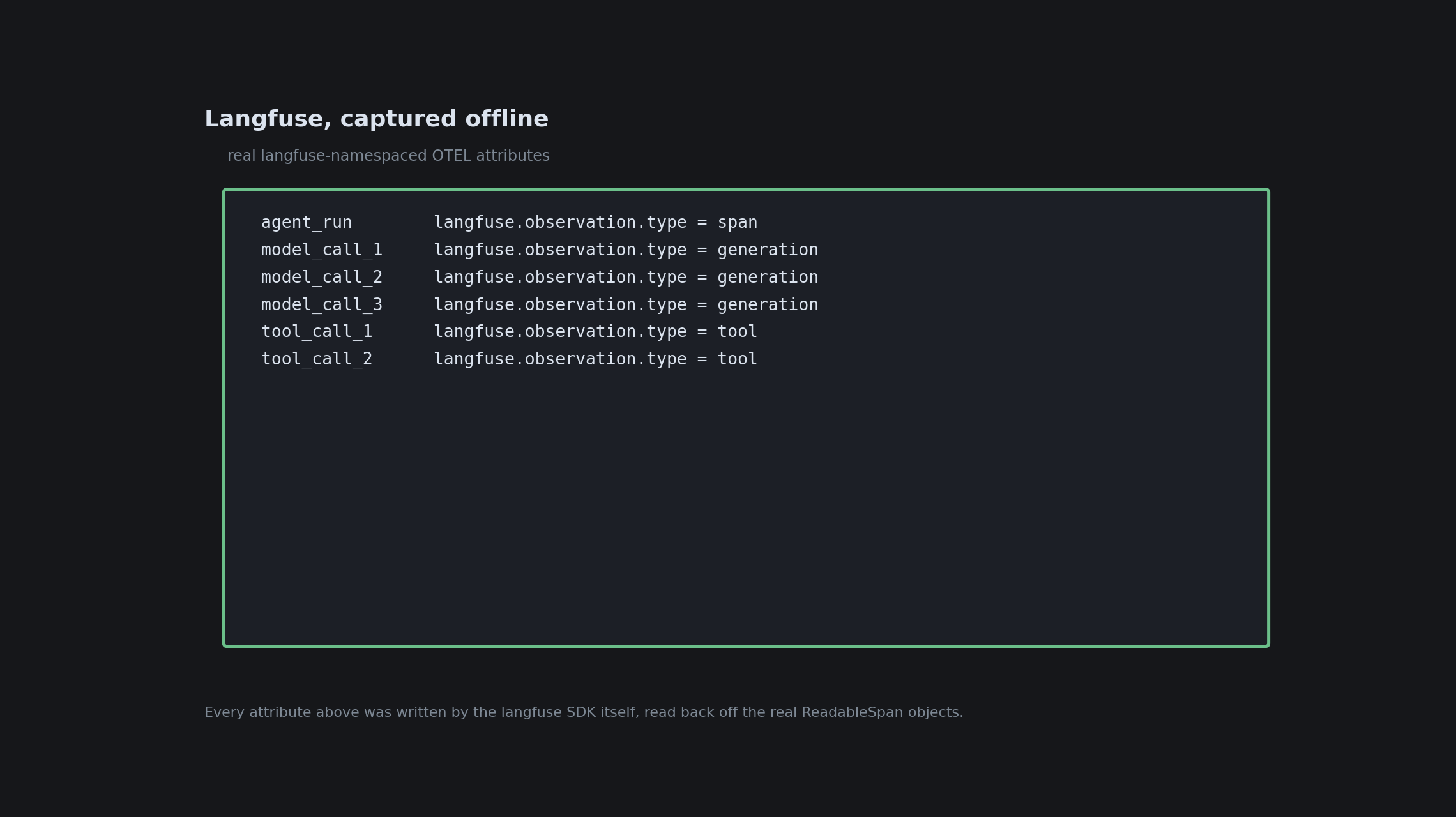
Three widely used libraries, run for real and deterministically: DeepEval’s own metric objects, Ragas’s own non-LLM metrics, and the Langfuse SDK’s own span emission, captured offline with an in-memory OpenTelemetry exporter.
A real library’s own objects and formulas can run deterministically without ever calling a hosted LLM, the point of Part 3 is the code path, not the difficulty of the metric.
DeepEval docs · Ragas docs · Langfuse v4 (OpenTelemetry-based) docs
Guides Anthropic, Demystifying evals for AI agents · OpenAI, A practical guide to building agents · Anthropic, Building effective agents
Libraries DeepEval docs · Ragas docs · Langfuse docs
Siblings How Git Works, Visually · How RAG Works, Visually · How Inference & Serving Work, Visually · How Agentic Harnesses Work, Visually · How LangChain & LangGraph Work, Visually
Every figure in this deck: a real run of langchain 1.3 / langgraph 1.2 / deepeval / ragas / langfuse at Beanline Coffee, regenerable with build/regen_all.py · versions pinned in build/requirements.txt