How RAG Works, Visually
The mental model behind chunks, retrieval, and grounded answers
The problem, and the fix
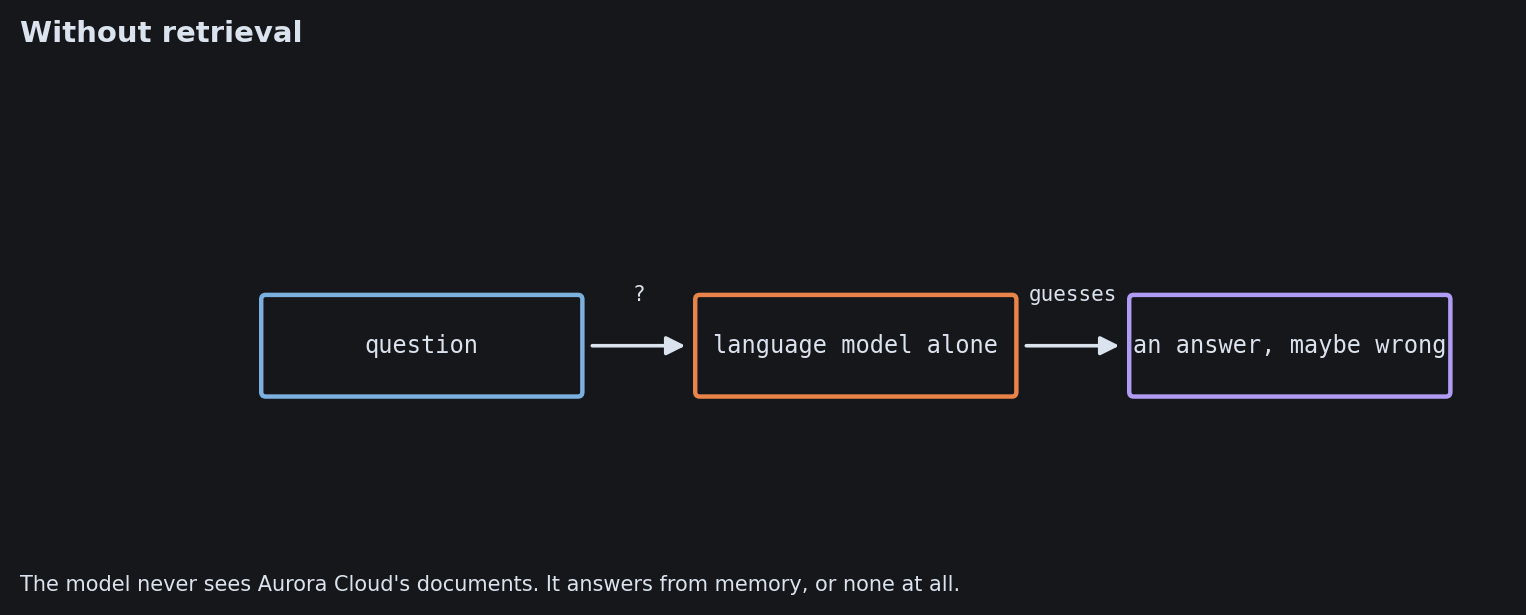
Ask a plain language model a question about documents it has never seen, and it will still answer. Confidently, and often wrong.
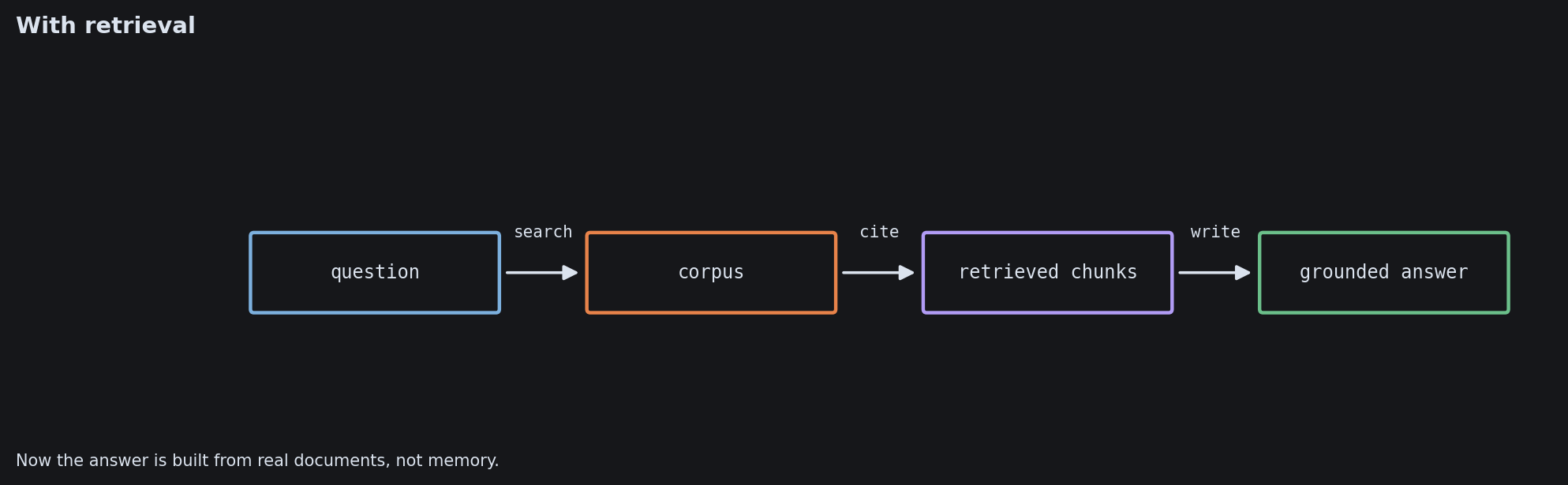
Retrieval-augmented generation is the fix: look the answer up before writing it.
Ask it something it has never seen
A plain model has no way to check itself against real documents. It fills the gap with whatever is most probable, not what is true.
Same question, three different answers, and no way to tell which one is real.
Meet Aurora Cloud
Aurora Cloud is the fictional company behind every example in this deck: 48 documents across four topics.
What retrieval changes
Retrieval-augmented generation adds one step in front of writing: look before you answer.
The answer is no longer memory. It is a copy of what the corpus actually says.
The rule: cite or refuse
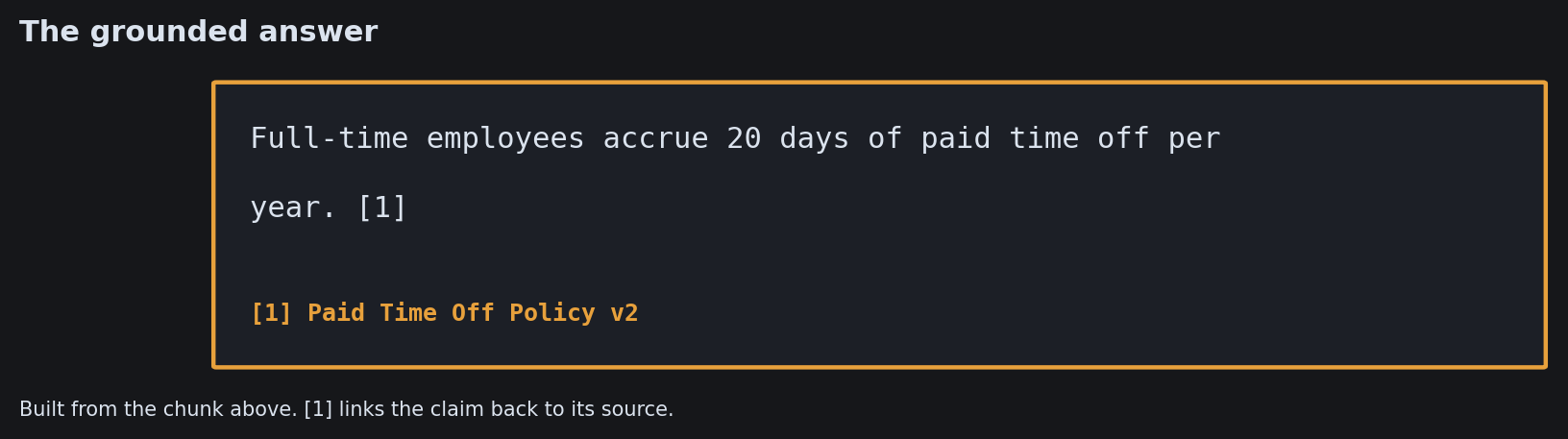
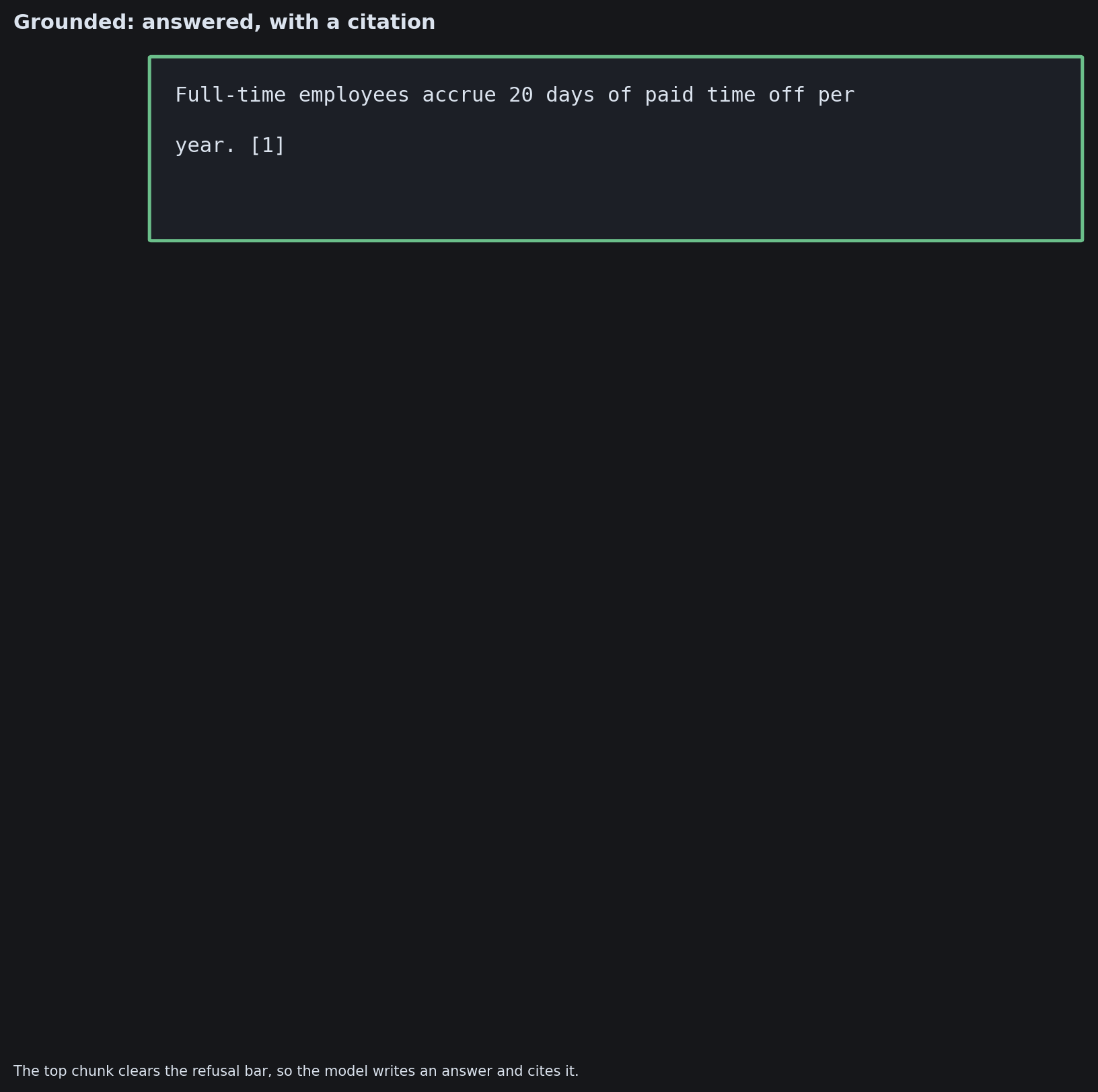
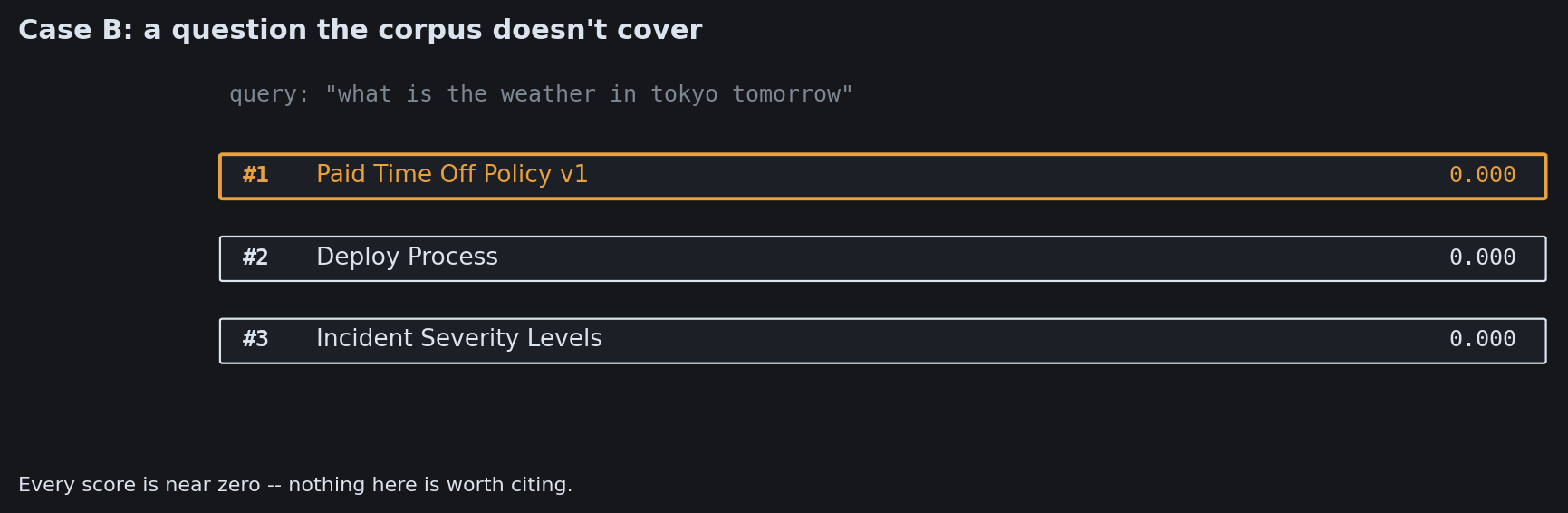
Grounding is a contract, not a suggestion. A covered question gets a citation. An uncovered one gets a decline, never a guess.
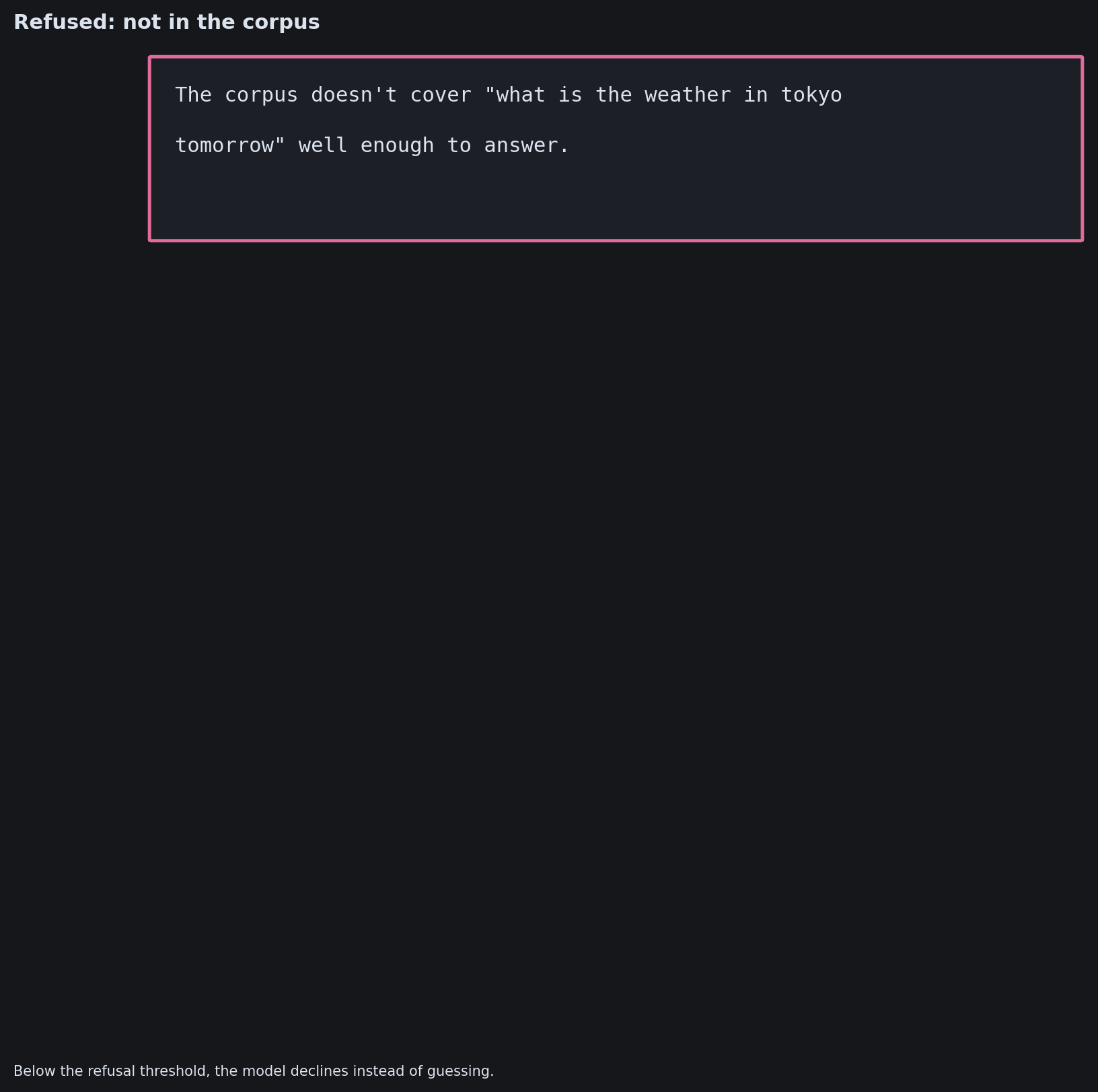
A refusal is a correct answer too, when the corpus genuinely doesn’t cover it.
Cite-or-refuse, the contract behind every answer this deck builds toward: a claim traces to a retrieved chunk and names it with [n], or the system declines instead of guessing.
Retrieval turns a prompt into evidence; generation must cite it or refuse. Every concept from here on is one piece of making that contract real.
The Problem, and the Fix
The Problem, and the Fix
The Problem, and the Fix
The Problem, and the Fix
The Problem, and the Fix
Two clocks, one system
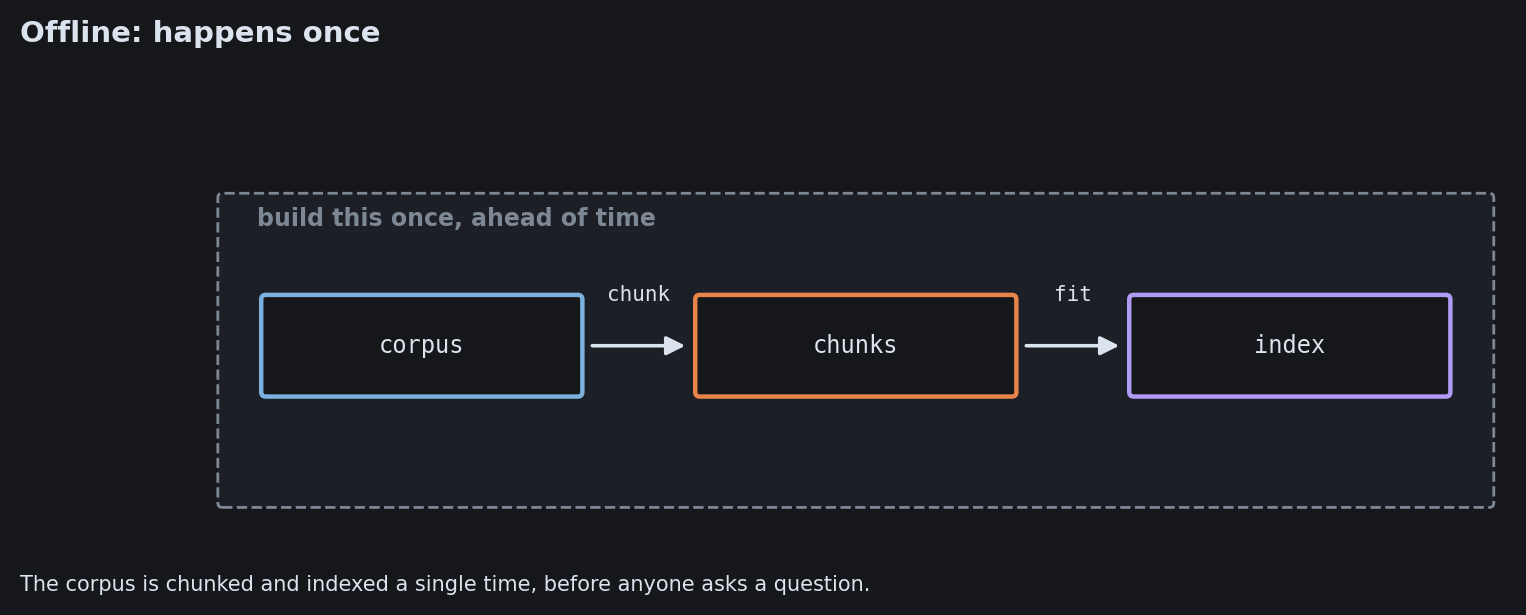
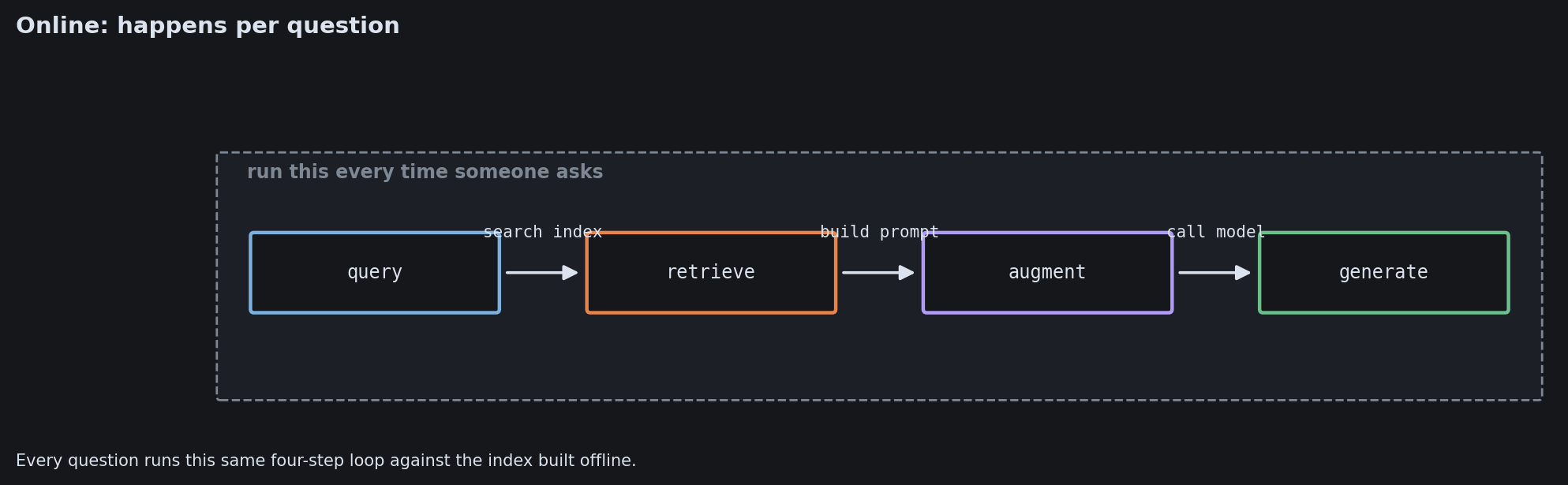
Building the index and answering a question are two different jobs, on two different clocks.
One runs once, ahead of time. The other runs every time someone types a question.
Two different jobs, two different clocks: the offline build (chunk, embed, index) happens once; the online loop (retrieve, augment, generate) reruns for every question.
The corpus becomes a frozen index
The raw documents get chunked and turned into vectors a single time. After that, the index just sits there, ready to be searched.
Every question walks the same four steps
A question comes in, gets turned into a search, and the results get folded into a prompt before the model ever runs.
Same shape, very different rhythm
Put both loops side by side and the contrast is the whole point: one column runs once, the other runs again for every question that comes in.
This is the whole map
Everything from here on zooms into one box from this picture: how retrieval actually scores a match, how the prompt gets assembled, how the model is kept from making things up.
The whole pipeline, five stages
ingest
raw documents: HR, product, engineering, off-topic
index
chunk, embed, and fit the vectors into one structure
retrieve
score every chunk against the query, keep the top-k
rerank
score just those candidates again, more carefully
generate
cite the evidence, or refuse
The Naive RAG Loop
The Naive RAG Loop
The Naive RAG Loop
The Naive RAG Loop
The Naive RAG Loop
One document holds many facts
A document mixes several separate facts into one block of text. A question only needs one of them back, not the whole page.
Chunk, the unit retrieval actually indexes and hands back: one self-contained slice of a document, small enough that a question only pulls the fact it needs.
Equal, non-overlapping cuts can break an idea
A window of fixed size slides across the words. The simplest version just cuts, edge to edge, with nothing shared.
A fact that straddles a chunk boundary survives whole in neither chunk. Fixed-size, non-overlapping cuts guarantee this happens somewhere in a large corpus, overlap (the next slide) is the guard.
Overlap keeps the idea whole
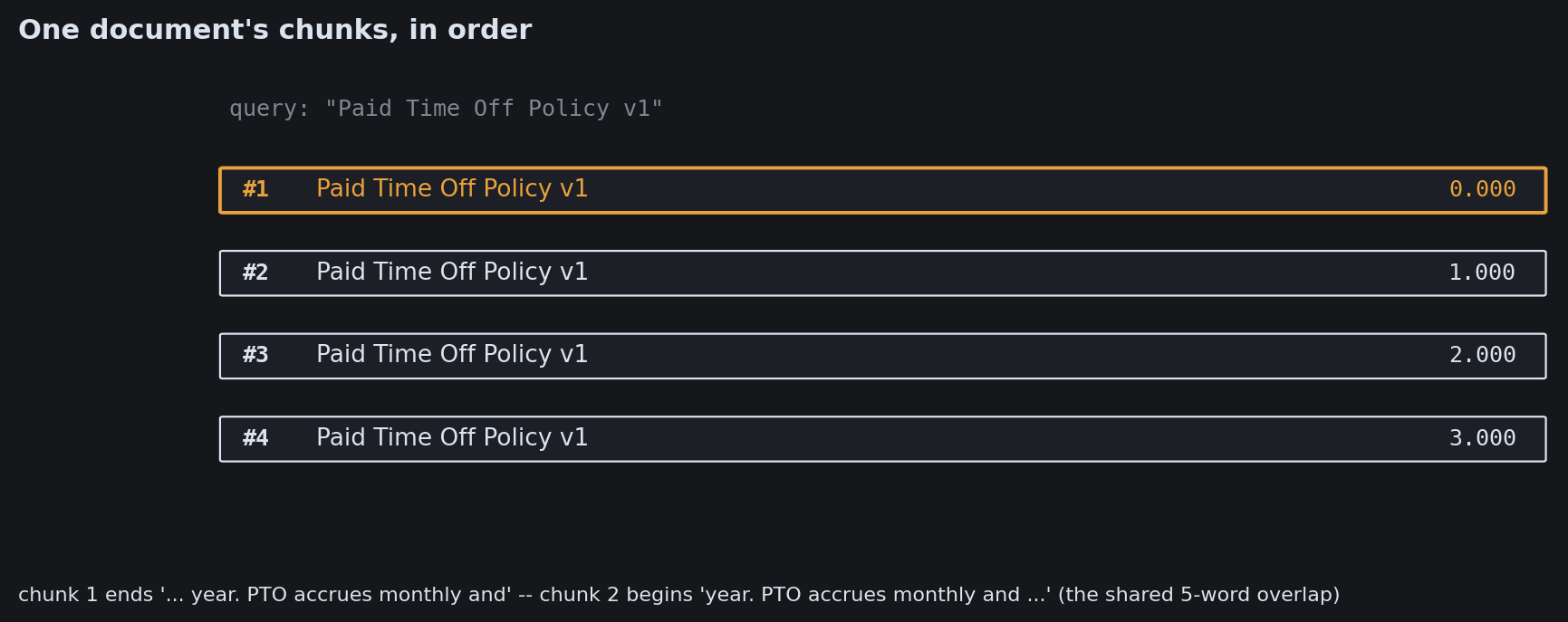
Shift the window by less than its full size, and consecutive chunks share a few words at the seam.
Size is a tradeoff
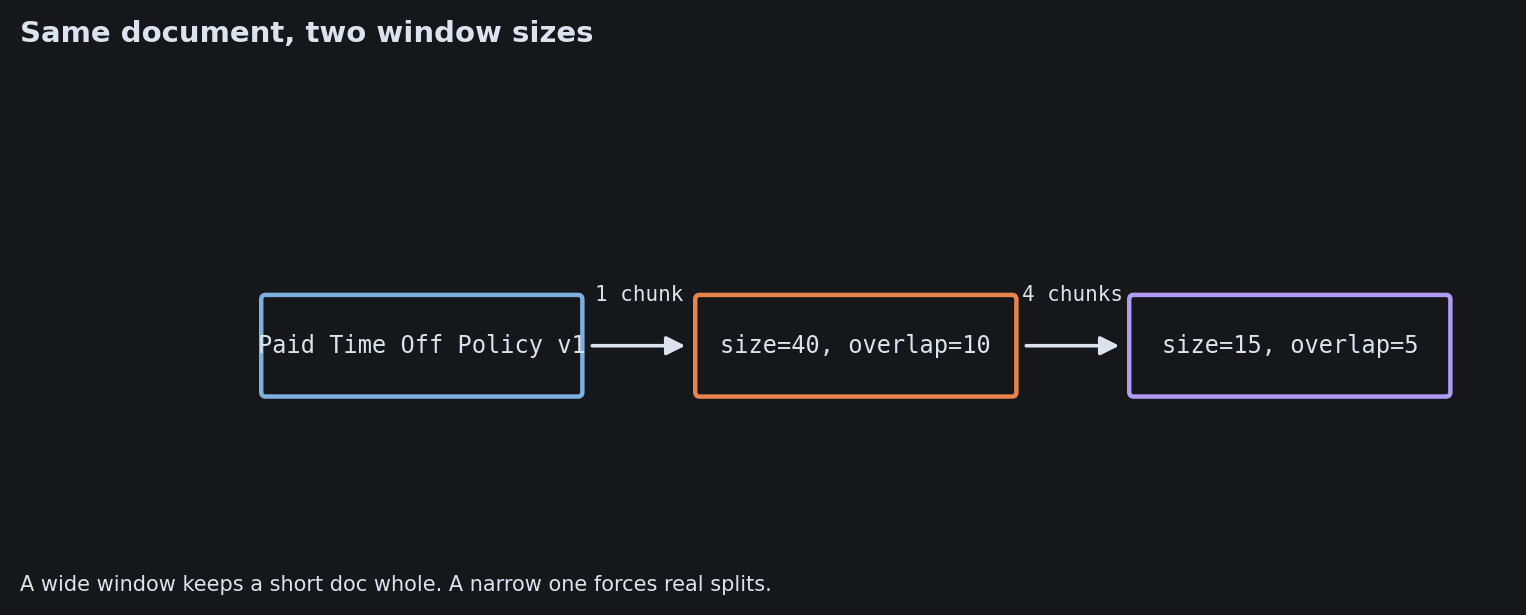
A bigger window swallows unrelated ideas into one chunk. A smaller window slices a single idea into fragments that lose their surrounding context.
Most of Aurora Cloud’s documents need no splitting at all
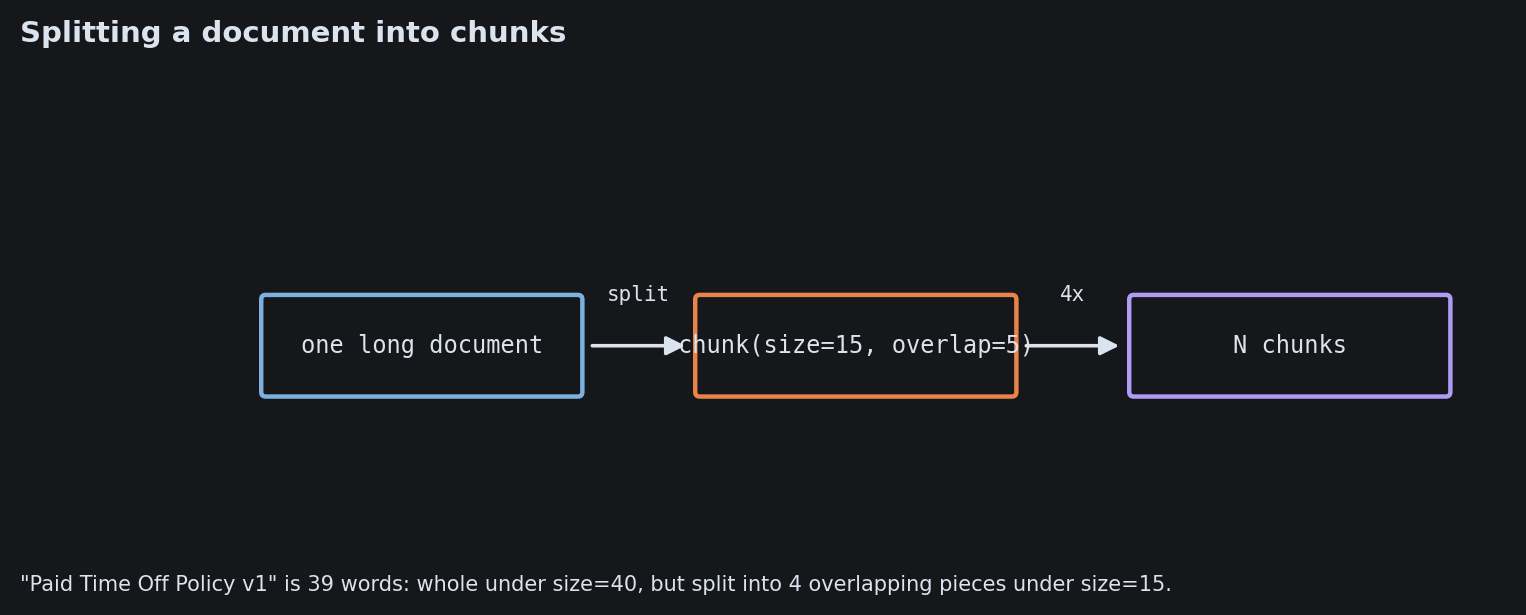
Under the window this pipeline actually uses, nearly every one of the 48 documents collapses to a single chunk. Shrink the window, and one of them finally splits for real.
Chunk size is a tradeoff, not a default: too big dilutes a chunk across unrelated facts, too small shatters one fact into pieces with no context. Overlap fixes the second failure, not the first.
Chunking the Corpus
Chunking the Corpus
Chunking the Corpus
Chunking the Corpus
Embeddings are geometry
A chunk of text turns into a list of numbers. That list is a location - somewhere you could point to on a map.
Once meaning has a location, comparing meanings becomes measuring distance.
Embedding, the list of numbers a chunk (or a query) turns into: a location in a shared space where distance stands in for how related two pieces of text are.
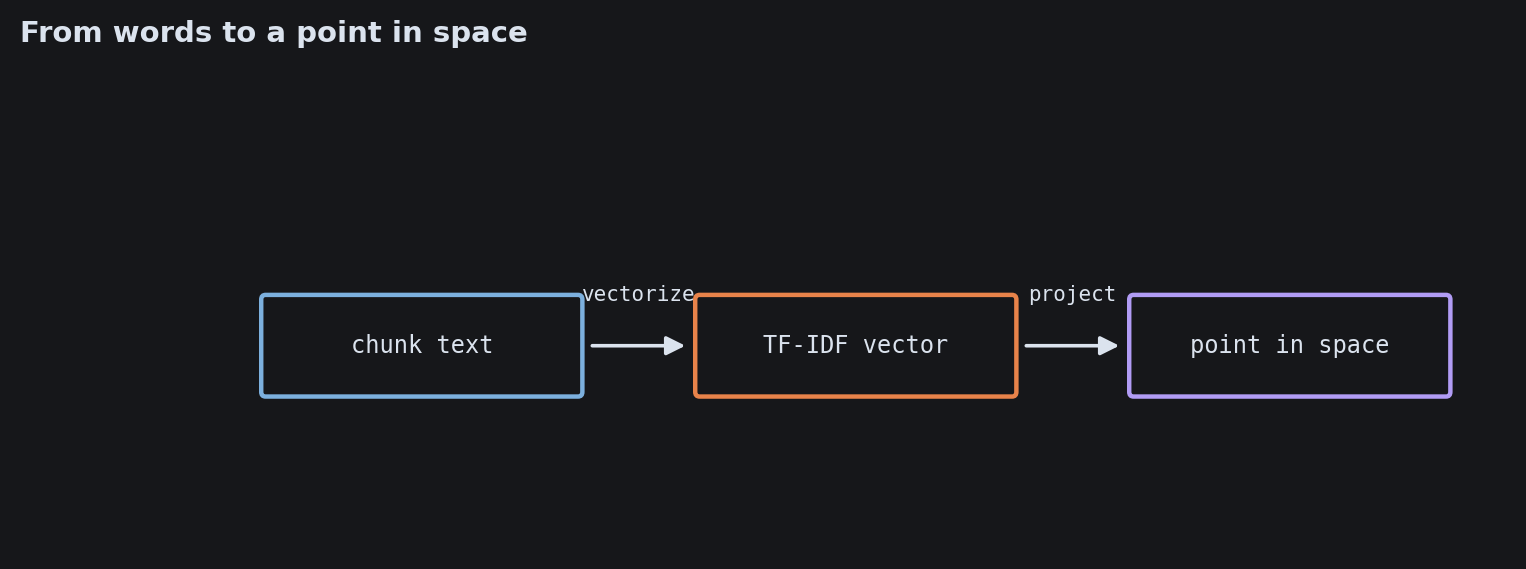
A chunk becomes a point in space
Hundreds of numbers, two you can draw
Related chunks land close together
Search by meaning is search by distance
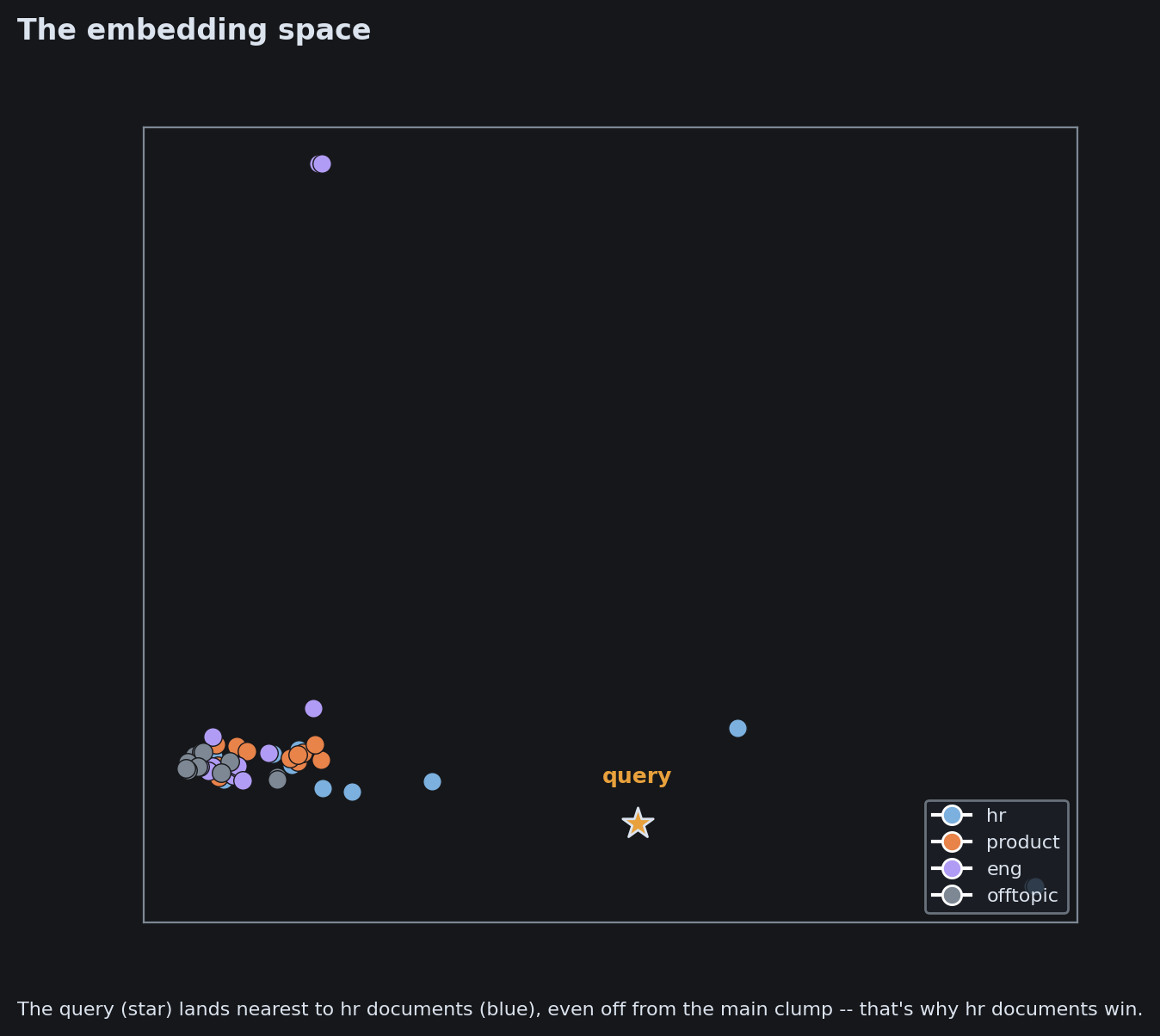
The query gets vectorized exactly like every chunk, then dropped onto the same map. Whichever dot it lands nearest is the answer.
The next screens are the real thing
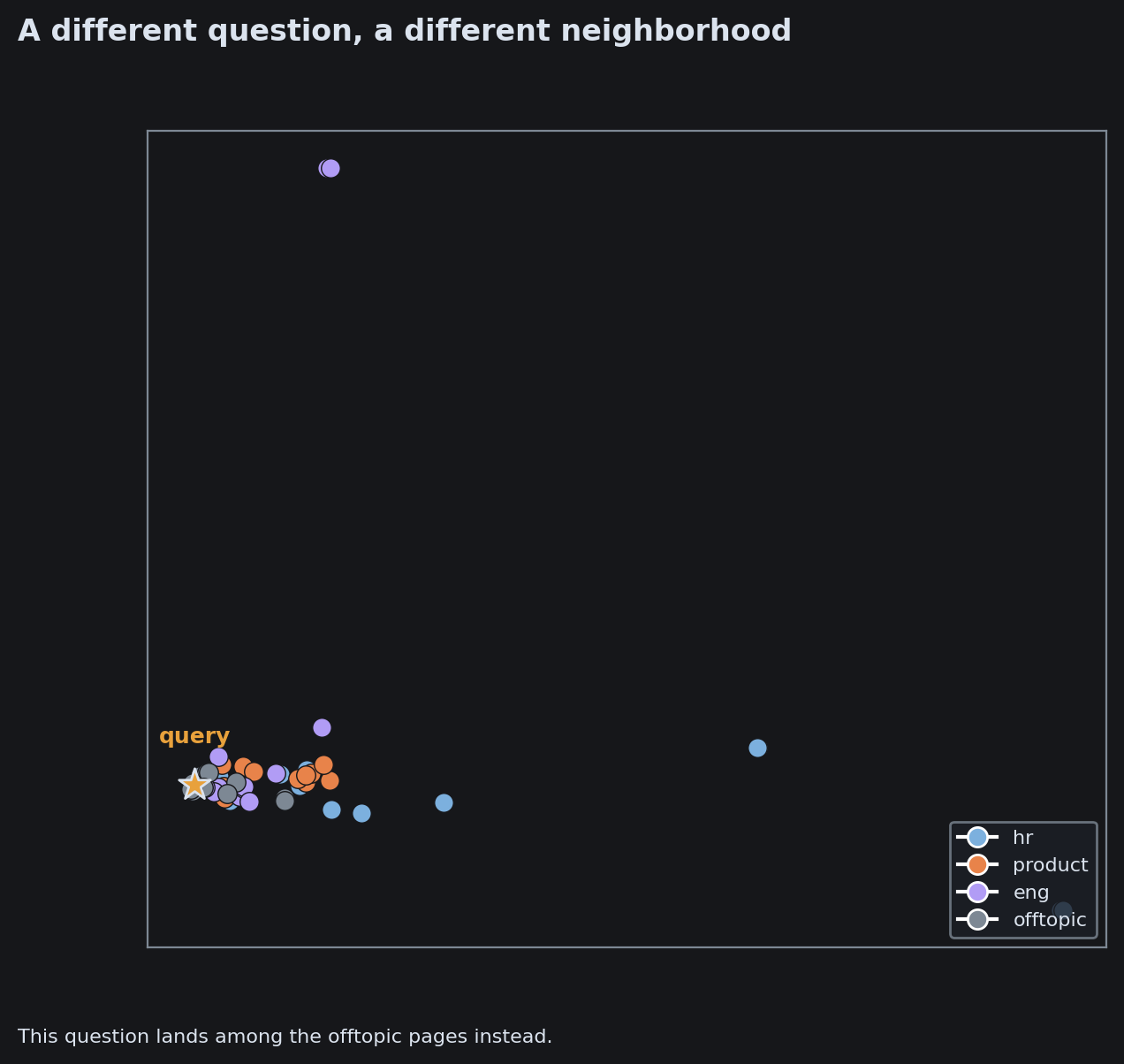
Not a mockup: the real 48-document Aurora Cloud corpus, chunked and turned into real TF-IDF vectors, projected to 2 axes. Each dot is a real chunk, colored by its document’s tag. The star is a real query, placed by the same vectorizer, at its real projected position.
Once meaning has a location, “search by meaning” has a precise mechanical definition: nearest-neighbor distance on that map. Retrieval is exactly this, run at real scale.
Embeddings Are Geometry
Embeddings Are Geometry
Embeddings Are Geometry
Embeddings Are Geometry
Building the Index
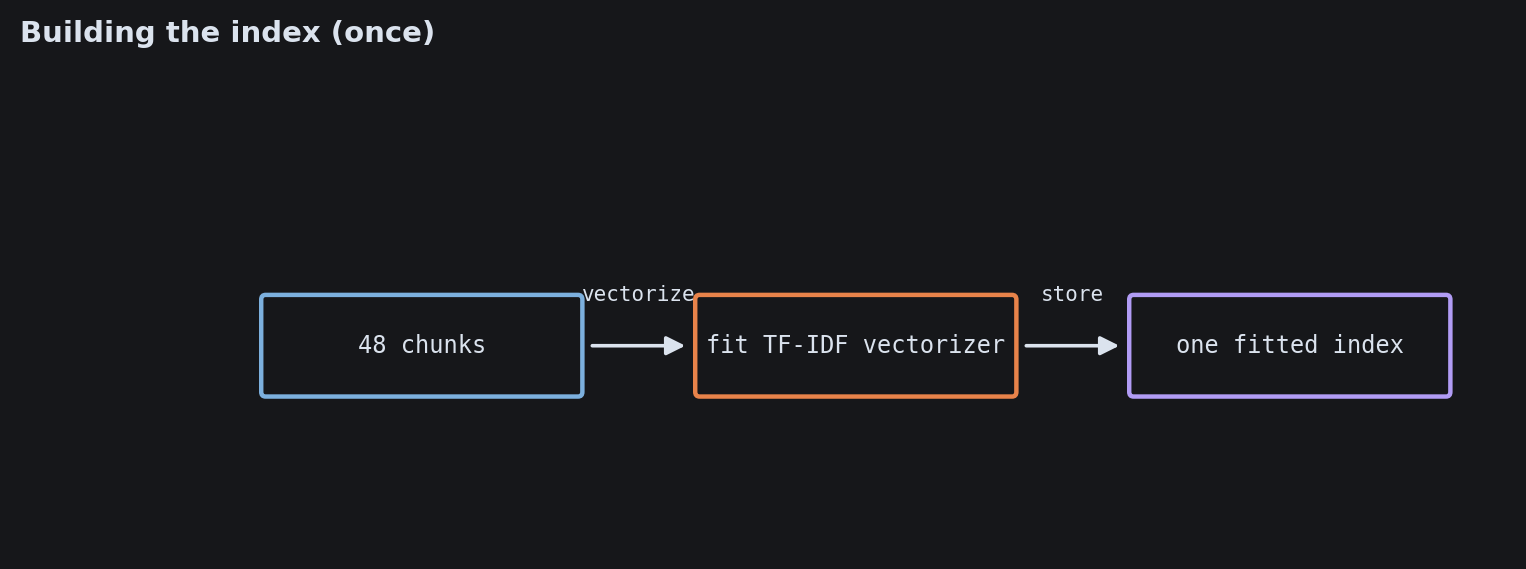
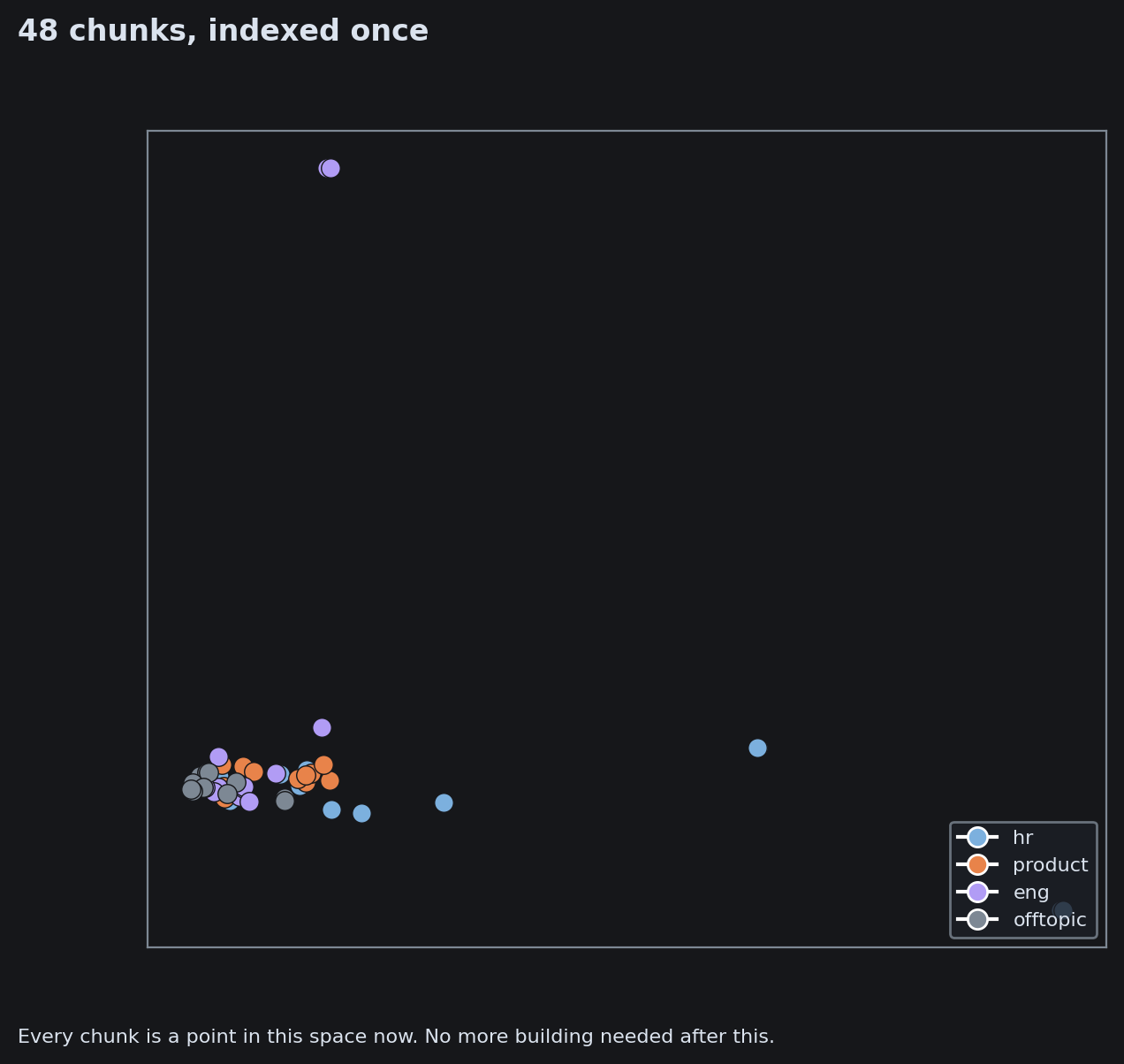
Every chunk now has a vector. Those vectors don’t sit around loose - they get packed together into one structure: the index. Building it happens once. Answering a question against it never does.
Vector index, every chunk’s embedding stored together in one fitted structure. Built once from the whole corpus; every later question is a read against it, never a rebuild.
Vectors get stored together
48 separate vectors. One structure holds all of them.
Fit once, then query without limit
The fit is a single event. Every search after it is free to repeat.
Many questions, one index
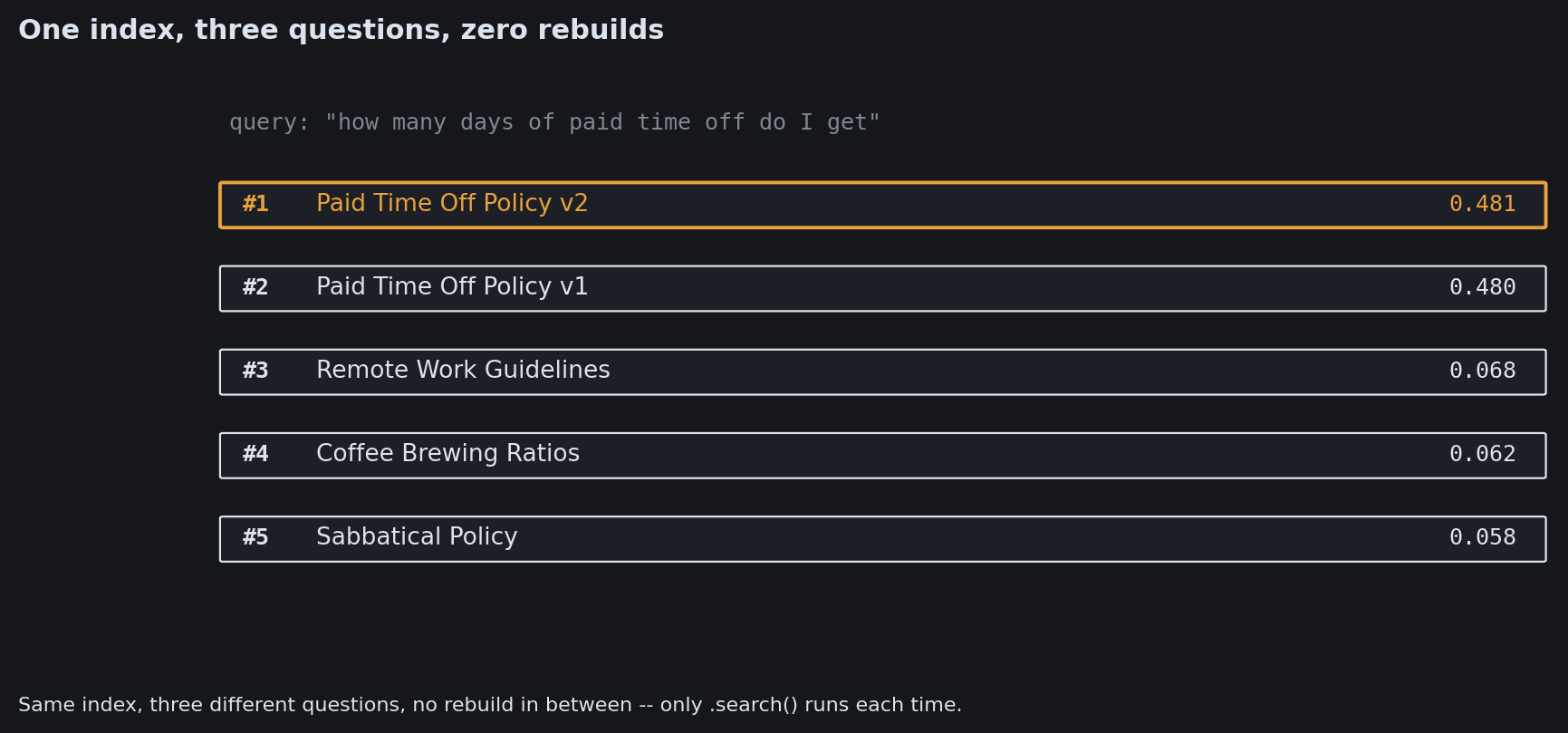
Three unrelated questions. One already-built index answers all of them.
The index never rebuilds
The wrong mental model refits per question. The right one fits once.
Fitting the index is a one-time cost; search is what recurs, and search is cheap. Treating “build the index” as a per-question step is the mistake to rule out.
Building the Index
Building the Index
Building the Index
Building the Index
Retrieval: The Nearest Points Win
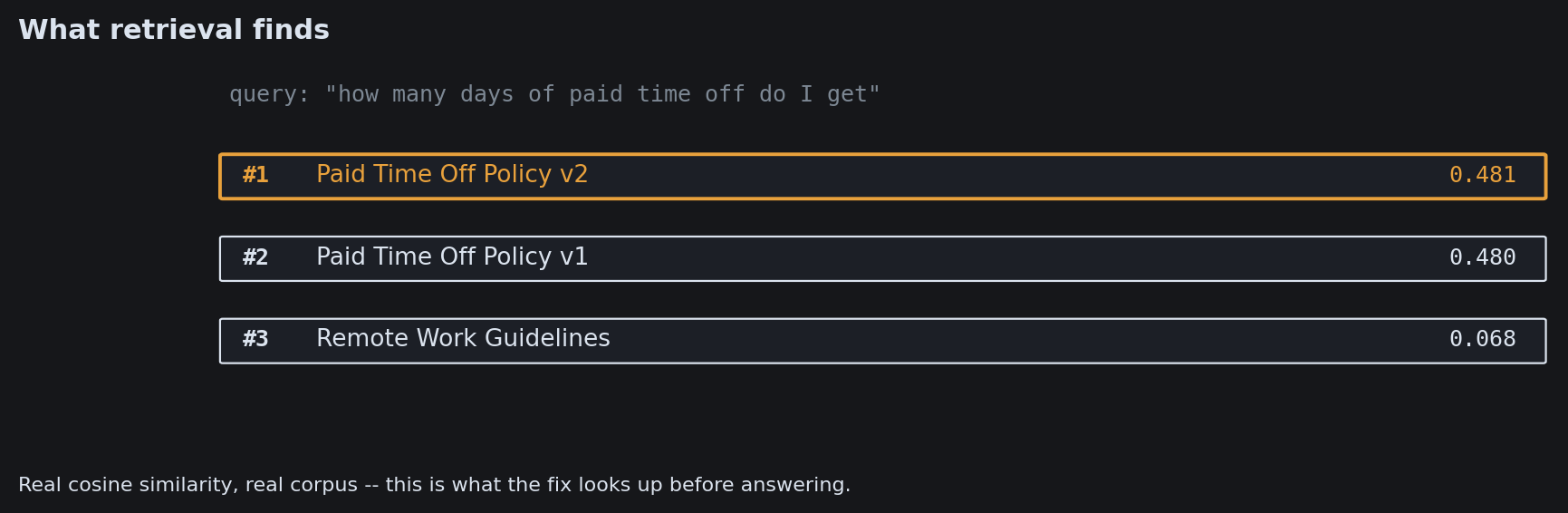
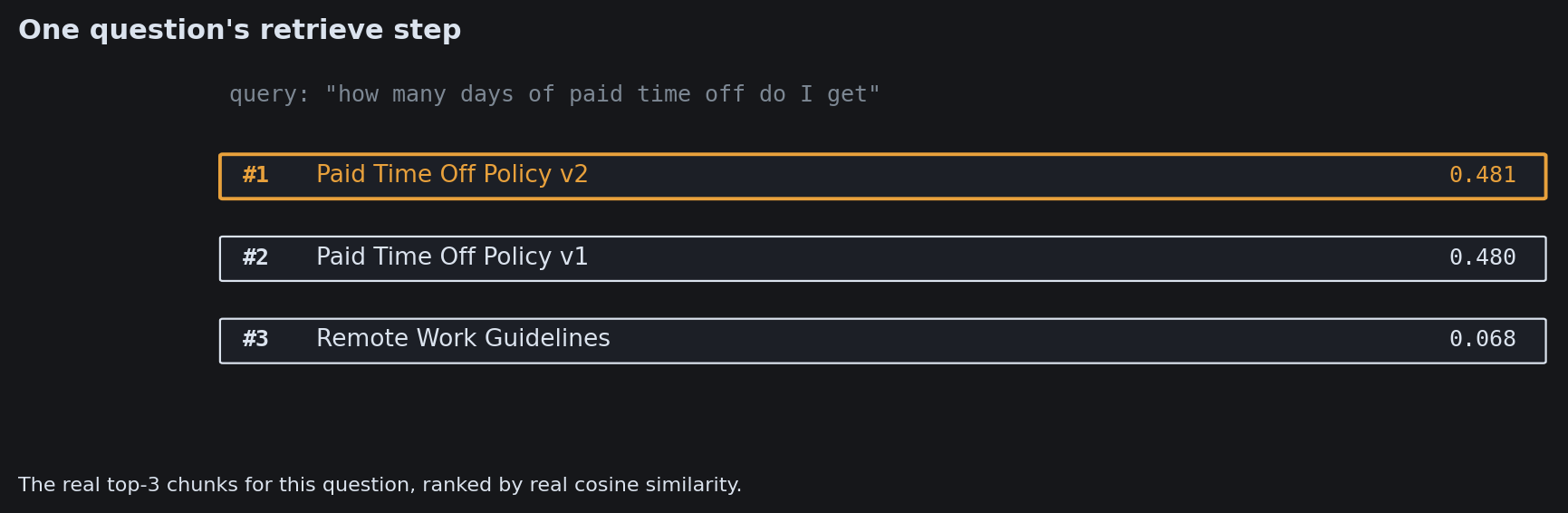
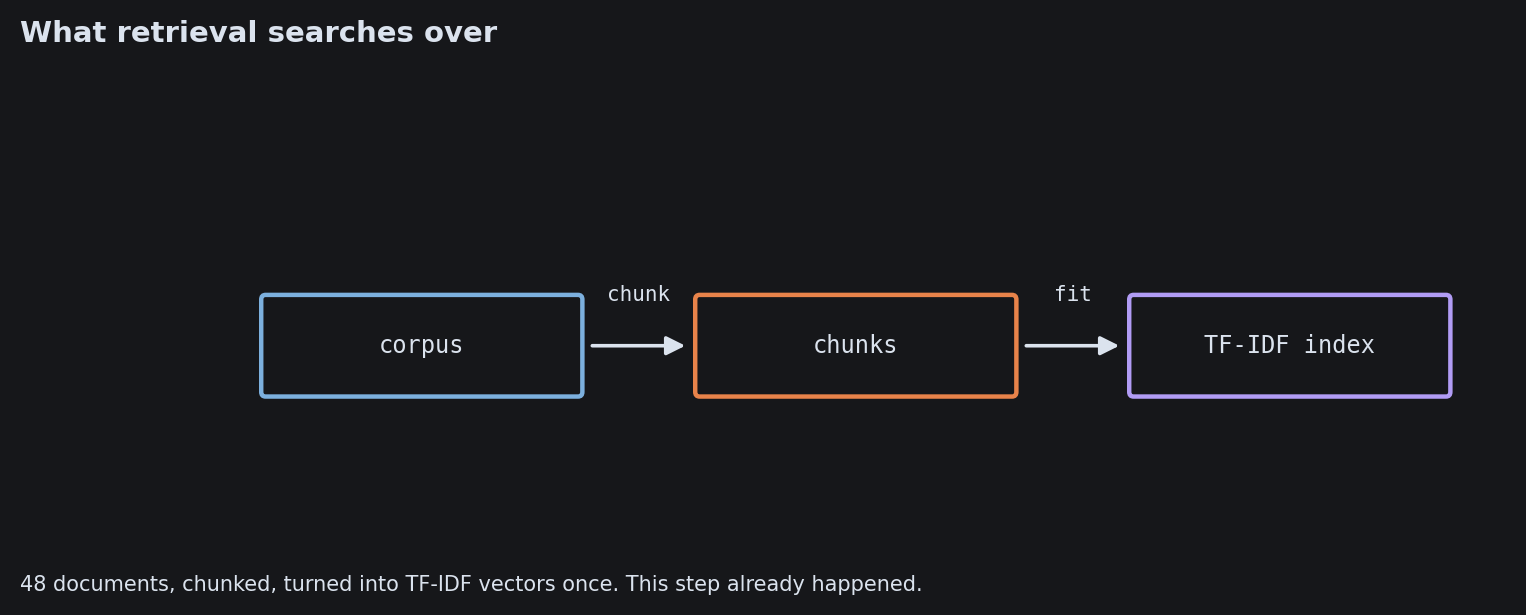
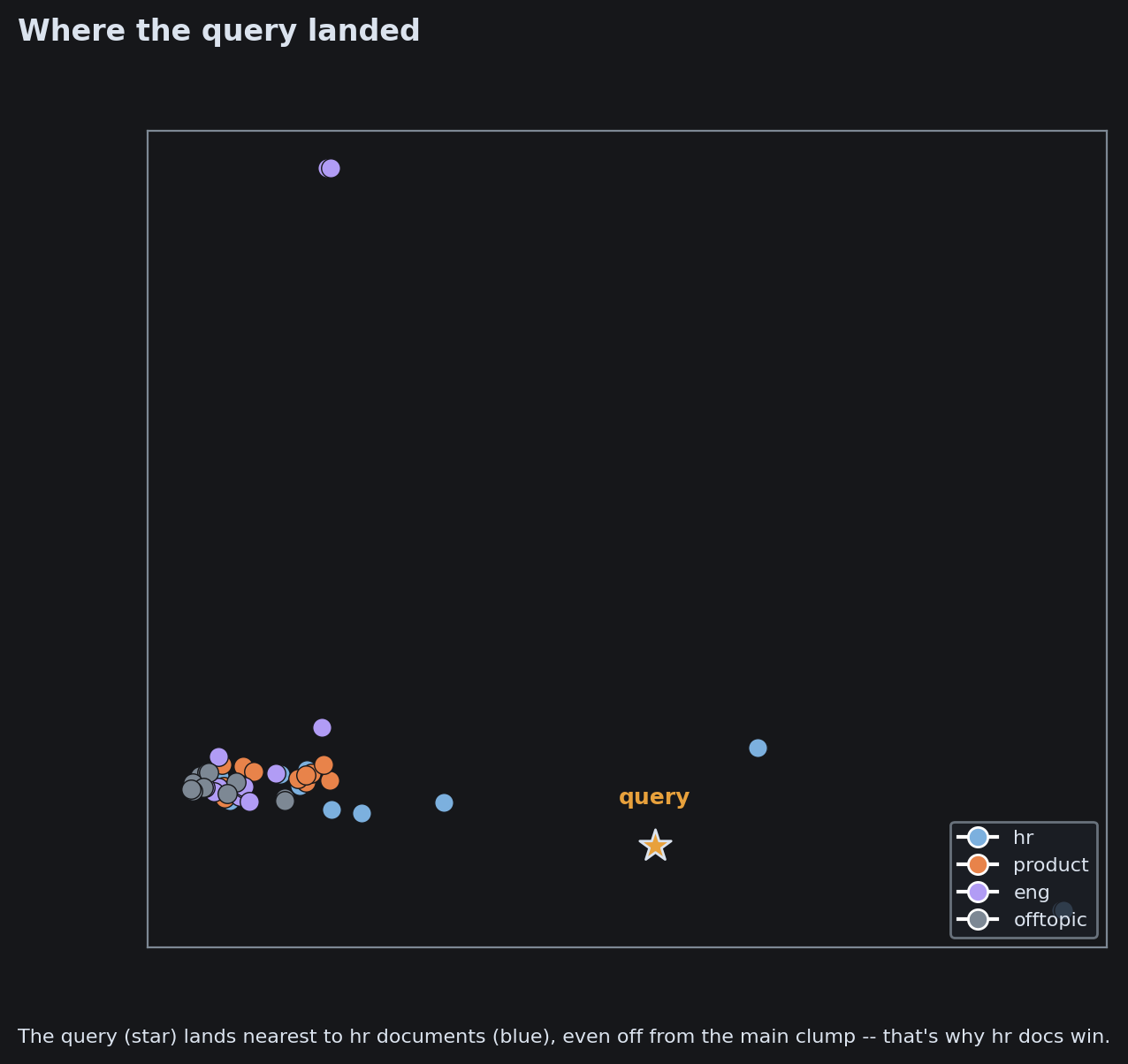
The index holds 48 points. Retrieval is the one operation that matters: drop the query onto the same map, and read off whichever points sit closest.
Nothing about retrieval is mysterious once the geometry is in place. It’s a distance calculation, run once per question.
Retrieval, scoring every chunk in the index against the query’s vector and keeping the top few. One distance calculation, run once per question, before generation ever sees the corpus.
From a question to a ranked list
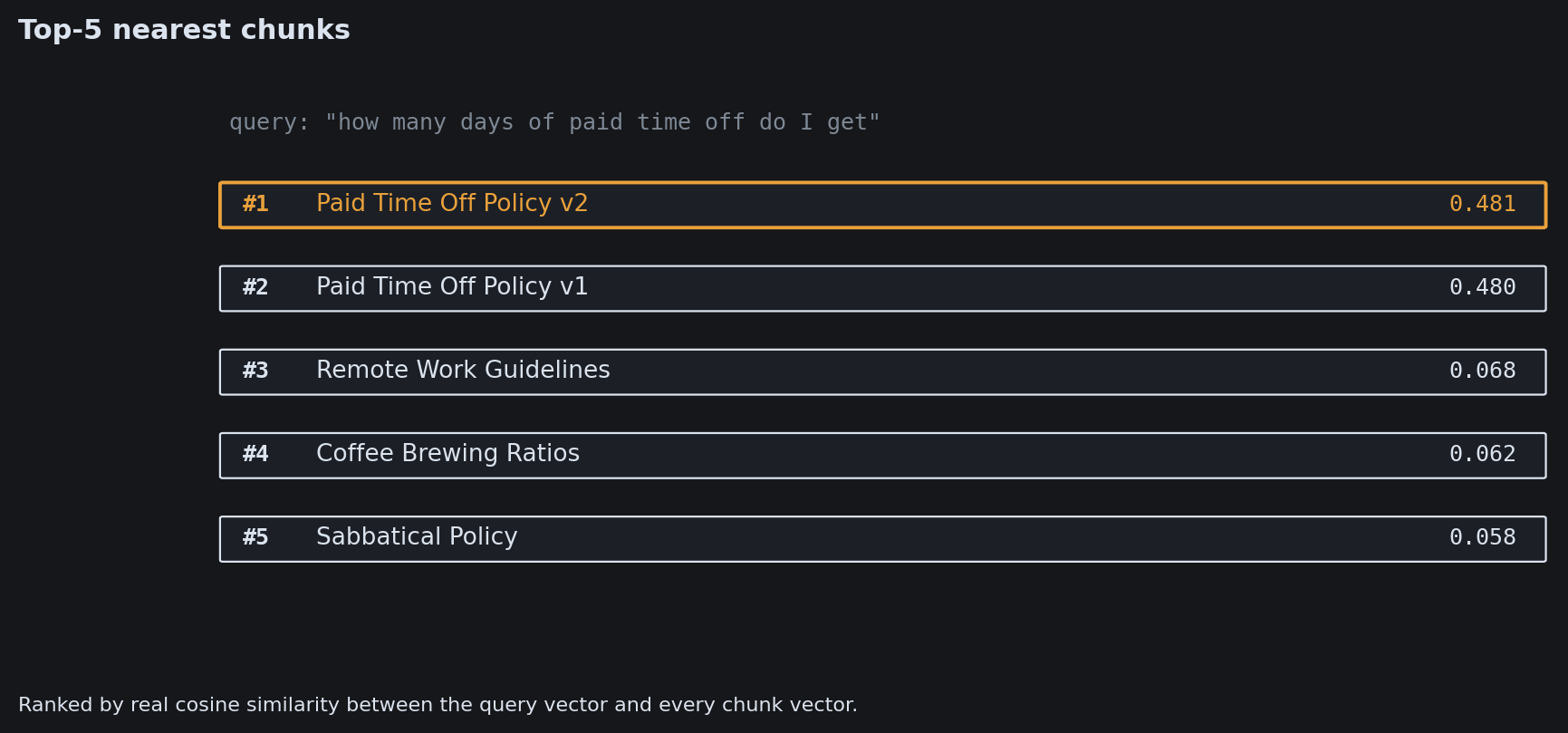
Nearest wins, and “nearest” is a number
The next screens are the real thing
Not a mockup: the real 48-document Aurora Cloud corpus, the real fitted index from the last concept, one real query run through .search(). The ranked list, the scores, and the map are all computed live.
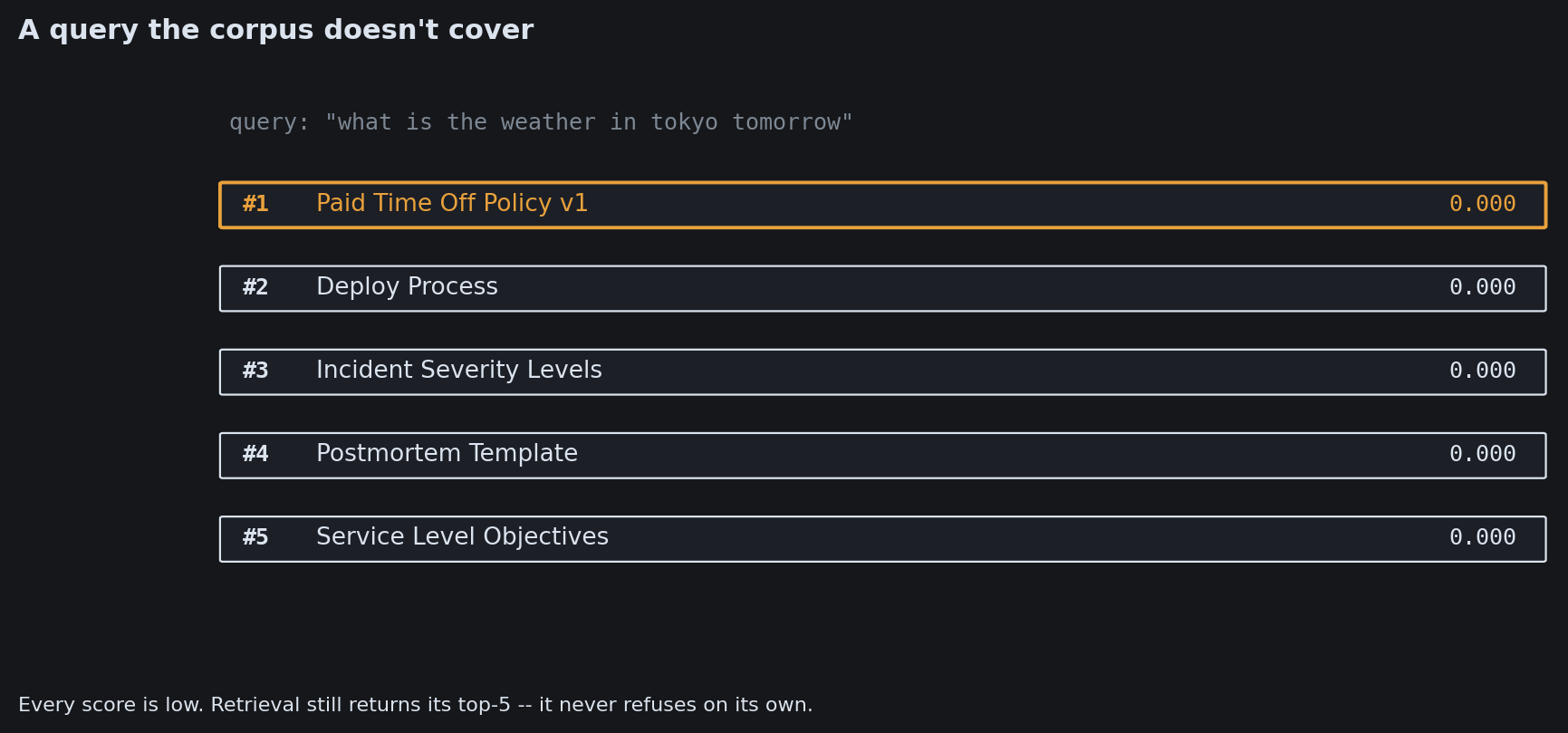
Retrieval always returns its top-k, confidently, whether the best score is 0.48 or 0.02. Deciding what a weak score means is generation’s job, not retrieval’s.
Retrieval: The Nearest Points Win
Retrieval: The Nearest Points Win
Retrieval: The Nearest Points Win
Retrieval: The Nearest Points Win
Retrieval: The Nearest Points Win
One ranking isn’t enough
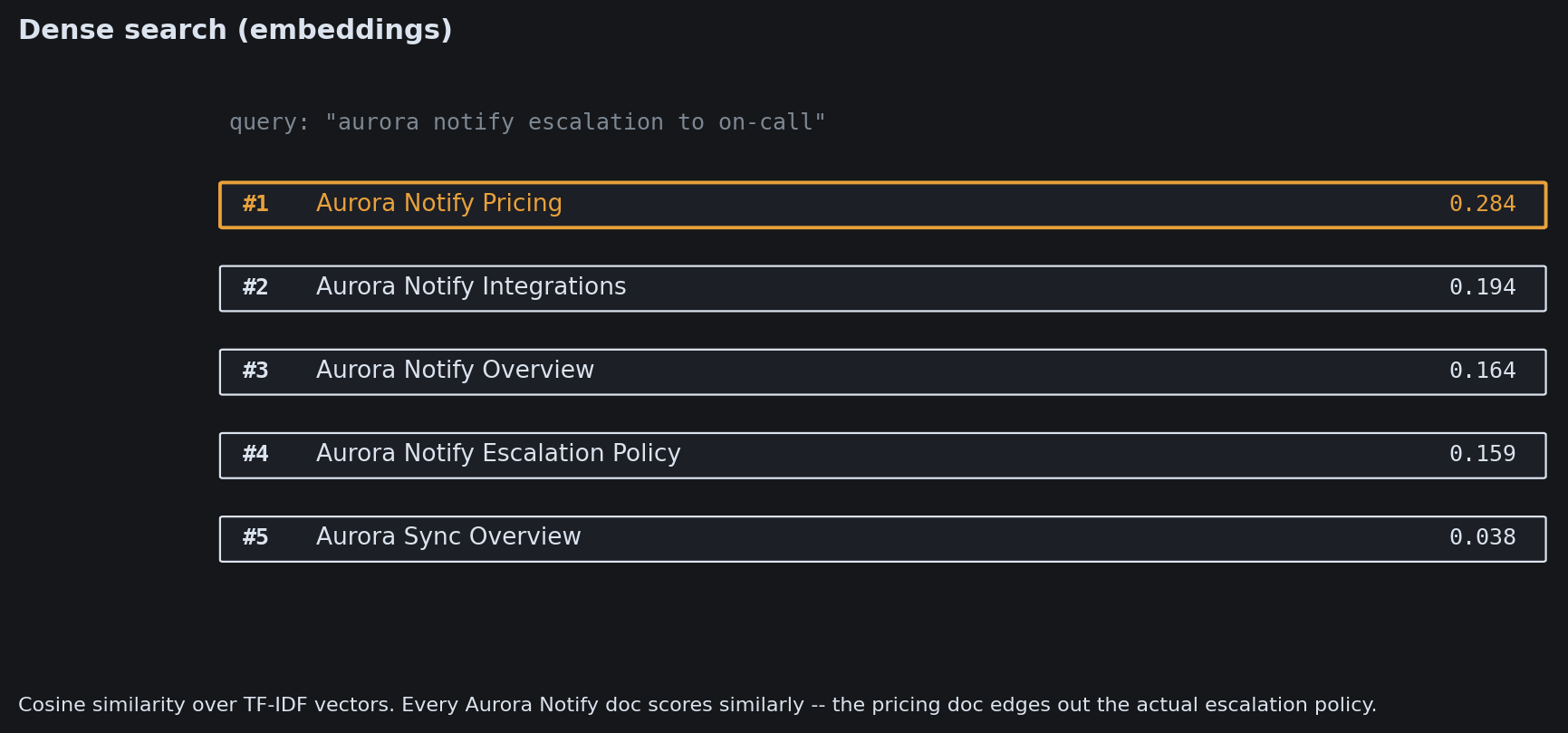
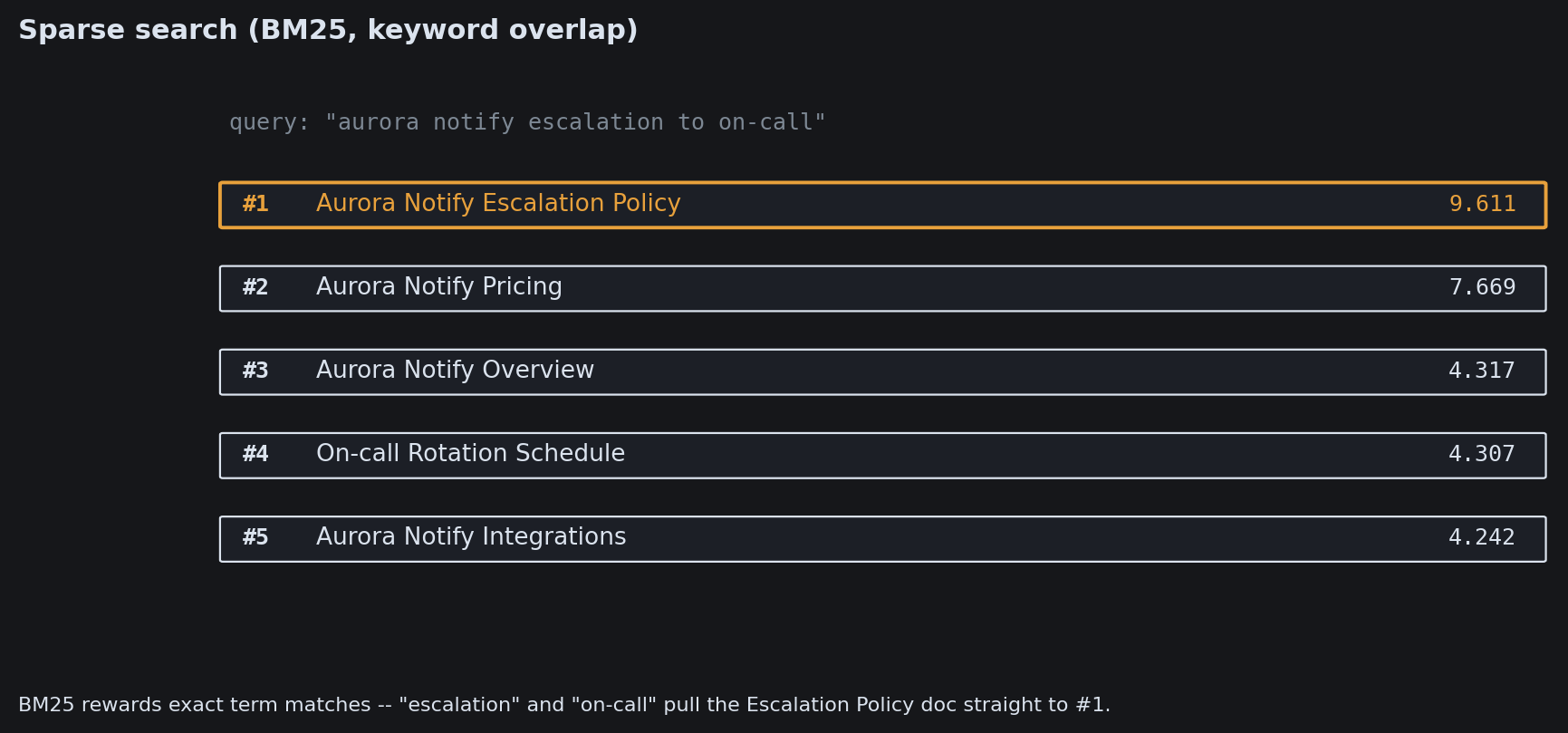
Dense search ranks by meaning. Sparse search ranks by exact words. Run the same query through both and they don’t agree - fusing the two beats trusting either alone.
Three notions of “relevant”
lexical
BM25 / TF-IDF, rewards exact term overlap, blind to paraphrase
semantic
dense cosine similarity, rewards topical closeness, blind to rare exact terms
hybrid
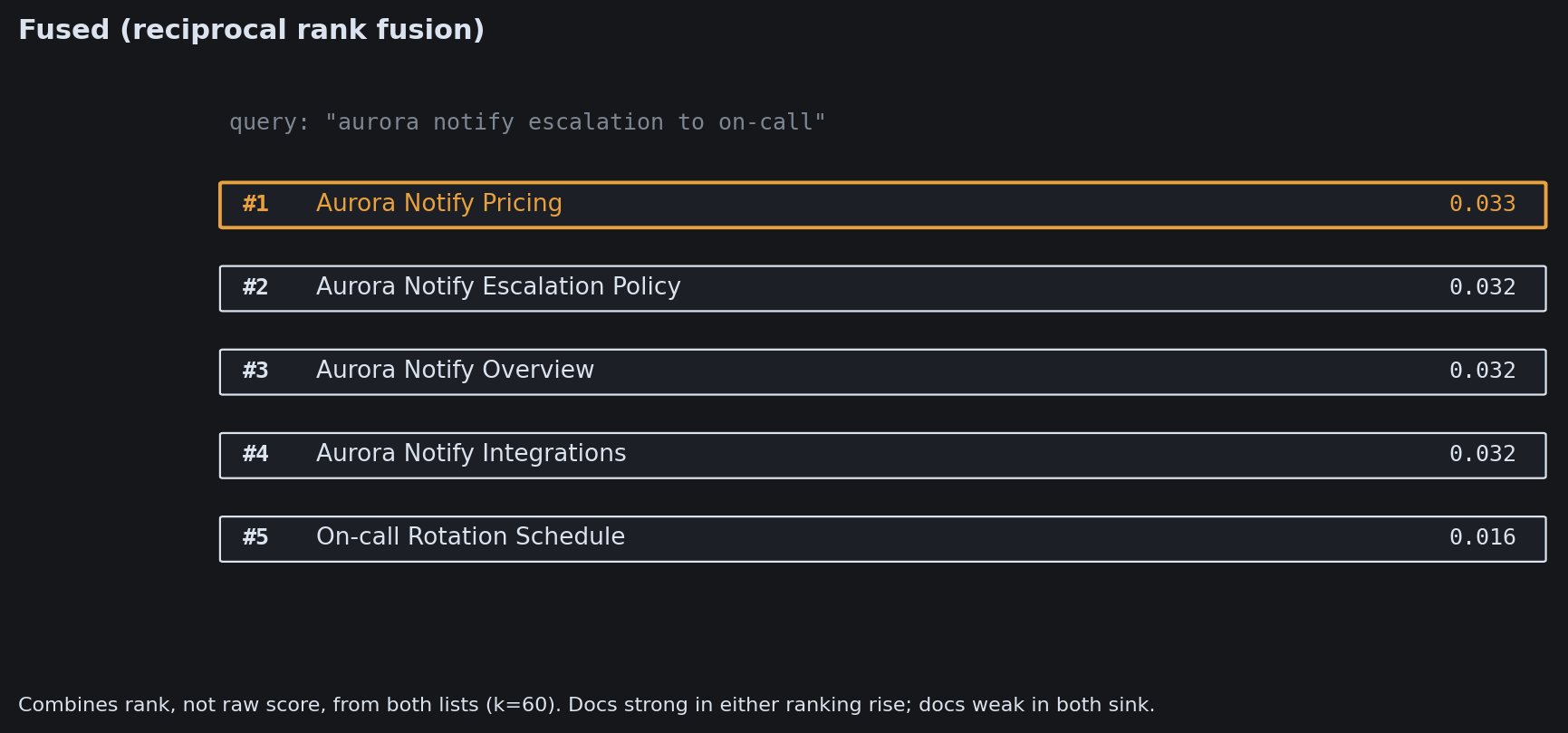
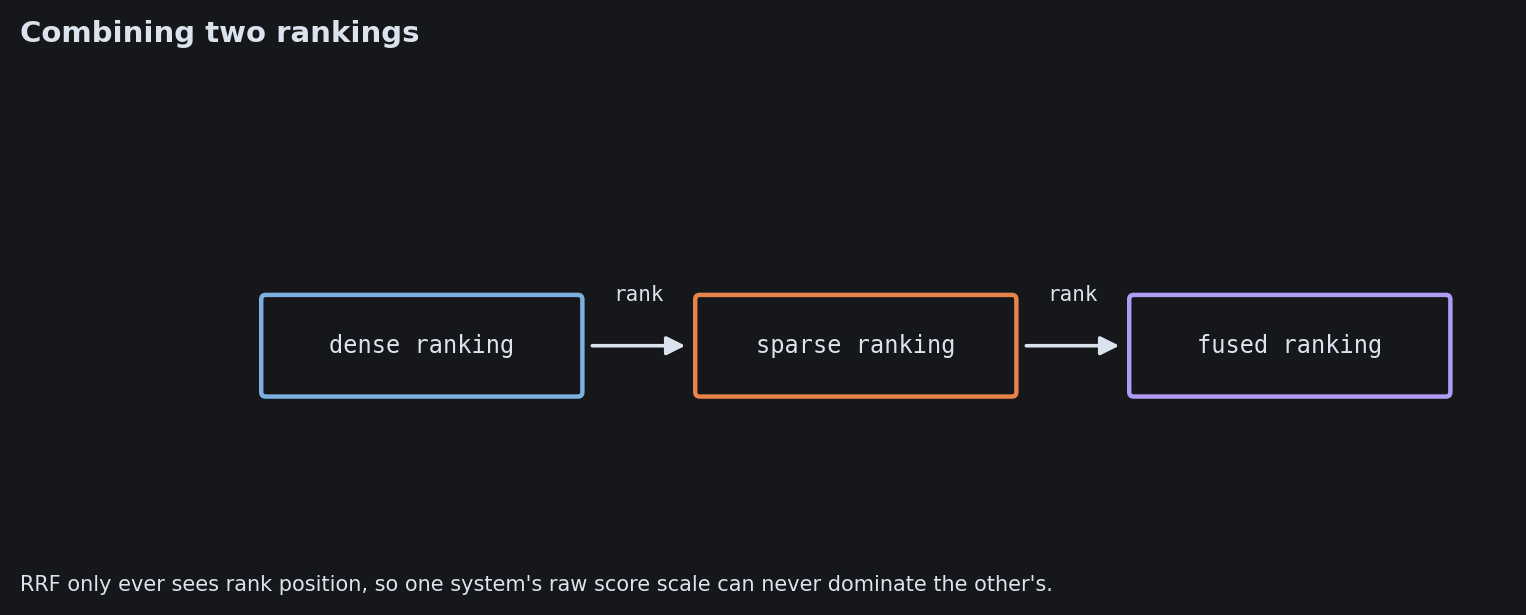
reciprocal rank fusion, combines both rankings by position, not raw score
Dense vs. sparse: two different notions of “relevant”
Same query, two different rankings
Fusion: combine by rank, not raw score
Why fusion is more robust than either alone
Dense and sparse have different blind spots, paraphrase versus rare exact terms. Fusing them means the system never has to bet on which failure mode a given query will hit.
Hybrid Search
Hybrid Search
Hybrid Search
Hybrid Search
Hybrid Search
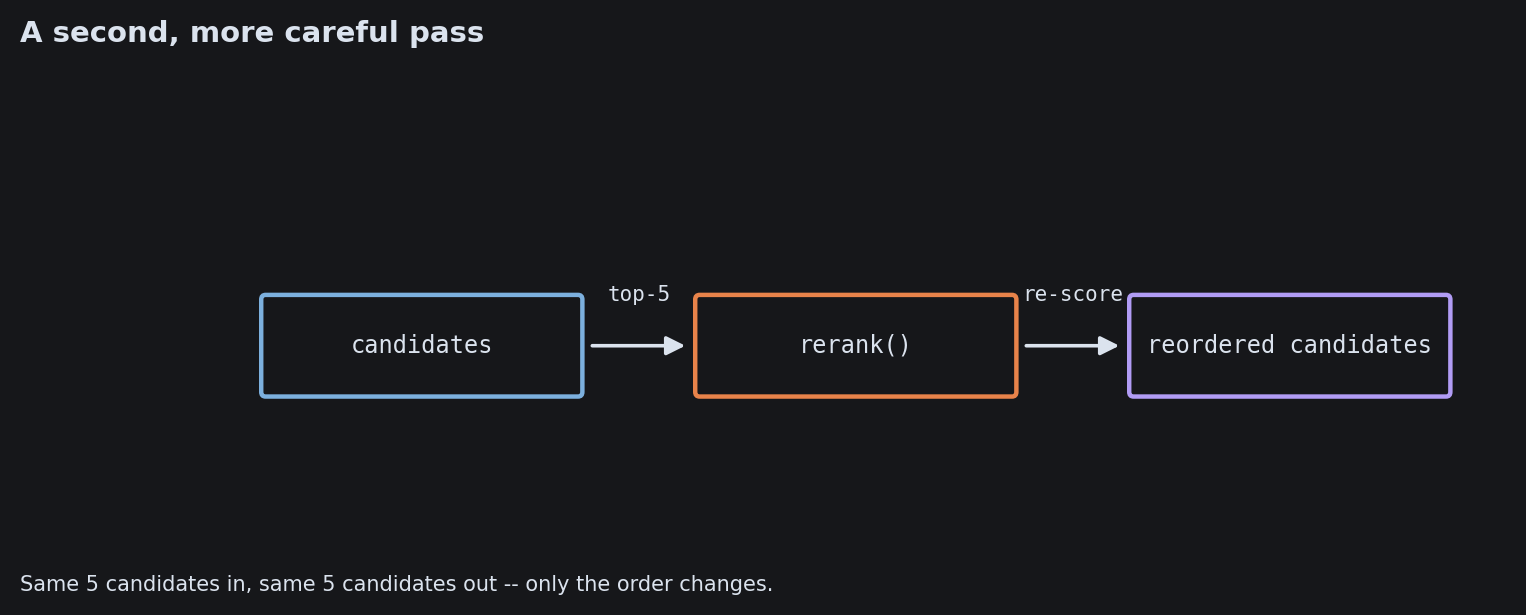
Reranking: A Second, More Careful Pass
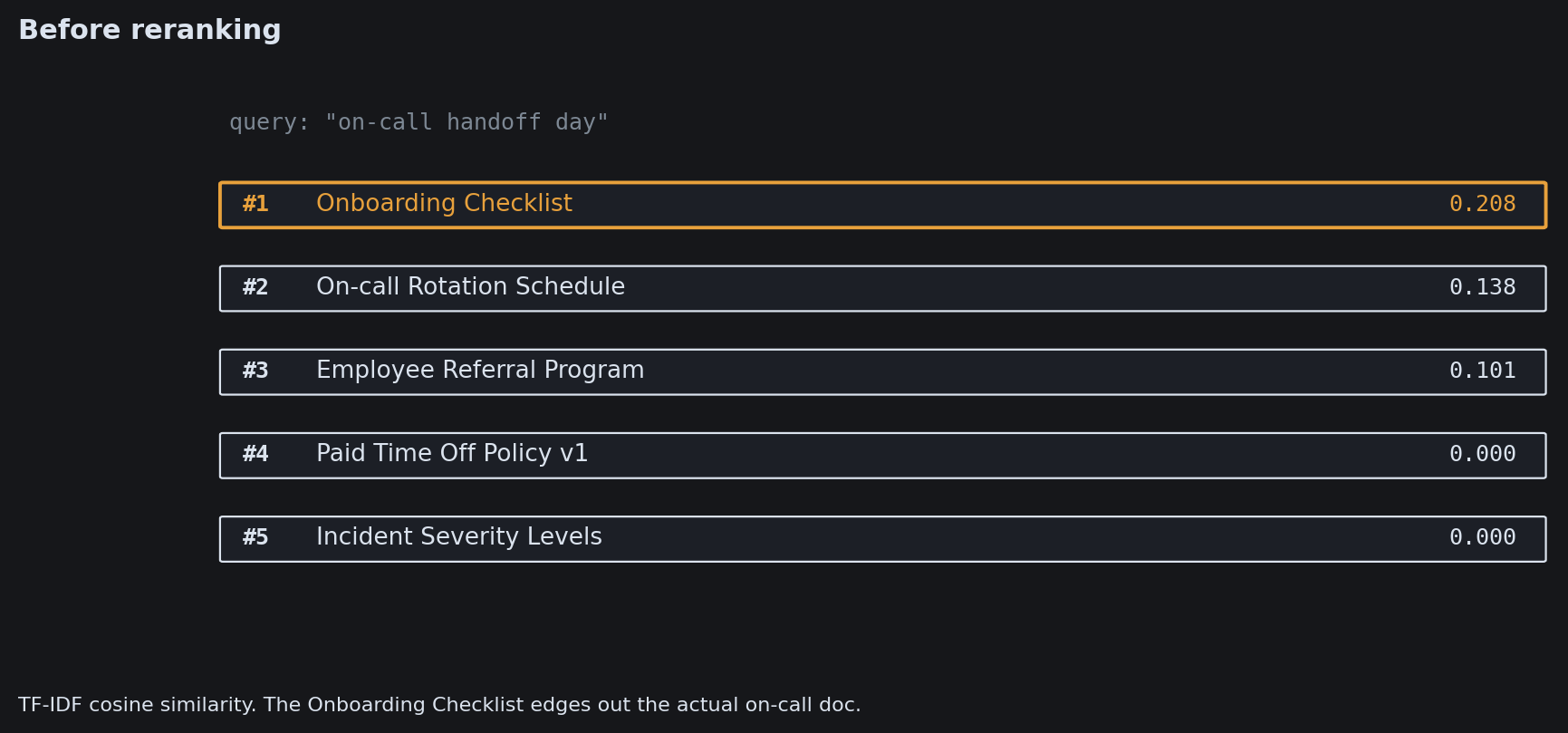
Retrieval scores every chunk against the query with one cheap, global signal, across the whole corpus at once. That is what makes it fast, and it is also why the order it returns is only approximately right.
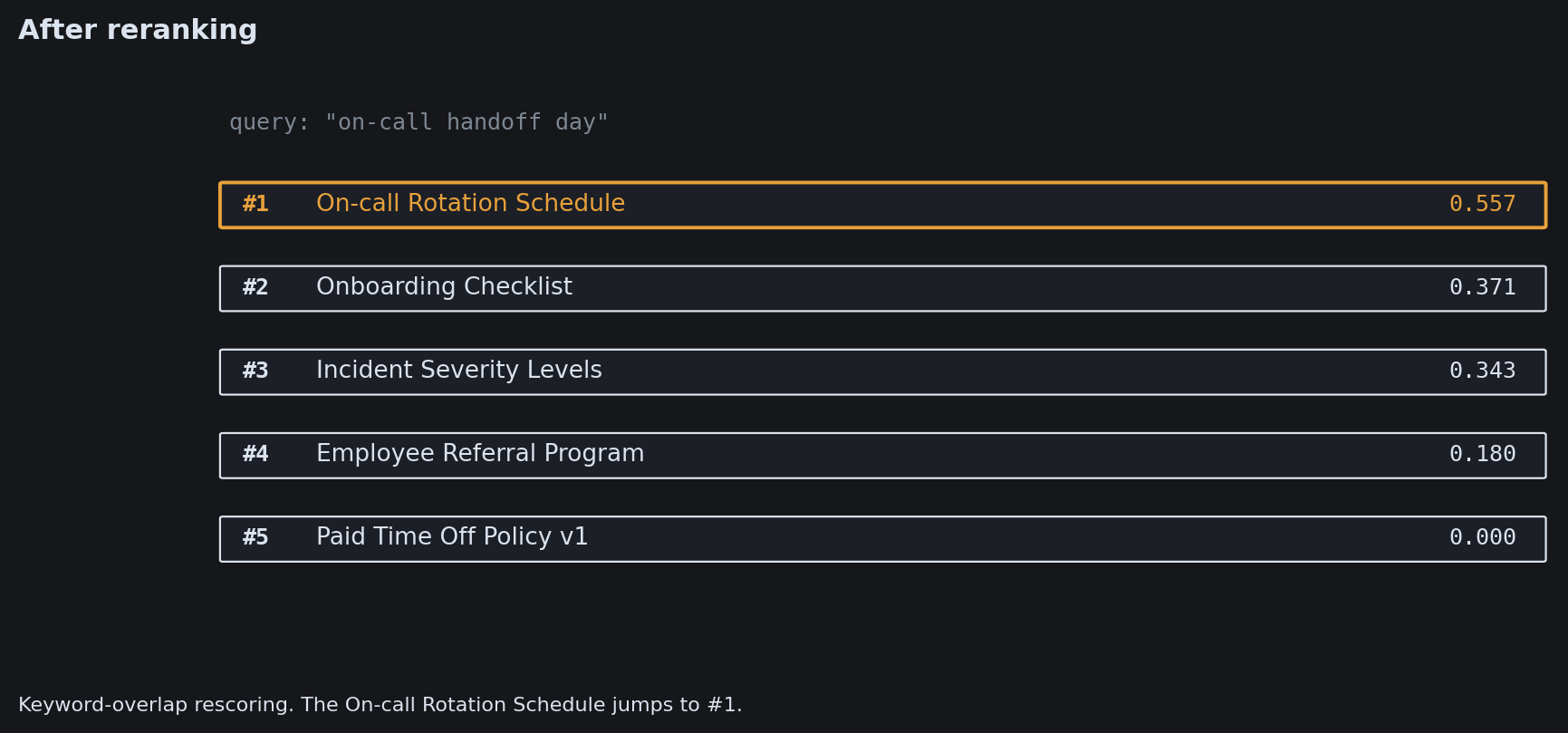
Reranking takes just the candidates retrieval already found and looks at each one again, one at a time, with a narrower, more literal question: how much of the query’s actual wording is in this chunk.
Reranking, a second, narrower pass over just the candidates retrieval already found, scoring each one on its own instead of against the whole corpus at once. It reorders; it never fetches a new document.
The First Pass Is Approximate
A single global signal, spread across every word in the query, does not always put the right document on top.
A single global signal, scored across the whole corpus at once, is what makes retrieval fast, and exactly why its order is only approximately right. Reranking trades that speed for a second, narrower look.
What Actually Happened: “on-call handoff day”
Tried the near-duplicate pairs first (PTO days, expense threshold, outage lag) - none of them swap, because the one word that tells those two docs apart never appears in the query. This query, tried next, produces a real swap at #1.
Reranking Reorders. It Does Not Fetch.
What Reranking Can’t Fix
The corpus has three near-duplicate pairs, same wording, one changed number. None of them swap under this reranker.
That is an honest limit, not a bug: a reranker that only counts word overlap can’t tell two documents apart on the one word neither of them is being asked about.
A reranker that only counts word overlap can’t break a tie on the one word neither candidate mentions. Aurora Cloud’s near-duplicate PTO pair (15 days vs. 20) never swaps under this reranker.
Reranking
Reranking
Reranking
Reranking
The chunks aren’t the input
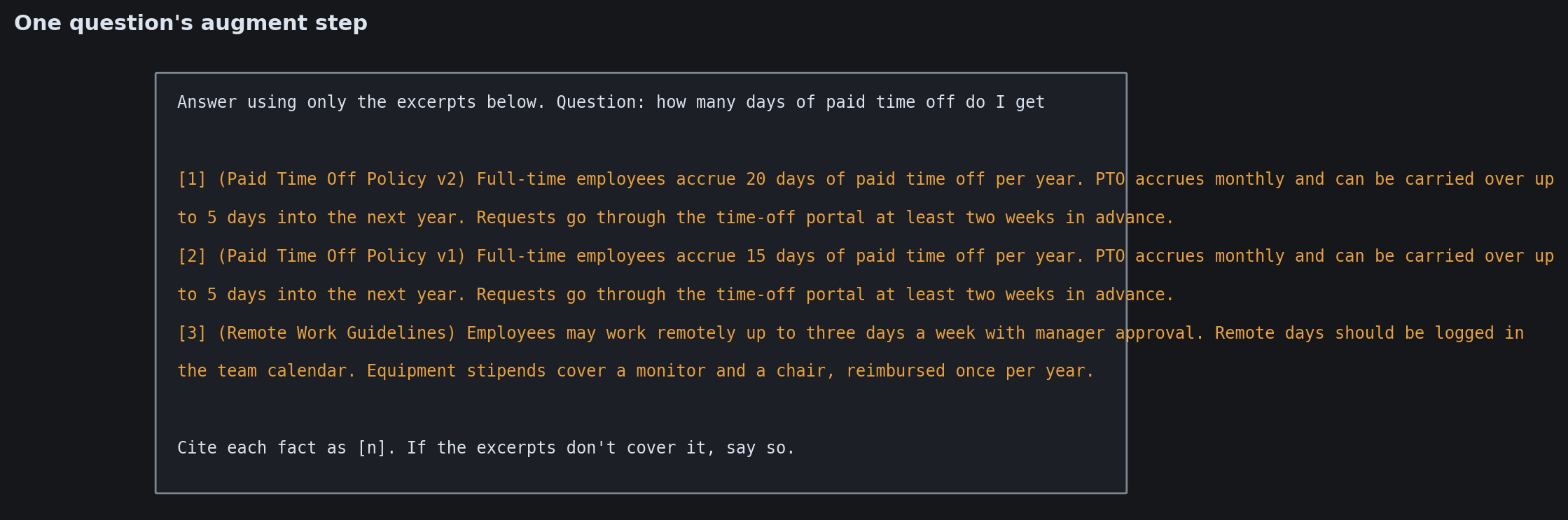
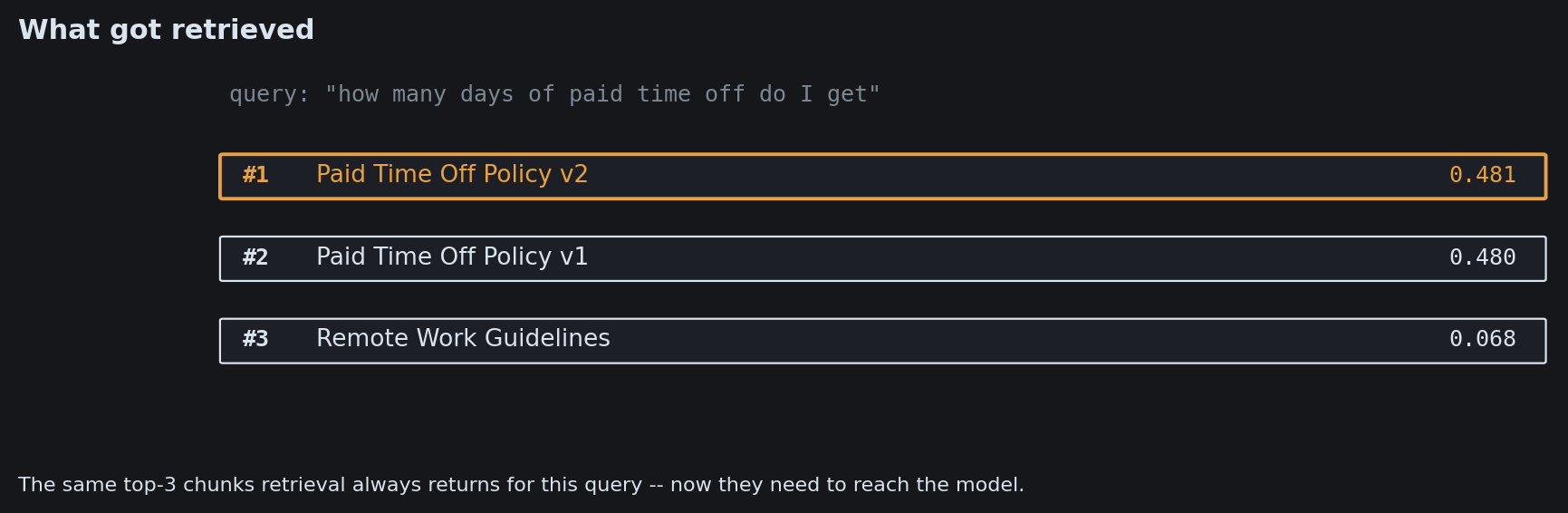
Retrieval hands back three objects. The model reads one string. Something has to build that string.
A chat model takes plain text in. Three Chunk objects are not plain text yet.
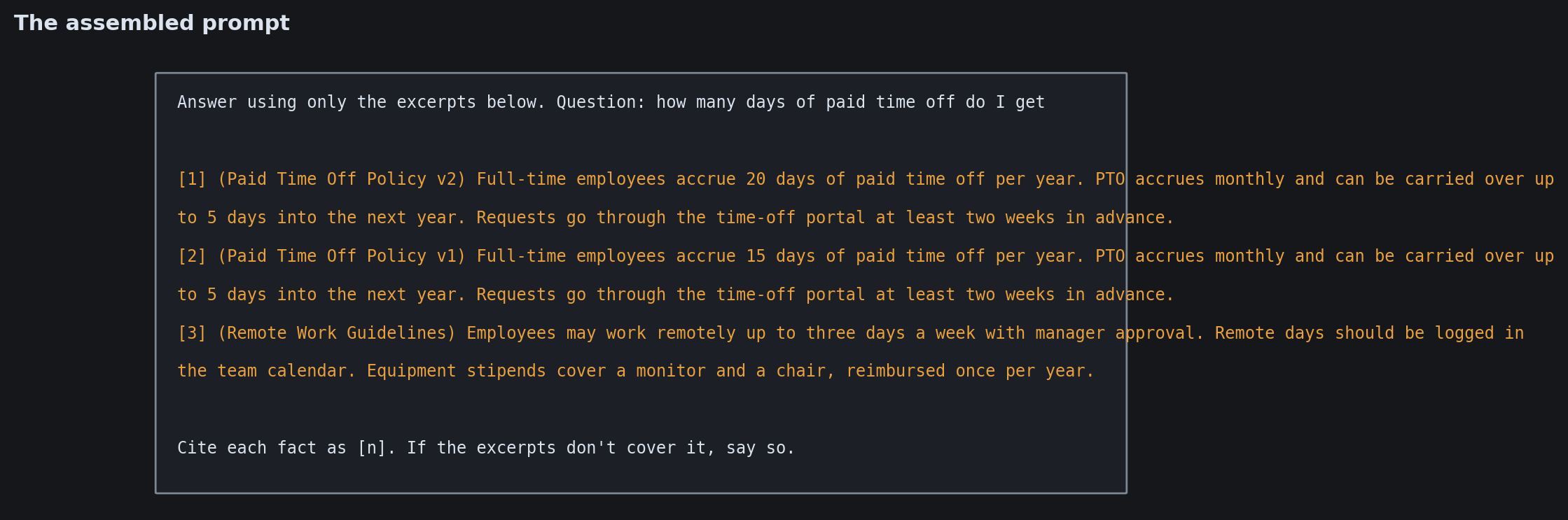
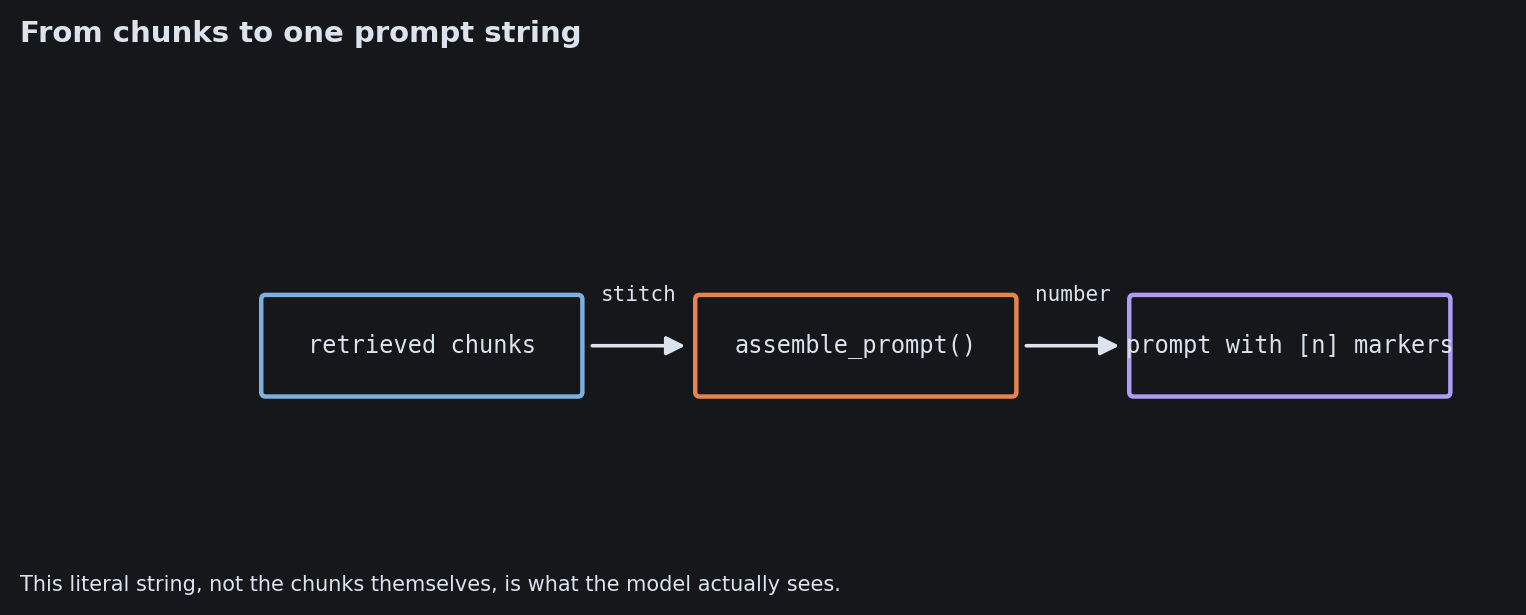
assemble_prompt() turns them into one string
The retrieved chunks flow into a single card, and each one gains a number as it lands.
Every excerpt is numbered, not named
A chunk’s doc title never reaches the model directly. Its [n] does.
An instruction wraps the excerpts
What crosses the boundary to the model
The model never sees the corpus. It never sees the index. It sees one string, built once, per question.
The model’s entire universe for an answer is the literal prompt string assemble_prompt() built. Corpus, index, and every other chunk never cross that boundary, which is exactly what makes grounding checkable.
Augmentation: Building the Prompt
Augmentation: Building the Prompt
Augmentation: Building the Prompt
Augmentation: Building the Prompt
Cite or Refuse
Retrieval and augmentation hand the model a stack of excerpts. Generation is the last step: turn that stack into a sentence a human can trust, or say, honestly, that the corpus doesn’t have the answer.
Cite or refuse is the discipline that makes a RAG system trustworthy.
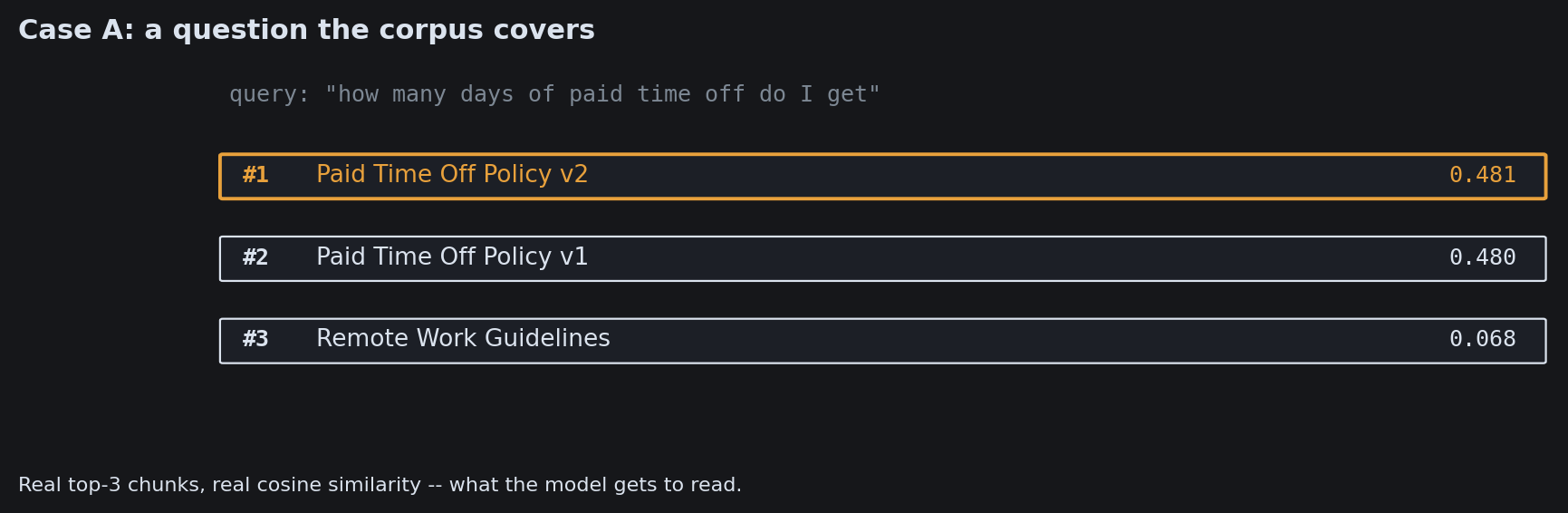
Two ways a question can end
A citation is a pointer, not decoration
Where the line gets drawn
No relevant chunk retrieved, without a refusal gate, the model falls back on parametric memory and answers fluently anyway, with no warning it is guessing. The similarity threshold is the guard that turns “no evidence” into an honest decline instead of a confident hallucination.
No partial credit
A plain model always produces text. Cite-or-refuse gives the system a branch a plain model doesn’t have: the ability to say “I don’t know” instead of a fluent guess.
Generation: Cite or Refuse
Generation: Cite or Refuse
Generation: Cite or Refuse
Generation: Cite or Refuse
Generation: Cite or Refuse
Agentic RAG: The Tool-Use Loop
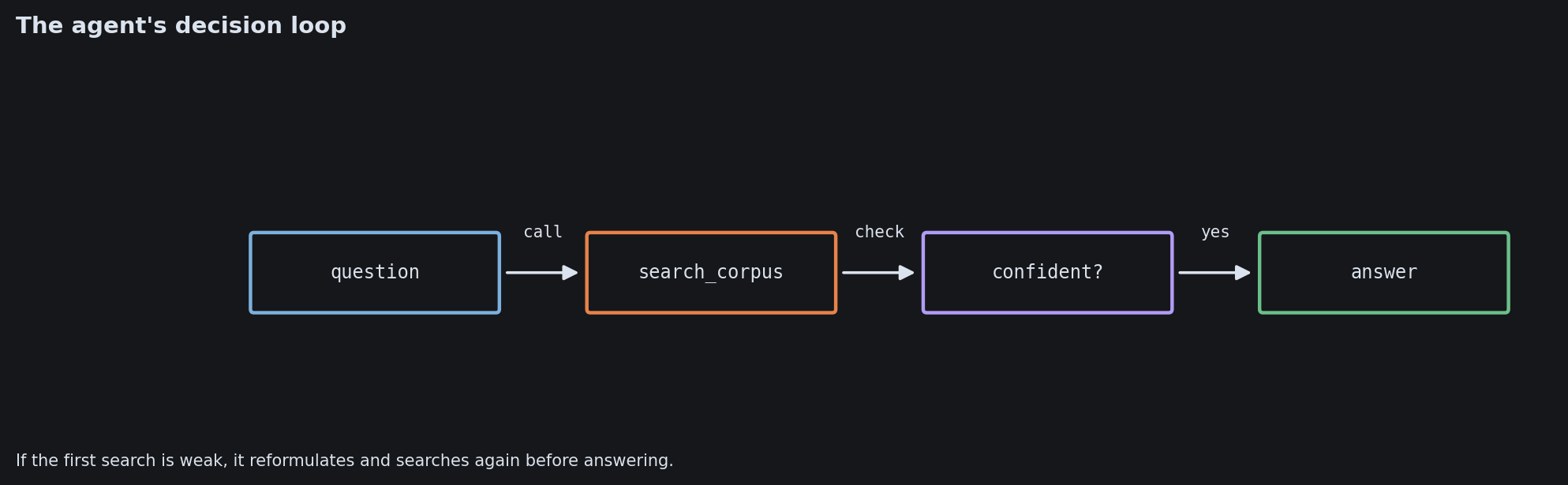
Every concept so far runs retrieval exactly once per question. An agent gets to check its own result first, and search again if it wasn’t good enough.
One search, or two?
The retrieval loop so far always asks once. An agent gets to check its own work first.
The decision loop
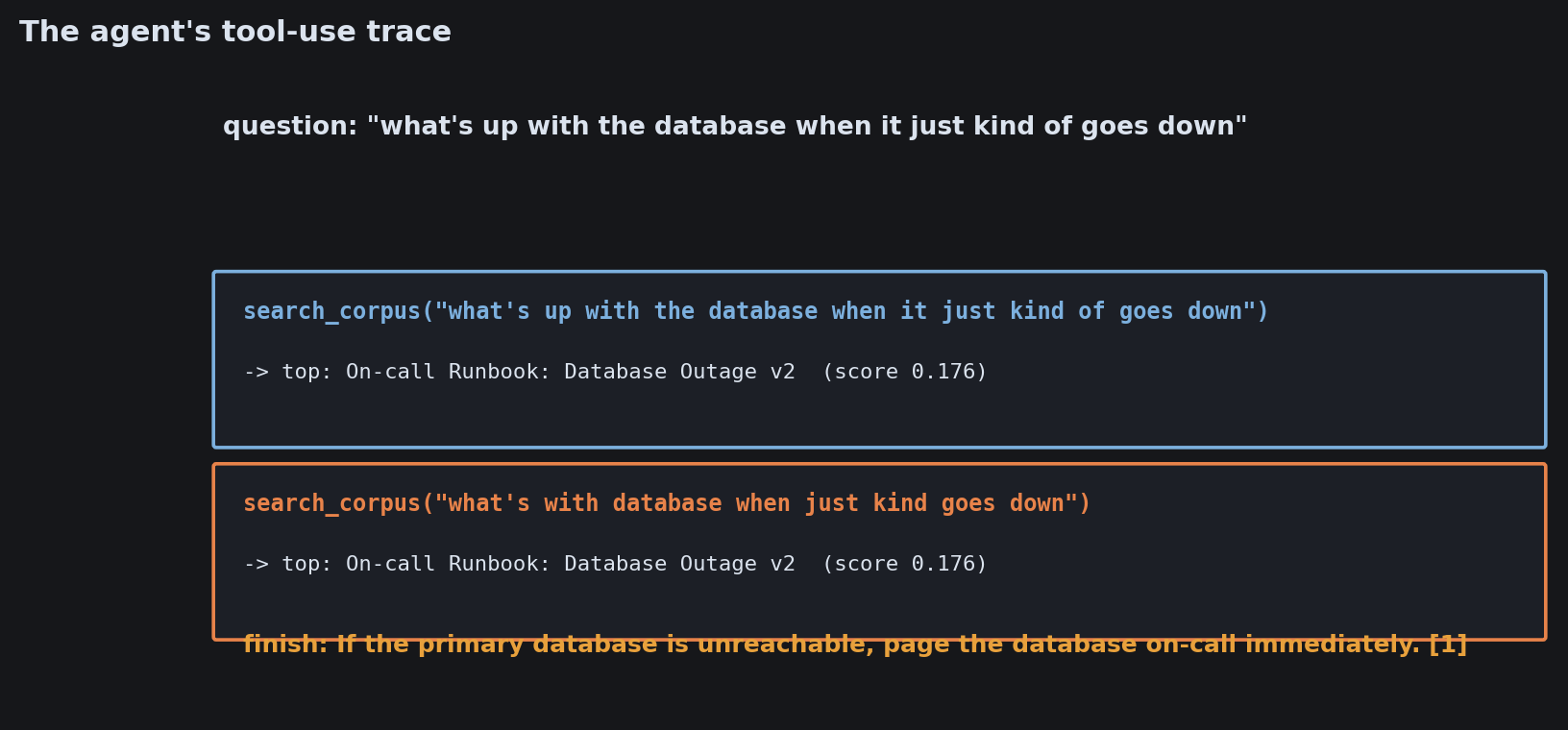
One tool call, one confidence check, and a fork: answer now, or search again first.
A real trace
The question: “what’s up with the database when it just kind of goes down.” Vague on purpose.
How the rewrite happens
The reformulation is a word filter, not a rewrite from scratch: drop anything four letters or shorter.
Not blind repetition
The agent only pays for a second search when the first one earns it.
The only difference between one-shot and agentic retrieval is the ability to check a confidence score and try again. The retry is capped at one call, gated on a real threshold, never an unbounded search spiral.
Agentic RAG: The Tool-Use Loop
Agentic RAG: The Tool-Use Loop
Agentic RAG: The Tool-Use Loop
Evaluation: How You Know It’s Working
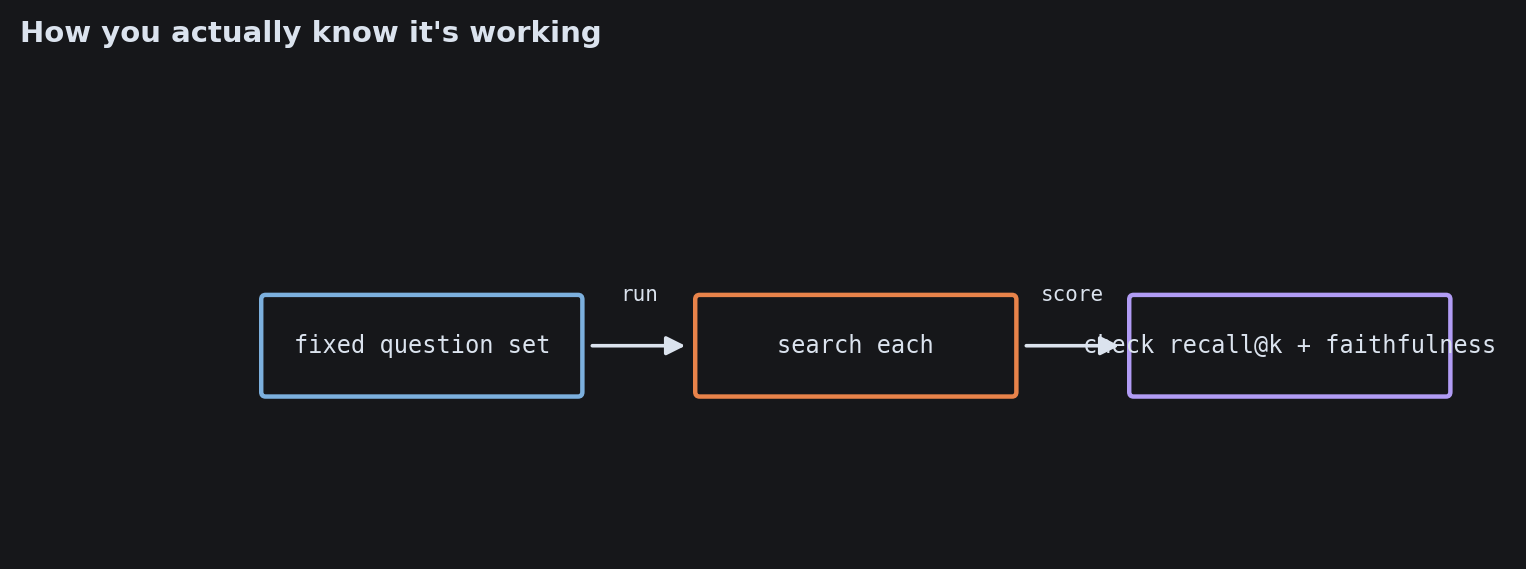
A demo can look convincing and still be wrong. The only way to trust a RAG system is to run it against questions with known answers, and grade it honestly.
Every concept so far - chunking, retrieval, hybrid search, reranking, generation - is a design choice. Evaluation is how you find out whether those choices actually work.
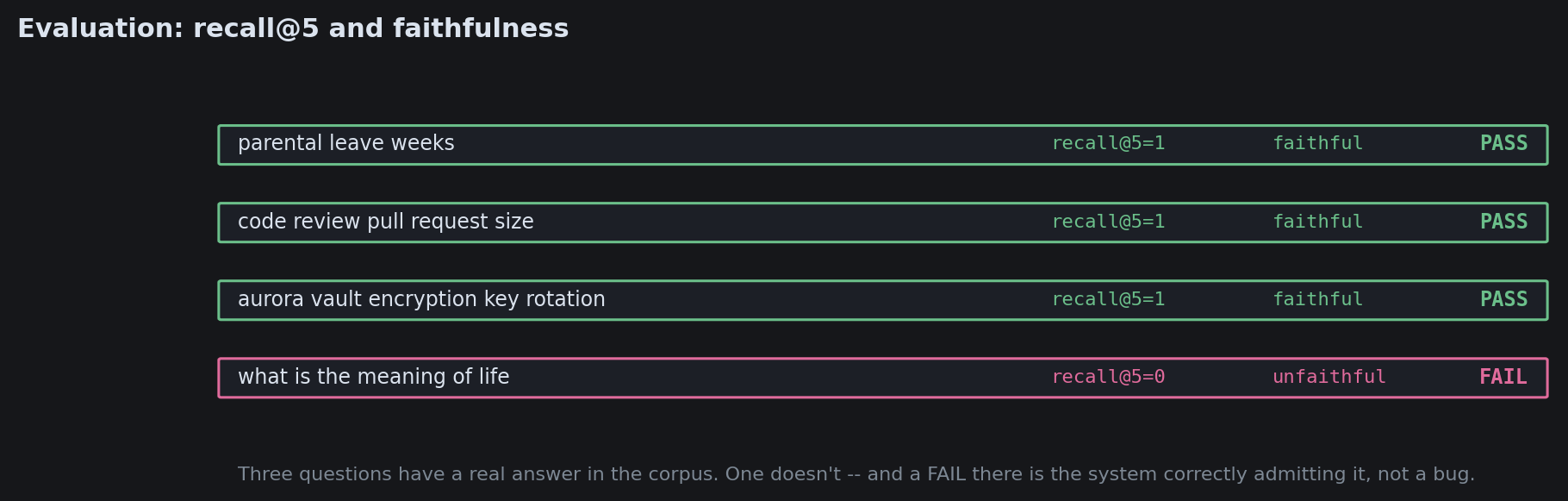
A frozen set of questions, each with a known answer
Write down real questions a user would ask, then name the one document that actually answers each. Freeze the list. Score every future change against it, unchanged.
Recall@k is a looser bar than faithful
Recall@k asks whether the right document is anywhere in the top few results. Faithful asks a stricter question - is it the very top hit, with a real similarity score worth trusting.
Recall@k, whether the right document lands anywhere in the top k results. A looser bar than faithful, which asks whether it’s the #1 hit with a score worth trusting.
Running it for real
Back to where this deck started
A plain language model would have answered the meaning-of-life question anyway, fluently and with no warning that it was guessing. This system checks itself against real evidence first. It only speaks when it has some.
Every design choice in this deck, chunk size, hybrid fusion, reranking, the refusal threshold, is just a hypothesis until it’s run against frozen questions with known answers. Evaluation is how you find out whether those choices actually work.
Evaluation: How You Know It Works
Evaluation: How You Know It Works
Evaluation: How You Know It Works
Making It Real, With Chroma
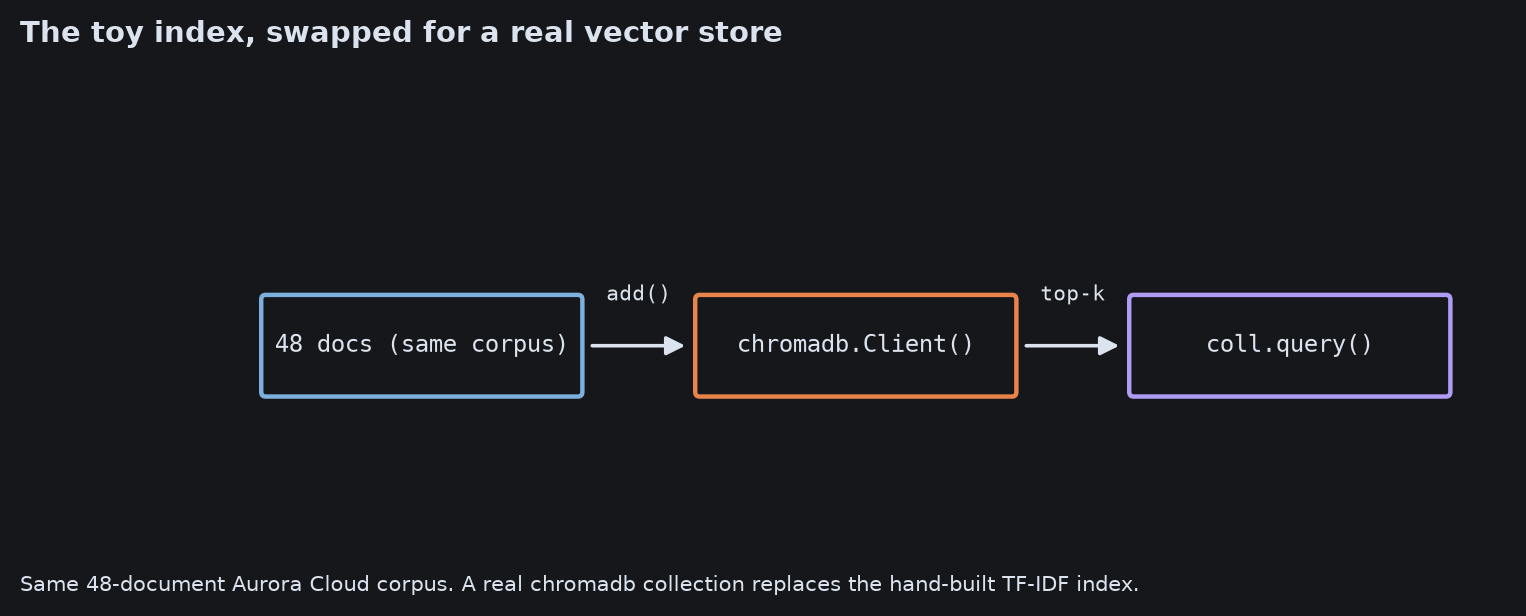
Everything so far ran a hand-built TF-IDF index. Swap in chromadb, a real vector store, and chonkie, a real chunker, and the retrieval story does not change, only the plumbing underneath it does.
Chroma, an embedded vector store, pip install chromadb, no server to run. A collection stores documents, embeds them, and answers .query() calls with the nearest matches, all inside the same Python process.
The Toy Index, Now Real Chroma
The Toy Index, Now Real Chroma
The Toy Index, Now Real Chroma
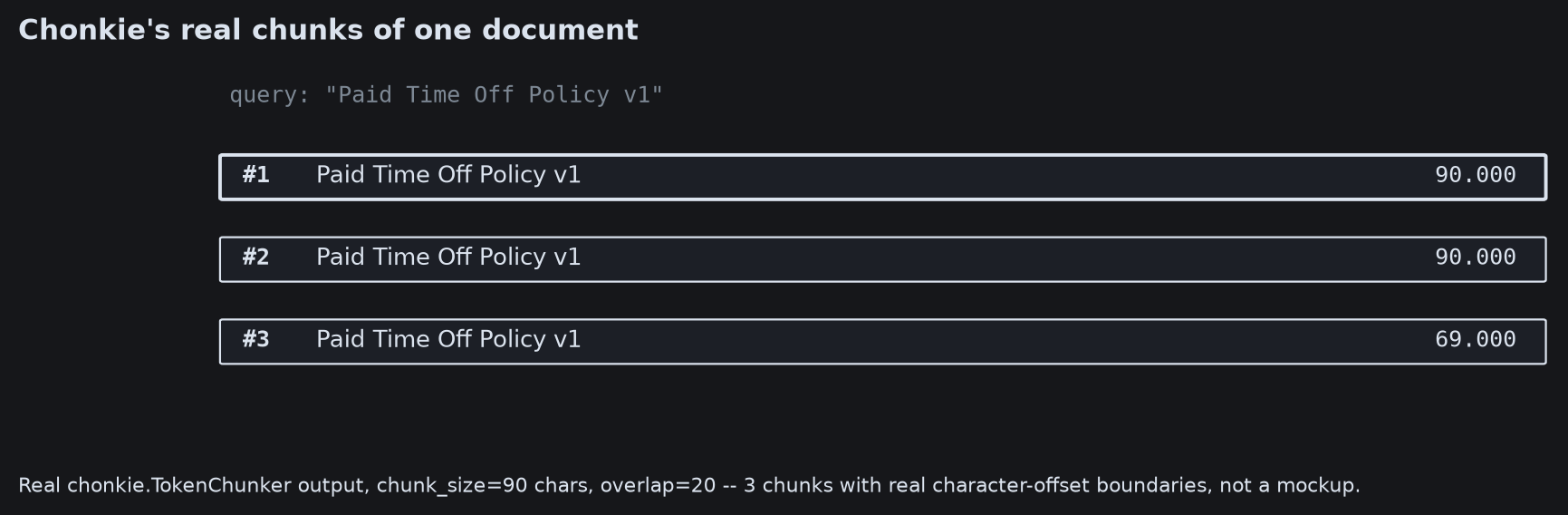
The Toy Index, Now Real Chroma
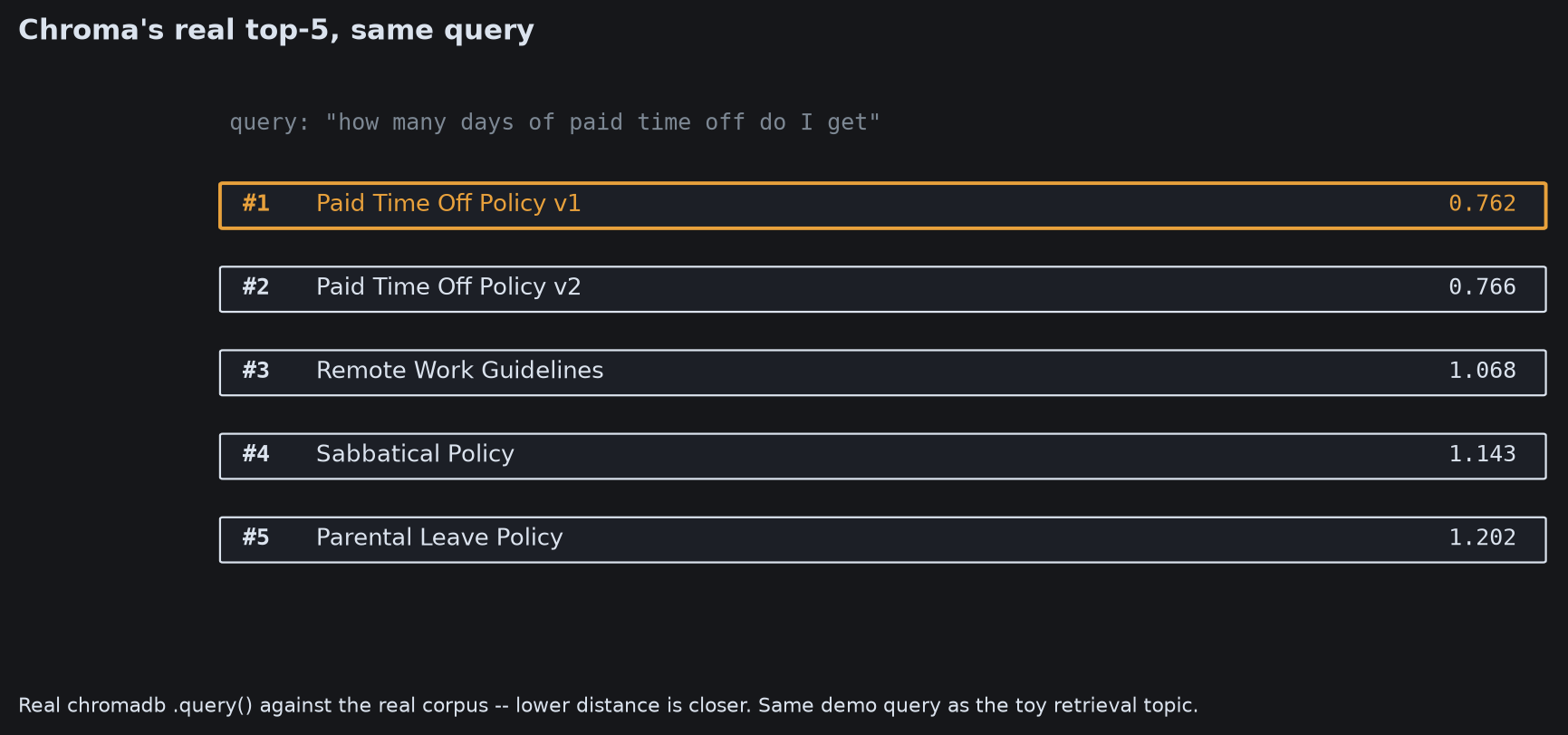
The hand-built TF-IDF index becomes one real library call, coll.query(). Same corpus, same query, a relevant document retrieved, now backed by a real vector store instead of a few hundred lines of hand-rolled code.
chroma
embedded and local, runs in-process, no server, the vector store this coda actually calls
milvus, pinecone
managed vector stores built for scale, a server (or a cloud service) to run and operate
chonkie, docling
chonkie chunks text, used above for real, docling ingests PDFs and other documents into text, named here, not run
References
Guides Lewis et al., Retrieval-Augmented Generation (2020) · Robertson & Zaragoza, BM25 and Beyond (2009) · LangChain, retrieval concepts · Anthropic, Contextual Retrieval
Siblings How Git Works, Visually · How Inference & Serving Work, Visually · How Evals & Observability Work, Visually · How Agentic Harnesses Work, Visually · How LangChain & LangGraph Work, Visually
Every figure in this deck: a real TF-IDF pipeline over the 48-document Aurora Cloud corpus, regenerable with build/regen_all.py